

With the global EDI software market projected to reach $2.68 billion by the end of 2026, digital trade has become the undeniable backbone of the global economy. For many supply chain leaders, however, the technical complexity of edi standards feels less like a tool for growth and more like a barrier of impenetrable jargon. It’s difficult to feel confident when you’re caught between the latest ANSI ASC X12 version 008070 updates and the global requirements of UN/EDIFACT D.24A, all while trying to keep your operations running smoothly.
We know the pressure of avoiding retailer chargebacks and the confusion that comes with selecting the right framework for your specific industry. It’s a lot to manage, but you don’t have to handle these intricate data requirements alone. This guide provides a clear path to mastering the complex world of electronic data interchange. You’ll gain a deep understanding of the major standards used today, a roadmap for achieving partner compliance, and the insights needed to select a cloud based EDI provider with confidence. We’ll break down the shift toward hybrid API connectivity and show you how to streamline your global supply chain operations for 2026 and beyond.
Key Takeaways
- Understand how standardized data formats act as a common language to eliminate manual entry errors between trading partners.
- Learn to distinguish between North American and international edi standards to ensure seamless communication across your entire global supply chain.
- Identify specific regulatory requirements and industry subsets that dictate how your data must be structured for partner compliance.
- Discover how integrating EDI software with your ERP system prevents costly retailer chargebacks and automates complex data workflows.
- Explore the transition toward hybrid connectivity models that combine traditional frameworks with modern APIs for enhanced real-time visibility.
The Foundation of B2B Communication: Defining EDI Standards in 2026
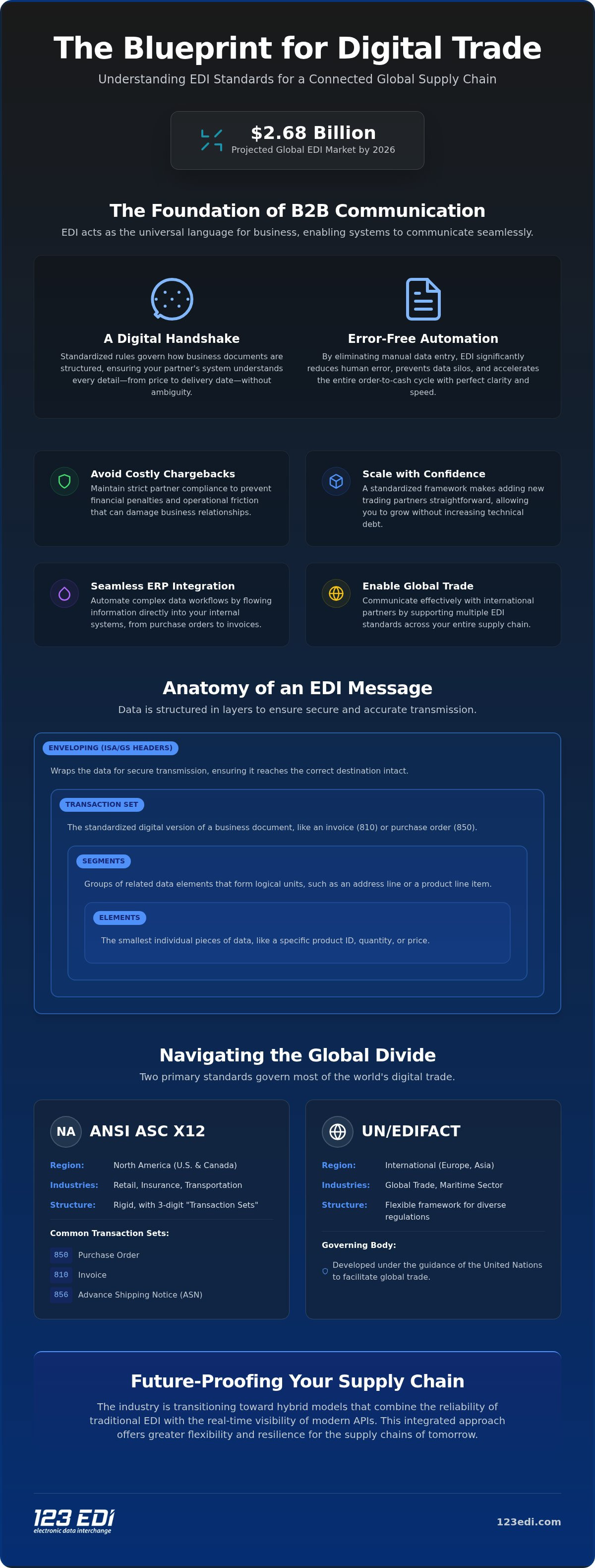
Think of Electronic Data Interchange (EDI) as the digital handshake of modern commerce. At its core, edi standards represent the agreed-upon rules that govern how business documents are formatted and structured. Without these rules, two computers attempting to exchange an invoice would be like two people trying to negotiate a contract in different languages. Standardization ensures that when your system sends a purchase order, your partner’s system understands exactly where the price, quantity, and delivery date are located. This common language eliminates the need for manual data entry, which remains a primary source of errors and delays in the global supply chain. By creating a uniform structure, these standards prevent data silos and ensure that diverse ERP systems can communicate with perfect clarity and speed.
Why Standardization is Non-Negotiable
Standards remove the guesswork from business transactions by defining every specific data element with precision. They dictate how date formats are read, which currency codes apply to a total, and how product identifiers are structured. When a business deviates from these established rules, they often face retailer chargebacks and significant operational friction that can damage long-term partnerships. Compliance isn’t just about following rules; it’s about building a foundation of reliability. A standardized approach also provides the essential framework for growth. Once your edi standards are correctly implemented, adding 100 new trading partners becomes as straightforward as adding one, allowing your business to scale without the burden of increasing technical debt.
The Anatomy of an EDI Standard
To understand how these messages function, it’s helpful to look at their internal building blocks. Each message is composed of segments and elements. Elements are the smallest pieces of data, such as a specific product ID or a quantity, while segments group those elements into logical units, like an address line or a line item. These segments are then protected by a process known as “enveloping.” This utilizes ISA and GS headers to wrap the data, ensuring it reaches the correct destination securely and remains intact during transmission. An EDI Transaction Set is essentially the standardized digital version of a traditional business form, such as an invoice or a shipping notice.
By using these structured layers, businesses can automate the flow of information directly into their internal systems. This reliability is what allows a “wise mentor” brand to provide a steady hand, removing the stress of intricate data management and replacing it with a roadmap for long-term success. As we look toward the complexities of 2026, mastering these foundational components is the first step toward a truly resilient supply chain.
ANSI ASC X12 vs. UN/EDIFACT: Navigating the Global Divide
While the goal of edi standards is universal clarity, the path to achieving it often splits into two primary regional dialects. For businesses operating within North America, ANSI ASC X12 is the definitive standard, serving as the cornerstone for retail, insurance, and transportation. Conversely, if your supply chain extends into Europe, Asia, or the maritime sector, you’ll likely encounter UN/EDIFACT. This international standard, developed under the guidance of the United Nations, facilitates global trade by providing a flexible framework that accommodates diverse regulatory requirements across borders. Understanding these differences is the first step toward building a truly global operation.
Choosing between these two isn’t usually a matter of preference but a requirement dictated by your trading partners. Because these standards use different syntax and terminology, your internal systems must be capable of translating both to remain competitive. At 123 EDI, we specialize in bridging this gap. Our EDI software and cloud-based portals are designed to handle both X12 and EDIFACT seamlessly, ensuring that your international expansion isn’t slowed down by technical friction.
Deep Dive into ANSI ASC X12
The X12 standard is ubiquitous in the United States and Canada. It’s characterized by its use of “Transaction Sets,” which are three-digit codes representing specific business documents. In the retail sector, for instance, you’ll frequently manage the 850 Purchase Order, the 810 Invoice, and the EDI 856 Advance Shipping Notice (ASN). For a comprehensive breakdown of how these codes work across different business scenarios, our guide to EDI transactions, codes, standards, and business flow provides an essential reference. Because of its rigid structure, X12 is exceptionally reliable for high-volume domestic trade. To maximize the efficiency of these transactions, many organizations focus on Mastering EDI Integration with ERP systems to automate the flow of data directly into their financial and inventory modules, reducing the risk of manual errors.
The Global Reach of UN/EDIFACT
UN/EDIFACT takes a broader approach, utilizing “Messages” rather than transaction sets. One of the most noticeable differences lies in the syntax. While X12 typically uses asterisks (*) and tildes (~) as delimiters, EDIFACT relies on plus signs (+) and colons (:). It also encompasses several industry-specific subsets, such as EANCOM for the global retail sector and ODETTE for the European automotive industry. This flexibility makes it the preferred choice for complex international logistics and government administration. If you’re unsure which standard your new international partner requires, our team can help you identify the correct framework to maintain compliance and avoid costly delays.
Beyond syntax, versioning plays a critical role in maintaining a healthy supply chain. While X12 versions like 008070 are common in 2026, your partner might still be using an older release. A reliable partner like 123 EDI acts as a wise mentor in these situations, providing the translation tools necessary to ensure that different versions of edi standards don’t disrupt your data flow. By managing these technical nuances on your behalf, we allow you to focus on the human connections that drive your business forward.
Industry-Specific EDI Standards and Regulatory Requirements
Moving beyond general trade requires a deeper understanding of how specific sectors modify edi standards to meet unique operational needs. While the foundational frameworks we’ve discussed provide a broad structure, certain industries demand specialized data sets to handle complex transactions or satisfy strict government mandates. This is where the guidance of an industry veteran becomes invaluable. Regulatory pressure, particularly in sectors like healthcare and finance, often dictates not just the format of the data, but the speed and security of its transmission. Failing to align with these specific requirements can lead to more than just operational friction; it can result in legal non-compliance and significant financial penalties.
Healthcare and HIPAA Compliance
In the United States, healthcare organizations must adhere to X12N, a specific subset of the X12 standard designed to protect patient privacy and streamline insurance claims. As of 2026, the 008060 versions of HIPAA-mandated implementation guides have officially replaced older versions, requiring providers to update their systems for enrollment, eligibility, and payment advice. A significant regulatory shift occurred on March 24, 2026, when a final rule established new standards for electronic health care claims attachments and electronic signatures. This rule, which became effective on May 26, 2026, highlights why security and encryption are baked into these transactions. By utilizing standardized transactions, healthcare entities can ensure that sensitive patient data remains protected while moving through the complex insurance ecosystem.
Specialized Standards: RosettaNet, SWIFT, and VDA
Outside of healthcare, other niche frameworks address the high-speed requirements of modern manufacturing and finance. RosettaNet, for instance, remains the preferred choice for the high-tech and semiconductor industries, where real-time supply chain visibility is critical for managing short product lifecycles. In the financial sector, SWIFT serves as the backbone for international messaging and payments, ensuring that cross-border capital moves with precision and speed. Automotive suppliers often encounter VDA, a German standard that frequently coexists with EDIFACT to manage just-in-time manufacturing processes. Each of these specialized edi standards requires a unique approach to data mapping and validation to ensure that every partner in the chain stays in sync.
Navigating these niche compliance hurdles doesn’t have to be a solo journey. At 123 EDI, we act as a mentor to guide your business through the complexities of industry-specific mandates. We understand that the relationship between these standards and secure data transfer protocols, such as AS2, is vital for maintaining a healthy supply chain. Our team helps you implement the right EDI software and communication protocols to ensure your data is both compliant and secure. By aligning your technology with these specific mandates, you build a resilient operation that’s ready for any regulatory shift in the global market.
Maintaining Compliance: Mapping Standards to ERP Systems
Understanding the theory behind edi standards is a vital first step, but the true operational value is realized when that data flows seamlessly into your internal systems. Most ERP platforms, including NetSuite, SAP, and QuickBooks, don’t natively process the raw segments of an X12 or EDIFACT file. This creates a critical need for a sophisticated translation process that converts complex EDI data into ERP-friendly formats such as JSON, XML, or CSV. Relying on manual mapping or custom-coded scripts is a significant risk that often leads to data corruption, partner non-compliance, and expensive retailer chargebacks. For those who need a foundational refresher on these concepts, our resource on What is EDI? The Comprehensive Guide offers a helpful starting point.
The Workflow of an EDI Transaction
To maintain a high level of precision, a standardized workflow is essential for every document exchanged. The process typically begins when your ERP exports raw business data, such as a pending shipment or an outgoing invoice. From there, dedicated EDI software translates that data into the specific version of the standard required by your trading partner. Once the message is correctly structured, it’s transmitted via secure protocols like AS2 or SFTP, or through a Value Added Network (VAN). Understanding the full lifecycle of EDI transactions and how each code maps to a specific business document is essential for ensuring that your edi standards remain consistent across every transaction, regardless of the complexity of the data being moved.
Overcoming Mapping Challenges
Managing the technical nuances of mapping becomes particularly challenging when partners decide to upgrade their requirements. When a major retailer moves from X12 version 4010 to 5010, for example, your mapping logic must be adjusted to accommodate new segments and elements without disrupting your existing ERP workflows. Data validation is another hurdle; every segment must be checked against the partner’s specific implementation guide before transmission to prevent errors. In 2026, many businesses are moving away from rigid, legacy systems in favor of more flexible solutions. Our cloud-based EDI portal simplifies these complex mapping tasks for non-technical users, acting as a steady hand that ensures your compliance is always up to date. By automating these translations, we help you build a foundation of long-term trust with your trading partners.
Through our 30 years of expertise, we’ve seen how the right integration strategy can transform a supply chain from a source of stress into a competitive advantage. If you’re ready to automate your compliance, consider how our specialized EDI integration with ERP systems can accelerate your results and remove the burden of manual data management.
Future-Proofing Your Supply Chain: EDI Standards in 2026 and Beyond
As we look toward the close of 2026, it’s clear that edi standards aren’t static relics of the past; they’re evolving frameworks that underpin a projected $2.68 billion global software market. The most significant shift we’re seeing is the rise of hybrid EDI. This approach doesn’t seek to replace traditional X12 or EDIFACT structures but rather augments them with RESTful APIs to provide the real-time visibility that modern consumers demand. By integrating JSON-EDI, the industry is making these complex standards more accessible for a new generation of developers, allowing for faster onboarding and more intuitive data mapping without sacrificing the robust security of legacy systems.
While new formats emerge, the foundational security of your data remains a top priority. Protocols like AS2 continue to dominate B2B communications because they offer non-repudiation and end-to-end encryption that simple webhooks often lack. At 123 EDI, we’ve spent over 30 years helping partners refine their data strategies, ensuring that your investment in technology remains protected as these technical requirements shift. Our commitment is to act as a stabilizing force, providing the institutional knowledge you need to stay ahead of the curve.
EDI vs. API: A Collaborative Future
The debate between EDI and API is no longer about which will win, but how they can best work together. EDI remains the undisputed standard of record for high-volume, batch transactions like daily purchase orders and weekly invoices because of its unmatched efficiency in processing large data sets. However, APIs are now frequently used for “last-mile” tracking, instant inventory lookups, and real-time price checks. This collaborative model allows your business to maintain a stable core while remaining agile enough to respond to immediate supply chain disruptions. When deciding how to transport this data, understanding your connectivity options is essential; you can explore this further in our guide on AS2 vs FTP for EDI: Choosing Your Protocol.
Building a Resilient EDI Strategy
A truly future-proof strategy requires more than just the right software; it demands a partnership with a provider that understands the nuances of global trade. With the EDI market forecasted to grow at a compound annual growth rate of 11.5% through 2034, scalability is a necessity. You need a partner that offers 24/7 monitoring and proactive error resolution to ensure that a single mismatched segment doesn’t halt your entire production line. Edi standards act as the stabilizing force in an increasingly complex market, providing the “business grammar” needed for long-term success. By selecting a provider that supports all major global and industry standards, you ensure that your supply chain remains resilient, compliant, and ready for whatever the next decade brings.
Building a Resilient Digital Supply Chain
Mastering the nuances of edi standards is about more than just checking a box for partner compliance; it’s about building a foundation for scalable, error-free growth. These frameworks enable seamless communication across the global divide, bridging the gap between North American retail requirements and international maritime trade. By automating the mapping process between your ERP and your trading partners, you remove the stress of manual data management and protect your business from costly operational delays.
As the digital landscape shifts toward hybrid connectivity, having a steady hand to guide your integration becomes a strategic advantage. With 30+ years of industry leadership, 123 EDI specializes in providing secure AS2 communication and seamless integration with platforms like NetSuite, SAP, and QuickBooks. We’re here to ensure your data remains accurate and your operations remain resilient as technical requirements evolve. Our team acts as a dedicated partner, simplifying the complex so you can focus on your core business objectives.
Streamline your compliance with 123 EDI’s expert integration services today.
The path toward a fully automated supply chain is clear, and we’re ready to help you navigate every step with confidence.
Frequently Asked Questions
What are the most common EDI standards used today?
The two most prevalent frameworks are ANSI ASC X12, which dominates North American commerce, and UN/EDIFACT, the international standard for global trade. Within these, you’ll find industry specific subsets like X12N for healthcare and EANCOM for global retail. While newer formats like JSON are gaining traction in hybrid models, these established standards remain the primary languages for high volume B2B transactions across the global supply chain.
Is there a difference between an EDI standard and an EDI protocol?
The standard is the format of the data, while the protocol is the method used to transmit it. Think of the standard as the language written in a letter and the protocol as the envelope and the postal service used to deliver it. Common protocols include AS2 and SFTP, which provide the secure connection needed to move standardized files like X12 or EDIFACT between different business systems.
Do I need different software for X12 and EDIFACT standards?
You don’t need separate tools if you use a comprehensive platform. Modern EDI software is designed to handle multiple standards within a single interface. This flexibility allows you to manage North American partners using X12 and international partners using EDIFACT without the complexity of switching systems. Our cloud based solutions at 123 EDI are built to translate various formats into a single, ERP friendly data stream.
How often do EDI standards change or get updated?
Major updates to these frameworks typically occur on an annual cycle, though adoption by trading partners can take much longer. For instance, X12 version 008070 became available in early 2026, but many retailers still utilize version 4010 or 5010. Your business only needs to update when a specific partner mandates a version change, making it essential to monitor their implementation guides for any scheduled transitions.
Why do retailers like Walmart or Amazon require specific EDI standards?
Retailers use these requirements to achieve high volume automation and eliminate manual entry errors across their entire supply chain. By mandating specific edi standards like X12, they ensure every supplier sends data in a uniform format that integrates directly into their warehouse and financial systems. This consistency is what allows these giants to manage thousands of vendors simultaneously while maintaining perfect inventory accuracy and rapid fulfillment cycles.
Can my small business handle EDI standards without an internal IT team?
Smaller organizations can successfully manage these requirements by leveraging a cloud based EDI portal. These platforms act as a managed service, handling the complex data mapping and technical validation on your behalf. This removes the need for an expensive internal IT team or specialized EDI coordinators. It’s an efficient way to achieve full compliance with major retailers while keeping your operational overhead low and manageable.
What happens if I send an EDI document that doesn’t follow the standard?
Sending a non compliant document usually triggers a system rejection at the receiver’s end, preventing the data from reaching their ERP. This failure can lead to missed shipping windows, delayed payments, and significant retailer chargebacks. Consistent errors might even result in a partner suspending your vendor status. Utilizing automated validation tools ensures your edi standards are met before the file ever leaves your system, protecting your reputation. For shipment-specific documents, understanding how to correctly structure an EDI 856 Advance Ship Notice is one of the most effective ways to avoid these costly rejections.
How do I know which version of X12 my partner requires?
Your trading partner will provide an implementation guide that specifies the exact version and transaction sets they support. This document is the definitive rulebook for your relationship, detailing every mandatory segment and element required for compliance. If you’re unsure where to find this information, our team at 123 EDI can help you identify the correct specifications and configure your system to match your partner’s unique data requirements.