

What if outsourcing EDI shifts the workload but leaves your team unsure who owns the next error, partner change, or integration issue? That uncertainty is a real concern when evaluating managed EDI services. Software, integration, and ongoing operations can overlap, making it hard to see what a provider handles and what stays with your team.
Looking beyond the promise of less day-to-day effort is essential. The right arrangement should make responsibilities clear while giving your business enough visibility and control to manage connected workflows confidently. Your team may also need specialist EDI knowledge that is difficult to maintain alongside other priorities.
This guide explains what managed EDI services can include, compares self-managed, managed, and hybrid approaches, and outlines questions that clarify ownership before you choose. It also explores how cloud-based EDI, portals, communications, and integration with existing ERP systems can support business processes. With those boundaries in view, you can assess which model fits your internal expertise, workload, and need for oversight.
Key Takeaways
- Clarify which EDI technology and operational activities a managed arrangement covers, and which responsibilities remain with your team.
- Compare self-managed, managed, and hybrid EDI by internal effort, control, provider involvement, and business needs.
- Assess your workflows, transaction types, trading partner requirements, ERP connections, and in-house expertise before choosing among managed EDI services.
- Cloud-based EDI, portals, communications, and AS2 can support partner data exchange as part of connected workflows.
- ERP integration can align EDI workflows with existing business systems while keeping operational ownership clear.
What Are Managed EDI Services, and What Problem Do They Solve?
Delegating EDI work shouldn’t mean losing sight of how orders, invoices, and other business documents move through your operation. Before handing over responsibilities, define what the arrangement covers, where the provider’s role ends, and what your team still owns.
Managed EDI services are an arrangement in which a provider supplies or supports EDI technology and performs operational activities agreed with the business. The term describes a service model, not a particular platform. One arrangement may focus on technology and connectivity; another may include a wider set of operational tasks. The agreed scope, rather than the label, defines how work is divided.
At a high level, EDI enables organizations to exchange business documents in standardized electronic formats. For background on the purpose and foundations of Electronic Data Interchange (EDI), consider how structured documents travel between systems instead of being handled as separate paper records or manually entered data.
How does managed EDI differ from EDI software?
EDI software is the technology used to process and exchange electronic documents. Managed EDI adds a support model around that technology: a provider takes responsibility for specific activities, as defined in the arrangement. Buying software alone doesn’t transfer day-to-day responsibilities to a provider, and managed arrangements don’t all include the same work.
For example, a trading partner may send a purchase order through EDI technology to a company’s business system. The company then uses the information in its workflow, while a response document may travel back through the EDI connection. To clarify ownership, trace the order from receipt through internal processing and identify who handles each technical and business handoff. The specific systems and responsibilities depend on the business setup. For a broader explanation of document exchange and business use, see this comprehensive EDI overview.
Why do businesses consider managed EDI?
EDI requires coordination across internal teams, business systems, and trading partner requirements. A business may have the technology in place but limited staff time or specialist knowledge to manage the work around it. Others may be adding partner connections or supporting workflows that are difficult to oversee with existing resources.
- Capacity: Consider whether staff have time for recurring EDI responsibilities alongside their other duties.
- Expertise: Identify where your team has EDI knowledge and where additional support would help.
- Requirements: Map partner document and connection needs, along with the business workflows those exchanges serve.
The right scope depends on those needs and the resources you want to retain internally. Start by listing the EDI tasks your team performs, from maintaining technology and connections to handling partner-related changes. Then distinguish the technology you need from the operational activities you may want a provider to handle. This makes it easier to compare options without assuming outsourcing means handing over every decision.
What Do Managed EDI Services Include, and What Stays with Your Team?
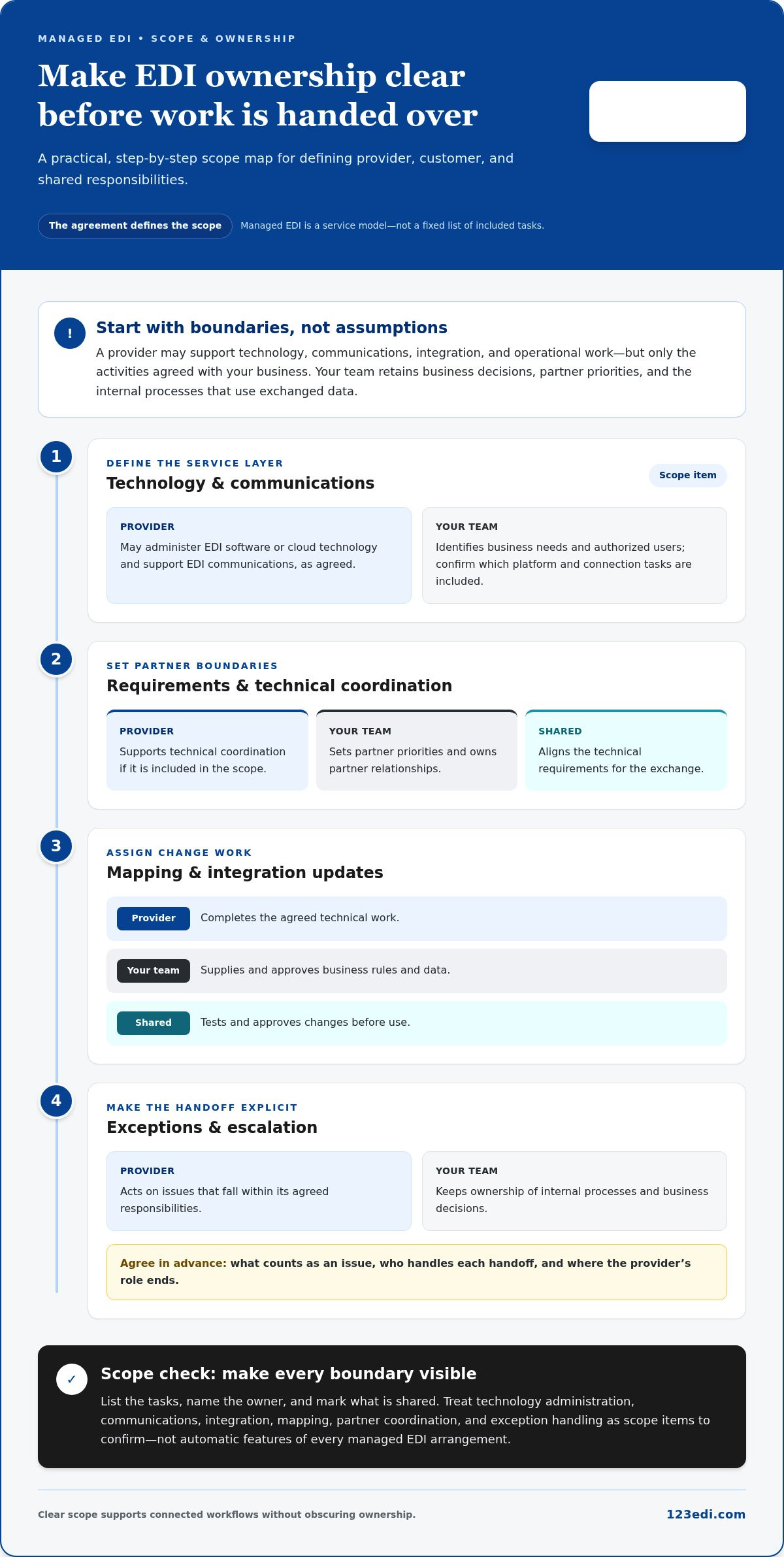
Once you’ve identified the work involved, make ownership visible. Managed EDI services can cover several parts of an EDI workflow, but the exact responsibilities depend on the agreement. Your business still directs partner priorities, approves business decisions, and owns the internal processes that use exchanged data. Clear boundaries help both sides act without assuming the other is responsible.
Which EDI activities may a provider manage?
Possible service areas span technology, communications, integration, and operational support. A provider may administer EDI software or cloud-based technology, support EDI communications, or assist with connections to business systems. Mapping, partner setup, and related coordination may also be included by agreement. Treat these as scope items to define, not automatic features of every arrangement. A cloud-based EDI solutions guide can help clarify how the technology layer fits into a connected workflow.
- Technology: EDI software or cloud platform administration, as agreed.
- Communications: EDI connections and communications responsibilities defined in the scope.
- Integration: Support for links between EDI and business systems, with responsibility boundaries set in advance.
- Operational support: Tasks such as mapping updates or partner-related work, if included in the agreement.
A practical responsibility matrix makes the division easier to discuss. Use this as a starting example, then adapt each assignment to the actual scope.
Responsibility | Provider | Customer | Shared ownership
Technology administration | Handles only the agreed platform tasks | Identifies business needs and authorized users | Reviews changes that affect workflows
Partner requirements | Supports technical coordination if included | Sets priorities and owns partner relationships | Aligns technical exchange requirements
Mapping or integration changes | Completes agreed technical work | Supplies and approves business rules and data | Tests and approves changes before use
Exceptions and escalation | Acts on issues within its agreed scope | Assesses business impact and makes decisions | Follows defined contacts and escalation paths
Which responsibilities remain with the business?
Your team remains accountable for business approvals, source-data quality, internal process ownership, and decisions about trading partner relationships. A provider can work within agreed technical parameters, but your organization determines whether a transaction reflects the right business intent. Assign named contacts for technical and business questions, and define how issues move between them. For example, when an order fails to match an internal process, the technical contact can investigate the exchange while the business contact decides how to handle the order.
Before work begins, document who can approve changes, who supplies accurate source data, and who communicates priorities to trading partners. Use the same responsibility map when processes or partner needs change. To explore how EDI software, communications, and integration can support connected workflows, visit 123 EDI’s EDI solutions.
Managed vs. Self-Managed vs. Hybrid EDI: Which Model Fits?
Choosing an EDI model is a decision about who does the work and how closely your team stays involved. Self-managed, managed, and hybrid arrangements can each be a sound fit, depending on your internal expertise, available capacity, system complexity, and preferred level of control. The goal isn’t to select the most outsourced option. It’s to assign responsibilities in a way your business can sustain.
The central trade-off is simple: keep more operational work and ownership in-house, or delegate defined tasks while retaining the business decisions that belong to your team. Managed EDI services can shift agreed technical or operational responsibilities to a provider, while a hybrid model divides work between the provider and your staff.
Comparison factor | Self-managed EDI | Managed EDI | Hybrid EDI
Internal effort | Higher. Your team handles the EDI work it owns. | Lower for tasks delegated under the agreement; internal coordination remains. | Shared. The workload depends on how responsibilities are divided.
Control | Direct internal oversight of technology and day-to-day decisions. | Your team sets business priorities; the provider handles agreed activities. | Internal oversight stays with your team in selected areas, alongside provider involvement elsewhere.
Provider involvement | Limited or focused on supplying technology. | Broader, according to the agreed scope. | Targeted to specific technical or operational responsibilities.
Possible fit | Established expertise, capacity, and clear internal ownership. | Limited internal capacity or a preference to delegate defined work. | A need for added support while retaining hands-on involvement in important workflows.
When does self-managed EDI make sense?
Self-management may suit a business with experienced EDI staff, time to maintain its workflows, and clear ownership across relevant teams. Those teams still need to coordinate the business processes connected to EDI, not just operate the technology. Owning EDI software alone doesn’t provide the staff capacity or expertise to manage the work around it.
When should a business consider managed or hybrid EDI?
Consider managed or hybrid arrangements if transaction workflows, partner needs, or system connections require more capacity or specialist knowledge than your team can consistently provide. A hybrid approach could assign technical integration tasks to a provider while your staff retain oversight of internal processes and business approvals. The division should reflect your actual workflow, not an assumed standard. For a closer look at connections between EDI and business systems, explore this EDI and ERP integration guide.
To compare models, list the work your team handles now, identify where delays or knowledge gaps arise, and decide which responsibilities you want to retain. Then match provider involvement to those specific needs. The right arrangement may change as your partner network, systems, or internal capacity changes, so revisit the division of work when your operating needs shift.
How to Evaluate Managed EDI Services for Your Business
Choose a service model based on the work your EDI operation needs to support, not a feature list alone. A clear assessment of your workflows, responsibilities, and integration points helps reveal where your team needs provider involvement and where internal ownership should remain. Use this process to turn those needs into a defined scope.
What should you map before selecting a service model?
Start with the way business documents move today. Record each trading partner connection, the transaction types exchanged, the systems involved, and the teams that handle each handoff. Note recurring exceptions and who resolves them. Separate immediate operational needs from future integration priorities so planned changes don’t obscure the work that needs attention now.
- Document workflows and ownership. Trace each transaction from its source through EDI and into the business process it supports. Identify the internal teams responsible for reviewing or acting on the information.
- Inventory transaction and partner requirements. List the documents exchanged with each trading partner and any connection or format requirements that shape those exchanges. Note where requirements differ across partners.
- Map systems and expertise. Identify where EDI connects to your ERP and other relevant business systems. Record who understands those connections internally and where knowledge or available capacity is limited.
- Define the needed scope. Turn the findings into a responsibility outline: what your team owns, what provider involvement would cover, and which decisions or exceptions require shared coordination.
How should you assess integration and communication needs?
Map the data entering and leaving your ERP, then identify where each EDI transaction joins an existing workflow. For example, determine which business process uses incoming order information and where outgoing documents originate. This helps clarify whether your priority is EDI software, ERP integration, communications, or a combination of connected capabilities.
Next, document partner communication requirements, including whether AS2 is relevant to a particular workflow. 123 EDI offers cloud-based EDI, software, communications, AS2, and ERP integration for these technology and connectivity needs. The AS2 as a service overview provides context for considering AS2 within EDI communications.
Make visibility part of the scope, too. Write down what your team needs to know about workflow status, how issues are communicated, and who receives escalations. Specify responsibility boundaries for changes, approvals, and business decisions. These details give internal staff a clear view of their role and help connect your requirements to relevant EDI software and integration capabilities.
Explore 123 EDI’s EDI software and integration solutions in light of the workflows and connections you’ve mapped.
How 123 EDI Supports Managed EDI Workflows
A well-matched EDI approach brings technology and business workflows together while keeping responsibilities clear. 123 EDI provides cloud-based EDI, EDI software, an EDI portal, EDI communications, AS2, and integration with ERP systems. These capabilities can support different parts of a partner data exchange, depending on your systems and requirements. Start with the workflows you mapped rather than assuming every business needs the same setup.
As you assess managed EDI services, separate the technology and integration you need from the operational tasks you want handled. A clear scope helps your team understand what the EDI environment connects and how it fits into business processes, while making ownership explicit.
How can cloud EDI and ERP integration work together?
In a connected workflow, a trading partner sends an electronic business document through an EDI connection. EDI integration can link that exchange with an ERP workflow, so relevant information can be used within existing business systems. The reverse flow can support sending business documents from internal processes to a partner. The systems, transactions, and handoffs involved vary by company, so map integration needs to actual workflows.
Cloud-based EDI, communications, and AS2 address different parts of the overall arrangement. AS2 is a communications method used for secure data exchange, and it may be relevant where partner workflows call for it. An EDI portal is another part of 123 EDI’s offering. The role of each capability depends on how your organization exchanges data and connects its systems.
For example, a business might need incoming partner documents to connect with an ERP process, while outgoing documents follow a separate path. Mapping both directions helps identify which systems and teams are involved, where approvals happen, and what information staff need to understand the workflow. That picture can guide decisions about EDI software, communications, and ERP integration without presuming that one configuration suits every organization.
What should your next step be?
Bring together the practical requirements from your evaluation: the service scope you need, the responsibilities your team will retain, the integrations involved, and how EDI communications should work. Include the visibility your team needs to understand its workflows and the business contacts responsible for decisions. These points create a focused basis for defining an EDI approach.
123 EDI brings cloud EDI, software, portal, communications, AS2, and ERP integration capabilities to your EDI software and integration needs. A focused discussion can center on your current transaction flows, existing business systems, partner requirements, and desired level of provider involvement. This connects technical choices to how your organization works while keeping scope and ownership in view.
Discuss your EDI requirements with 123 EDI to explore how its EDI software and integration capabilities relate to your workflows.
Make Your EDI Model Ready for What Comes Next
Your EDI operating model shouldn’t be a one-time decision. As trading relationships, transaction needs, or internal workflows change, revisit who owns each task and whether the current division of work still serves the business. A review of responsibilities can reveal when to adjust your use of managed EDI services while preserving the visibility your team needs.
Use your current workflow priorities as the starting point for the next conversation. Bring the processes you want to support, the systems involved, and the level of provider participation you have in mind. That gives you a practical basis for aligning technology and integration with how your teams work, without losing sight of business ownership.
Discuss your EDI requirements with 123 EDI and take the next step toward an EDI approach that can evolve with your business. A clear starting point makes progress easier to plan.
Frequently Asked Questions
What are managed EDI services?
Managed EDI services are an arrangement in which a provider supplies or supports EDI technology and performs operational work defined with the business. For example, a company might use EDI software while assigning selected technical tasks to a provider. The useful distinction is the agreed allocation of work: document who can change transaction rules, approve business exceptions, and communicate partner priorities.
What is included in managed EDI services?
Inclusions depend on the service agreement, so the label alone doesn’t tell you exactly what’s covered. One arrangement might focus on EDI technology and communications, while another could also include agreed integration or mapping activities. Before work begins, translate the scope into tasks and decision rights. For instance, specify who prepares a change and who approves its impact on a business document.
What is the difference between managed and fully managed EDI?
“Fully managed” generally suggests a broader delegation of EDI-related operational work than a more limited managed arrangement, but the terms aren’t a reliable substitute for a written scope. The practical difference is which activities the provider takes responsibility for and which remain with the business. Even when more technical tasks are delegated, your organization retains ownership of its business priorities and decisions.
Is managed EDI better than managing EDI in-house?
Neither approach is automatically better; the fit depends on your team’s capacity, expertise, and need for direct control. In-house management may suit a company with experienced staff who can maintain EDI workflows alongside related business processes. If that expertise or time is limited, delegating defined activities may help align responsibilities with available resources. Compare the work involved, not just the software arrangement.
Can managed EDI services integrate with an ERP system?
Yes, EDI can be integrated with existing ERP platforms, though the appropriate setup depends on your systems and workflows. For example, map how an incoming partner document relates to an ERP process, then identify where information needs review or action. 123 EDI provides EDI integration with ERP systems, helping connect partner exchanges with existing business platforms.
How do managed EDI services handle trading-partner communications?
Partner communications can involve EDI connections and agreed communication methods, including AS2 where relevant to the workflow. The specific responsibilities depend on the arrangement and partner requirements. A practical example is documenting which connection method applies to each partner and who handles business questions if an exchanged document needs clarification. 123 EDI offers EDI communications and AS2 for partner data exchange.
What should a business evaluate before choosing managed EDI services?
Start by identifying the business workflows EDI supports, the documents exchanged, partner requirements, connected systems, and the expertise available internally. Then define the service scope, ownership of approvals, communication routes, and how your team will maintain visibility. For example, if an ERP connection is a priority but internal EDI capacity is limited, include both needs in the model assessment before deciding how responsibilities should be divided.