

What does “cloud-based” really tell you about whether your EDI transactions will keep moving during a disruption? Not enough on its own. Reliable EDI hosting depends on how well orders and partner communications continue, how quickly interrupted data flows can recover, and how clearly teams can detect and handle issues. When an outage could interrupt business, look beyond the hosting label and assess what reliability means across your actual workflow.
This guide explains how to evaluate dependable EDI operations and compare hosting approaches using practical criteria. You’ll learn what to examine in transaction continuity, recovery planning, monitoring, secure communications, and support expectations, so you can distinguish measurable capabilities from broad promises.
We’ll also trace how EDI data moves between trading partners and your ERP. Reliable exchange depends on the connections across that workflow, not just on the hosting environment. With a clearer view of cloud EDI, portals, communications such as AS2, and ERP integration, you can identify the questions that matter and plan your next steps with less uncertainty.
Key Takeaways
- Assess reliable EDI hosting through separate evidence for availability, transaction processing, communications, monitoring, and recovery.
- Understand how AS2 supports secure EDI communication without treating the protocol as proof of hosting uptime.
- Compare cloud-hosted EDI, self-managed software, and portal workflows by ownership, ERP connectivity, visibility, and scaling needs.
- Build a transition plan by inventorying EDI documents, trading partners, systems, protocols, and business owners before testing workflows.
- See how cloud EDI, portals, communications, AS2, and ERP integration can work together across a connected business workflow.
Why Reliable EDI Hosting Matters to Transaction Continuity
An EDI interruption is more than a technical inconvenience. If a purchase order is delayed, it may not appear in the usual business workflow. If an acknowledgment or shipping document fails to reach a partner, teams may need to investigate before an order can proceed. Invoicing and fulfillment can also be affected when connected systems don’t receive the information they need. The impact depends on the transaction and each company’s process, but the underlying requirement is the same: business data must move accurately between organizations and systems.
Electronic Data Interchange (EDI) enables businesses to exchange structured documents electronically. Hosting reliability matters because this exchange involves more than keeping a platform accessible. Data must be processed and routed through the right connections so partners and internal systems can act on it.
Which business workflows depend on hosted EDI?
Depending on the business and its trading-partner requirements, EDI workflows may include purchase orders, acknowledgments, invoices, and shipping documents. A purchase order might travel from a partner through an EDI connection, be translated into a format an internal ERP can use, and then trigger a response. Other documents may travel in the opposite direction, from an ERP through EDI to a partner. The document types and sequence vary by organization.
Every handoff is a place where the flow can stall or produce an exception. A document may reach the hosting environment while an ERP connection is unavailable, for example, or an outbound transaction may be processed internally but fail to reach its trading partner. Staff then need to locate the failure, determine whether a document needs attention, and coordinate next steps. Mapping the complete path helps teams identify where an interruption could affect orders, fulfillment, invoicing, or partner coordination.
What does EDI hosting reliability mean?
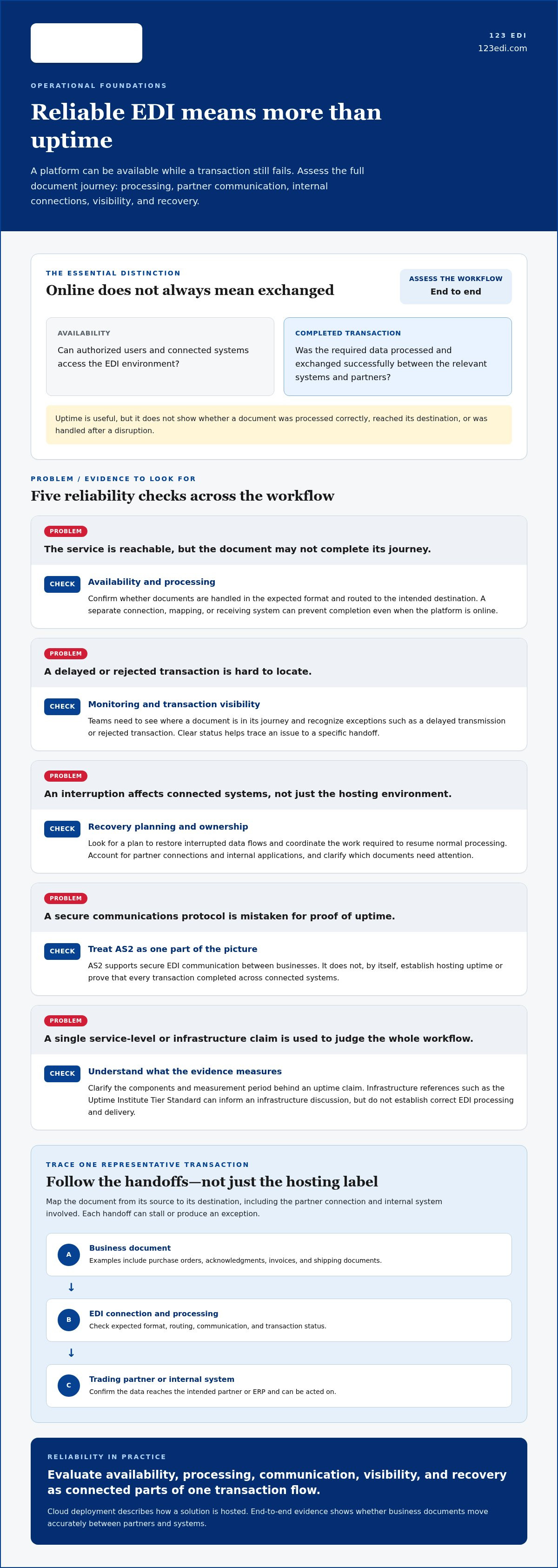
EDI hosting reliability means dependable availability, accurate processing, and continued movement of business documents across connected systems and trading partners. Uptime is useful, but it doesn’t show whether a transaction was processed correctly, reached its destination, or was handled appropriately after a disruption. Assess reliability across the entire workflow, rather than relying on a single platform metric.
System availability means the hosting environment can be accessed; completed business transactions mean the required data has also been processed and exchanged successfully between the relevant systems and partners. This distinction matters when comparing claims. A service can be online while a separate connection, data mapping, or receiving system prevents a transaction from completing.
- Availability: Can authorized users and connected systems access the EDI environment?
- Processing: Are documents handled in the expected format and routed to the intended destination?
- Continuity: Can teams identify transactions that need attention and coordinate a response when a handoff is interrupted?
Cloud deployment alone doesn’t answer these questions. It describes where or how a solution is hosted, not how every step in a company’s EDI and ERP workflow performs. To assess reliability, trace a representative transaction from its source to its destination, including the partner connection and internal system involved. This end-to-end view gives you a practical basis for evaluating whether hosted EDI supports business continuity.
What Makes EDI Hosting Reliable? The Operational Foundations
Reliability comes from several connected capabilities, not a single uptime figure. A hosting environment may be available while a transaction still fails because a document mapping is incorrect, a partner connection is unavailable, or an ERP application can’t accept the data. Reliable EDI depends on both platform availability and successful transaction flow. Assessing both helps you understand the full path your documents travel.
Availability, monitoring, and transaction visibility
Uptime describes how much of a defined period a service is available for use. Its meaning depends on what is measured, which components are included, and the measurement period. A data-center reference such as the Uptime Institute Tier Standard can inform a discussion of infrastructure, but it doesn’t establish whether EDI documents are correctly processed and delivered.
Monitoring and transaction visibility provide an operational view. Teams need to identify where a document is in its journey and recognize exceptions, such as a delayed transmission or rejected transaction. That information helps them trace an issue to a specific handoff instead of treating every delay as a general outage. A service-level claim describes an agreed measure; evidence of processing and communication outcomes shows how the workflow is performing.
Recovery planning and secure EDI communications
Recovery planning means preparing to restore interrupted data flows and coordinate the work needed to resume normal processing. It should account for dependencies, including partner connections and internal applications, rather than focusing only on the hosting environment. Clear transaction status and ownership help teams determine which documents need attention after an interruption.
AS2 is a communications protocol used for secure EDI exchange between businesses over the internet. It supports the communication step, but it isn’t a hosting guarantee. Platform availability, endpoint configuration, partner readiness, and successful processing still matter. For a closer comparison of communication methods, see the AS2 vs FTP for EDI guide.
In practice, the reliability dimensions reinforce one another:
- Availability concerns whether the required environment and connections can be reached.
- Processing depends on accurate mappings and the correct handling of each document.
- Communications carry information between the business, its partners, and connected systems.
- Monitoring makes delays and exceptions visible enough to investigate.
- Recovery supports a deliberate response when normal data flow is interrupted.
To assess reliable EDI hosting, trace one representative transaction across these dimensions. This can reveal gaps a platform-level metric alone won’t show. 123 EDI’s cloud-based EDI and ERP integration offerings connect hosting considerations with the systems that use business data. Explore 123 EDI’s connected EDI solutions to see how communications and ERP workflows can fit together.
How to Compare EDI Hosting Options and Reliability Evidence
Choosing an EDI operating model means deciding where responsibilities sit and how transactions connect with partners and internal systems. Cloud-hosted EDI, self-managed software, and portal-based workflows can suit different processes. Start your comparison with your team’s operating capacity, ERP needs, partner interactions, and the visibility required to manage daily transactions. No single model is right for every workflow.
Which EDI hosting model fits your operating needs?
Cloud hosting can reduce the need for a business to manage EDI infrastructure internally, while self-managed software places responsibility for its operating environment on the business. An EDI portal provides a web-based way to work with transactions, but it isn’t automatically a replacement for integrated system-to-system workflows. For more background on the cloud model, see this comprehensive cloud-based EDI guide.
| Consideration | Cloud-hosted EDI | Self-managed software | Portal-based workflow |
|---|---|---|---|
| Operational ownership | Hosting operations are outside the business’s internal environment; internal teams still define workflow needs. | The business manages the environment in which its EDI software operates. | Users work through a web-based interface, with responsibilities shaped by the workflow. |
| ERP connectivity | Can be part of an integrated EDI-to-ERP workflow. | Connectivity and ongoing operation sit within the business-managed setup. | May support user-led steps; assess whether the required ERP connection is included in the workflow. |
| Partner workflows | Consider how partner connections and document requirements are coordinated. | The business oversees its partner connections and configuration. | Useful for workflows involving direct user interaction, depending on process needs. |
| Visibility | Assess the transaction status information available to business users. | Visibility depends on the software and the business’s operating practices. | Users interact with transactions through the portal’s available views. |
| Scaling considerations | Consider how the arrangement accommodates changing transaction or partner needs. | Account for internal capacity to maintain and adapt the environment. | Consider whether the workflow remains practical as users, partners, or transaction volume changes. |
How to interpret uptime and reliability claims
A published uptime figure is useful only when its scope is clear. Check which service or network it measures, the period covered, and whether it includes the components your transactions depend on. A figure for a hosting environment may not represent partner connectivity, ERP availability, document accuracy, or successful processing.
When comparing reliable EDI hosting evidence, separate availability from transaction outcomes. Look for information about how delayed or rejected documents become visible, how communication failures are distinguished from processing issues, and how the reported measure relates to your workflow. A defined service-level measure can help set expectations, but it doesn’t prove that every business transaction completes successfully. Apply the same criteria to each model, then weigh the results against your team’s responsibilities and operating requirements.
How to Assess EDI Hosting Before Moving Business Transactions
A smooth transition starts with a clear picture of your current EDI workflow. Before moving transactions, document the systems, partners, people, and processes involved. This gives you a baseline for defining requirements, testing the new workflow, and identifying gaps before they affect routine business activity. Assessing reliable EDI hosting isn’t just a technology decision; it’s a coordinated review of how information moves through your organization.
Map current EDI transactions and dependencies
Build an inventory that connects each transaction to its business purpose and the systems that handle it. Include active trading partners, document types, communications protocols, schedules, ERP systems, and the business owners who rely on each flow. For each transaction, note who handles exceptions and how teams know a document needs attention.
- Partners and connections: Record trading partners, communication methods, and relevant connection details.
- Documents and timing: List transaction types, such as orders or invoices, and when they’re sent or received.
- Systems and mappings: Identify the ERP and other applications involved, plus the data transformations linking them.
- People and exceptions: Name the business teams that depend on each flow and document how they respond to errors or delays.
Separate documented facts from assumptions. A schedule in an old procedure, for example, may not reflect how a partner currently exchanges files. Validate the current state with the people who use the workflow and review available transaction records. For ERP dependencies, the EDI integration with ERP guide can help you identify which connections to include in your assessment.
Plan testing, transition, and ongoing review
Use your inventory to define what the new workflow must do before transactions move. Choose representative partner and document scenarios, including routine exchanges and known exceptions. Testing should confirm that documents can be exchanged, acknowledgments are handled, mappings produce the expected data, and ERP handoffs reach the right business process.
- Set requirements: Define the transactions, partner connections, communications protocols, and ERP handoffs that must work.
- Test representative flows: Exercise inbound and outbound documents, acknowledgments, mappings, and exception scenarios with relevant partner requirements in view.
- Transition in phases: Move a manageable set of workflows at a time, with named owners for issue escalation and communication to affected business teams.
- Review results: Compare expected and actual outcomes before expanding the transition, then track failed, delayed, or manually corrected transactions on a recurring basis.
A phased approach gives teams a structured way to learn from early results and address process gaps before moving additional workflows. Keep a record of test outcomes, unresolved issues, decisions, and ownership so operational knowledge doesn’t disappear between technical and business teams.
After transition, regular review can reveal recurring mapping problems, partner communication issues, or ERP handoff failures. Use those findings to refine requirements and prioritize follow-up. Explore 123 EDI’s cloud-based EDI and ERP integration offerings as you plan a connected transaction workflow.
How 123 EDI Connects Cloud Hosting, Communications, and ERP Workflows
Assessing EDI hosting reliability means looking at how each part of a transaction works together. A cloud environment, communications method, partner workflow, and ERP connection all contribute to the path business data takes. 123 EDI provides cloud-based EDI, EDI software, an EDI portal, EDI communications, AS2, and EDI integration with ERP systems. These are connected parts of a business workflow, rather than isolated technology choices.
Founded circa 1994, 123 EDI has worked in the EDI field across changing business and technology needs. For a company evaluating reliable EDI hosting, that history offers context. The practical assessment still rests on your organization’s requirements: which transactions need to move, how partners exchange them, and how the ERP uses the resulting data.
Connect hosted EDI with ERP and trading-partner workflows
EDI integration can link external transactions with existing ERP processes. Information received from a trading partner may need to enter an internal business system in a usable format, while documents created in that system may need to be exchanged with a partner. The sequence, documents, and system connections depend on each organization’s workflow.
Cloud EDI, software, portal access, and communications each have a role in that broader exchange. EDI communications support the transfer of business data, and AS2 is one option for secure business-to-business EDI communication. An EDI portal provides a web-based way to work with transactions, while integration connects EDI activity with business applications. Together, these offerings relate to the criteria explored in this guide:
- Transaction continuity: Consider how transactions move across the systems and partner connections involved in your process.
- Communications: Identify how business documents are exchanged with trading partners.
- ERP fit: Understand where EDI data enters or leaves your existing business processes.
- Operational visibility: Determine what information teams need to follow transaction progress and address exceptions.
Move from evaluation criteria to a practical next step
These criteria turn a broad hosting discussion into a focused review of connected workflows. Start with your transaction inventory and requirements, then consider how cloud EDI, communications, portal workflows, and ERP integration relate to those needs. The right fit depends on the flow your business must support, not simply on a cloud label or a single performance measure.
With a clear view of your partners, transactions, and ERP connections, you can evaluate the workflow with greater confidence. Explore 123 EDI’s solutions.
Turn Your EDI Assessment Into a Clear Next Step
Reliable EDI hosting is most useful when it supports the way your business actually works. Before making a change, bring the people responsible for EDI, ERP processes, and partner communication together. Agree on what a successful transaction looks like and how exceptions should be handled. That shared understanding can guide a focused evaluation and help teams move forward with fewer assumptions.
Next, consider how cloud-based EDI and integration can fit your existing workflows and business priorities. You don’t need to decide everything at once. Start with a clear view of the connections you want to support and the outcomes your teams need to see.
Explore 123 EDI’s cloud and integration solutions to take the next step toward a more connected EDI workflow.
Frequently Asked Questions
Is cloud EDI hosting secure?
Cloud EDI hosting can support secure data exchange, but the cloud label alone doesn’t establish how information is protected. To assess reliable EDI hosting, consider who can access or change transactions, how partner communications are protected, and how operational responsibilities are defined. For example, a business exchanging purchase orders and invoices should understand how access is managed as employee roles change. AS2 supports secure communications, but it doesn’t guarantee security across every system or process.
Can EDI hosting work with an existing ERP system?
Yes, hosted EDI can work with an existing ERP through EDI integration. The design depends on the ERP, document requirements, partner rules, and current data flows. A finance team may need invoice information to appear in an established accounts-payable process, while operations uses order data elsewhere in the ERP. 123 EDI provides EDI integration with ERP systems to connect business transactions with existing workflows.
What happens if an EDI transaction fails during processing?
A failed transaction may not reach the intended application or trading partner, and the next step depends on where the failure occurred. A rejected document may need correction, while a communication interruption may require checking whether the partner received it before resending. Distinguishing between these issues can help avoid duplicate processing. Record the document reference, failure status, and assigned owner so teams can coordinate resolution and keep affected business processes informed.
How much EDI hosting capacity does a business need?
Required capacity depends on transaction volume, partner requirements, document types, processing patterns, and expected growth. Look beyond an average daily count: a seasonal order surge or a new partner may change the workload and the connections involved. Inventory current exchanges, note periods of higher activity, and consider planned business changes. This gives teams a more useful basis for discussing capacity than a transaction estimate taken out of context.
Does EDI hosting replace the need for an internal EDI team?
No. Hosting can reduce the infrastructure your business operates, but it doesn’t remove the need for internal process ownership. Staff still need to understand partner requirements, approve changes that affect business workflows, and coordinate with teams such as finance or operations when exceptions arise. A responsibility chart can clarify who owns partner communication, business decisions, and transaction follow-up, while distinguishing those duties from management of the hosting environment.
Are AS2 and EDI hosting the same thing?
No. EDI hosting concerns the environment in which EDI software or workflows operate, while AS2 is a protocol for exchanging data between businesses. They address different parts of an EDI arrangement. A company may use a hosted workflow and communicate with a partner through AS2, while relying on separate ERP connections and document mappings. Keeping these concepts distinct helps teams describe their requirements precisely.
Is EDI hosting suitable for a small business?
It can suit a small business that needs to exchange structured documents with trading partners without operating all EDI infrastructure internally. Fit depends on partner expectations, transaction patterns, existing accounting or ERP processes, and staff capacity. A practical first step is to identify the documents and partner connections essential to daily operations. Then assess how a hosting approach fits the business’s resources and workflow.