

For many suppliers, the EDI 856 isn’t just a digital notification; it’s the thin line between a profitable partnership and a mountain of expensive retailer chargebacks. You’ve likely felt the frustration of staring at a complex SOPI hierarchy or dealing with the fallout of a minor data entry error that delayed an entire shipment. It’s a high-stakes environment where even a small oversight can lead to significant financial penalties and strained relationships with your trading partners.
We understand that managing these technical requirements can feel overwhelming, but we’re here to simplify the landscape. This guide provides a clear, step-by-step approach to mastering the EDI 856 Advance Ship Notice so you can achieve 100% compliance and accelerate your shipping results. We’ll walk you through the nuances of the hierarchy levels, demonstrate how to automate the process directly from your ERP, and show you how to reduce manual labor in the warehouse for a more efficient operation. By the end of this article, you’ll have a reliable roadmap to transform your shipping department into a center of precision and reliability.
Key Takeaways
- Understand the vital role of the EDI 856 in the “Perfect Order” lifecycle and how it replaces traditional paper packing slips with digital precision.
- Master the SOPI (Shipment, Order, Pack, Item) hierarchy to ensure your data structures align perfectly with strict retailer requirements.
- Identify the root causes of expensive chargebacks and learn how to synchronize physical logistics with digital data transmissions to maintain 100% compliance.
- Evaluate the transition from manual data entry to cloud-based automation or ERP integration to reduce warehouse labor and eliminate shipping delays.
Understanding the EDI 856: What is an Advance Ship Notice (ASN)?
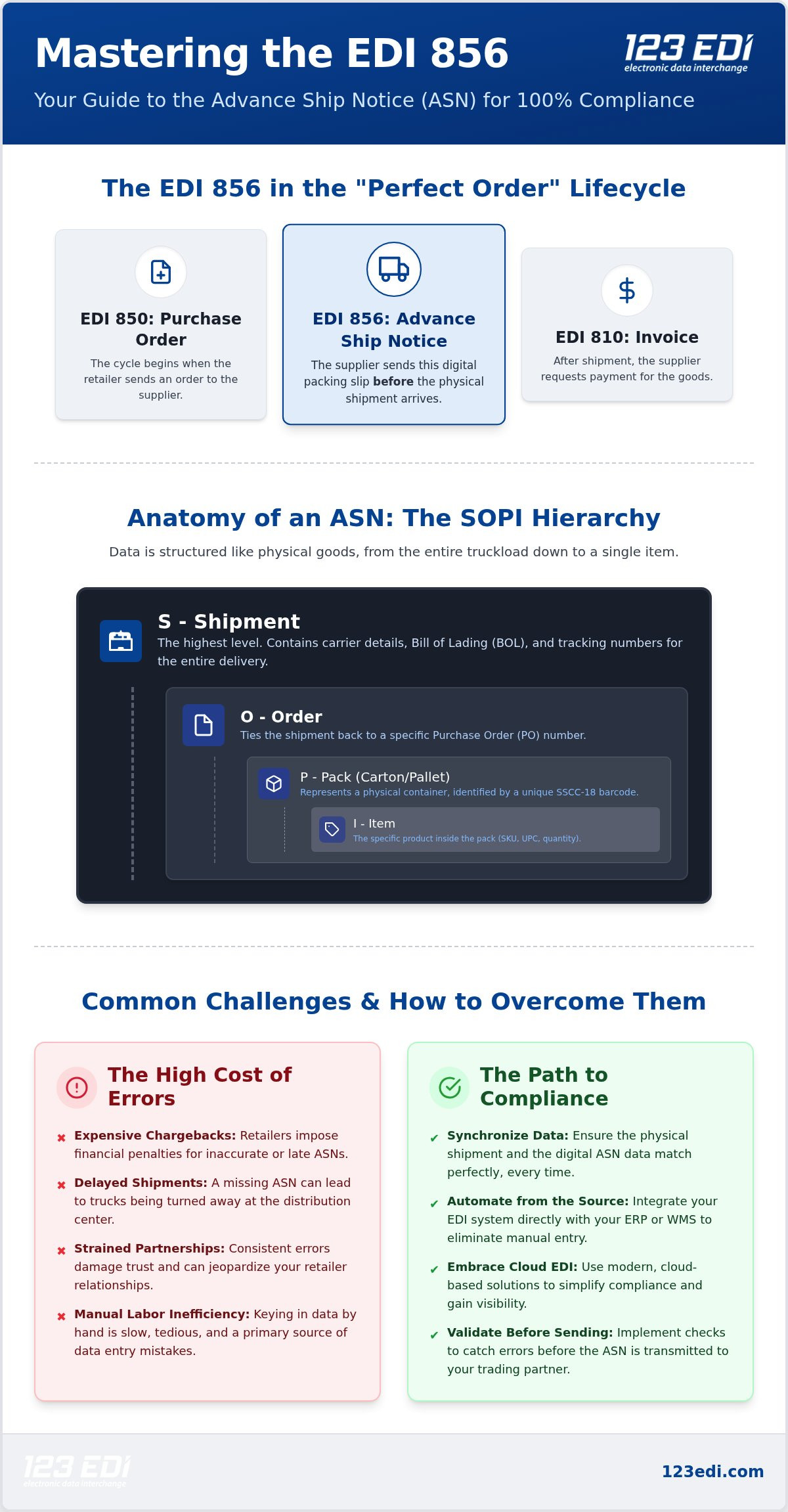
In its simplest form, the EDI 856 is the digital evolution of the traditional paper packing slip. While a physical slip travels inside a box, this electronic document travels ahead of the shipment to provide a detailed roadmap of what’s inside the delivery. It acts as a formal notification from a supplier to a buyer, detailing the contents of a shipment and its physical characteristics. For businesses striving for efficiency, it’s the critical middle link in the “Perfect Order” lifecycle. This cycle typically begins with an 850 Purchase Order, moves to the 856 ASN to confirm fulfillment, and concludes with the 810 Invoice to request payment.
The primary reason retailers require this document is visibility. When a retailer knows exactly what’s on a truck before it arrives, they can move from reactive receiving to proactive inventory management. This digital foresight allows for advanced warehouse functions like cross-docking, where goods are transferred directly from an incoming trailer to an outbound truck with minimal or no storage time. Without the data provided by an ASN, these high-speed logistics maneuvers would be impossible to coordinate.
The Role of the ASN in the Modern Supply Chain
The Advance Ship Notice (ASN) serves as a vital bridge between your warehouse floor and your partner’s accounts department. It ensures that the physical movement of goods is perfectly synchronized with the digital flow of information. Timing is the most sensitive factor here. If the physical truck reaches the distribution center before the data file arrives, the retailer’s system won’t recognize the shipment. This often leads to the truck being turned away or the supplier being hit with significant penalties. To understand how this document fits into the broader landscape of digital trade, you can explore our comprehensive guide to EDI transactions.
Why Retailers Demand EDI 856 Compliance
Retailers view visibility as a high-value business asset. By receiving an EDI 856 well in advance, they can plan labor schedules and allocate shelf space with surgical precision. They don’t just want to know that a shipment is coming; they need to know exactly how many cartons are on each pallet and which items are in which box. This level of detail allows them to automate their receiving process using barcode scanners, which eliminates the need for manual counting at the dock.
Because retailers rely so heavily on this data for their internal efficiency, they have very little patience for errors. Inaccurate or late ASNs disrupt their entire supply chain, leading to congested docks and empty shelves. To protect their operations, most major trading partners enforce strict compliance rules. Failure to meet these standards results in chargebacks, which are financial penalties deducted directly from your invoice. Mastering the 856 isn’t just about technical compliance; it’s about protecting your bottom line and building a foundation of trust with your partners.
The Anatomy of an EDI 856 Transaction: Hierarchical Levels Explained
While the EDI 856 might seem like a dense wall of text, its internal logic is remarkably organized. At the center of this logic is the Hierarchical Level (HL) segment. This segment acts as the backbone of the entire transaction, organizing data in a parent-child relationship that mirrors the physical reality of your shipment. By adhering to the X12 EDI standards, suppliers ensure that their digital manifests are readable by any major retailer’s system. This structured approach isn’t just about code; it’s about providing a transparent view of the cargo from the moment it leaves your dock.
Data flow begins at the physical loading dock, where information from the Bill of Lading (BOL) is captured and translated into these digital segments. This ensures that the weight, carrier details, and tracking numbers matched on the paper documents are identical to the electronic notification. One of the most critical pieces of this puzzle is the SSCC-18 (Serial Shipping Container Code). This 18-digit number acts as a unique license plate for every pallet or carton, allowing the retailer’s automated systems to “see” what’s inside a box simply by scanning the outside label. If you find these technical mappings challenging, our team can help you simplify your EDI integration to ensure every segment is perfectly aligned with your partner’s requirements.
Breaking Down the SOPI Structure
The most common hierarchy used in retail logistics is the SOPI structure. This acronym stands for Shipment, Order, Pack, and Item. Each level provides a specific layer of detail to help the receiver process the goods efficiently:
- Shipment Level: This is the top tier, containing high-level data like the BOL number, carrier SCAC codes, and the final destination address.
- Order Level: Here, you identify the specific Purchase Order (PO) number being fulfilled. If a shipment contains multiple POs, each gets its own order-level segment.
- Pack Level: This layer focuses on the physical containers. It’s where the SSCC-18 barcode is mapped, linking the digital data to the physical label on a pallet or carton.
- Item Level: The most granular level, detailing individual SKUs, quantities, and descriptions of the goods nested within those packs.
Standard Data Elements in an 856
Beyond the hierarchy, several standard elements must be present for a successful transmission. These include the precise date and time of shipment, carrier identification codes, and packaging descriptions like “CTN” for cartons or “PLT” for pallets. Much of this information is pulled directly from the warehouse management system to ensure consistency across all shipping documents. The HL segment serves as the unique identifier that nested data levels rely on to establish parent-child relationships within the file. By maintaining this strict organizational structure, you provide the clarity your trading partners need to keep their supply chains moving without interruption.
How to Implement an EDI 856 Workflow in 5 Steps
Establishing a reliable EDI 856 workflow often feels like a daunting technical hurdle for growing suppliers. However, when you approach implementation with a seasoned partner, the process becomes a manageable series of logical steps. Our goal is to act as your mentor, guiding you away from the risks of manual data entry and toward a streamlined, automated system. By focusing on a collaborative setup, we ensure your team understands the “why” behind the requirements while we handle the complex technical heavy lifting. During the initial mapping phase, it’s vital to align with current EDI standards to ensure long-term stability and compliance with all trading partners.
Step 1: Map Retailer-Specific Requirements
Every major retailer, from Walmart to Target, operates with a unique implementation guide or “map.” These documents dictate exactly how they want their data structured, including specific segments and mandatory fields. Interpreting these specification documents requires a deep understanding of technical syntax. At 123 EDI, we take these complex requirements and build custom maps for you. This ensures that your outgoing files perfectly match what your partner expects to receive, removing the guesswork and preventing technical rejections before they happen.
Step 2: Connect Your ERP System
Manual data entry into a standalone portal is the primary cause of EDI 856 errors and shipping delays. To achieve true efficiency, your EDI solution should pull data directly from your existing records. Implementing EDI integration with ERP systems allows your shipping notices to be generated automatically from the data already in your system. Whether you use NetSuite, SAP Business One, or QuickBooks, this connection ensures that the information on your digital notice perfectly matches what’s on your warehouse floor, eliminating the “timing gap” that causes so many compliance issues.
Step 3: Test Communication Protocols (AS2)
Once your data is mapped and integrated, you need a secure digital handshake to deliver it. Most modern retailers require the use of AS2 communication software to ensure that your sensitive shipment data is encrypted and traceable. This step involves a rigorous “Testing and Certification” phase where we send sample files to the retailer’s test environment. We verify that the connection is stable and that the data is being parsed correctly. Only after this secure handshake is perfected do we move your workflow into a live production environment, giving you the confidence that every shipment is backed by a reliable technical foundation.
Common EDI 856 Challenges and How to Overcome Them
Even the most seasoned logistics teams can find themselves caught off guard by the intricate requirements of the EDI 856. The primary concern for many suppliers is the retailer chargeback; a financial penalty that can quickly erode your profit margins. These fines often stem from a “Timing Gap,” where the physical shipment arrives at the distribution center before the digital data has been processed. If the retailer’s system doesn’t have your ASN ready at the dock, they can’t automate the receiving process, which leads to congested docks and administrative fees.
Another frequent hurdle is the “Data Mismatch” between the original 850 Purchase Order and the final 856. Errors often occur when warehouse staff manually enter quantities that differ from the PO without updating the digital record. By leveraging deep ERP integration with platforms like NetSuite, SAP Business One, or QuickBooks, you ensure that your shipping records and EDI files are always in perfect sync. This level of automation removes the human error that leads to rejected shipments. As your collaborative partner, 123 EDI acts as a steady hand, providing the visibility you need to catch these discrepancies before they leave your facility.
Avoiding Costly Retailer Chargebacks
To protect your bottom line, you need more than just a transmission tool; you need a system that validates your data before it’s sent. Automated validation rules can flag missing HL segments or incorrect SSCC-18 codes in real time. One of the most important safeguards is the “997 Functional Acknowledgment.” Think of this as your digital receipt; it confirms that the retailer’s system received your file and that the syntax was correct. Monitoring these acknowledgments is essential to ensure your data arrived safely. For warehouse staff, implementing scan-packing procedures ensures that the physical contents of every box match the digital manifest exactly. To further protect your revenue, understanding how electronic data interchange payment automates remittance reconciliation can help your accounts receivable team stay in sync with every transaction.
Managing Complex Shipments (Drop Ships vs. DC)
Shipping requirements change drastically depending on the destination. For direct-to-consumer drop shipping, the EDI 856 must include specific consumer-facing details and often triggers a branded packing slip. Conversely, shipments to a Distribution Center (DC) require complex palletization and multi-level SOPI structures to handle high volumes. For smaller suppliers or those with fluctuating orders, a cloud-based EDI portal provides the flexibility to manage these varied requirements without a massive infrastructure investment. If you’re tired of fighting chargebacks and want to streamline your workflow, explore our EDI integration solutions to see how we can protect your business.
Simplifying EDI 856 Compliance with 123 EDI Solutions
Mastering the technical nuances of the EDI 856 shouldn’t feel like a solitary burden for your operations team. At 123 EDI, we believe that true compliance isn’t just about software; it’s about a collaborative partnership that scales with your growth. We offer a choice between our user-friendly EDI Portal, which is perfect for smaller volumes, and deep EDI Integration with ERP systems for high-volume automation. This flexibility ensures that you have the right tools to meet your trading partners’ demands without over-complicating your internal workflows.
By choosing a cloud-based EDI solution, you gain the ability to respond to market changes with agility. Our platform handles the heavy lifting of data translation and secure transmission, which allows your team to focus on fulfilling orders rather than troubleshooting code. We invite you to reach out for a mentor-led consultation. During this dialogue, we can map out a strategy that removes the stress of retailer mandates and positions your business for long-term success.
The 123 EDI Advantage: Human Expertise Meets Tech
With over 32 years of institutional knowledge in B2B data integration, our team brings a level of seasoned reliability that few providers can match. Since our founding in 1994, we’ve committed ourselves to being a trusted consultant rather than just another technology vendor. We don’t just hand you a login and walk away. Instead, our support team acts as a seamless extension of your own IT department, providing the oversight and precision needed to maintain 100% compliance. This human-centric approach ensures that you always have an expert hand to guide you through the complexities of modern supply chain logistics.
Next Steps: Moving from Manual to Automated ASNs
Transitioning from manual data entry to a fully automated workflow is a significant step toward warehouse efficiency. You can request a personalized demo of our mapping and automation tools to see exactly how we pull data from your shipping records to generate a perfect EDI 856. While every retailer has different requirements, our typical timeline for going live with a new trading partner is designed to be methodical and thorough. This ensures a stable connection from day one. Let us help you master your EDI 856 compliance today.
Take Control of Your Shipping Compliance
Mastering the EDI 856 is a vital transition from manual complexity toward streamlined warehouse automation. By understanding the intricate SOPI hierarchy and integrating your existing ERP system, you eliminate the data entry errors that lead to expensive retailer chargebacks. This shift doesn’t just protect your profit margins; it builds a foundation of long-term trust with your trading partners through consistent, real-time visibility.
At 123 EDI, we bring over 32 years of seasoned expertise to every collaborative partnership. Our team acts as a steady hand, guiding you through the technical nuances of seamless integrations with NetSuite, SAP Business One, and QuickBooks. We don’t just provide technology; we offer a human-centric approach where our support staff serves as a dedicated extension of your own IT department.
Automate Your EDI 856 Compliance with 123 EDI
Take the next step toward a more efficient shipping operation today. With a clear roadmap and a trusted mentor by your side, you can transform your compliance process into a reliable engine for business growth and supply chain excellence.
Frequently Asked Questions
What is the difference between an EDI 856 and a packing slip?
An EDI 856 is the digital counterpart to a physical packing slip, but it carries much more strategic weight. While a paper slip is tucked inside a box for manual verification, the 856 travels electronically to the retailer’s system before the truck arrives. This digital notice enables automated warehouse functions like cross-docking and labor planning. It’s a structured data file that allows robots and scanners to process your shipment without human intervention.
Does every retailer require an EDI 856 Advance Ship Notice?
Most major big-box retailers and high-volume distributors require an EDI 856 as a condition of doing business. While smaller boutiques might still rely on paper, giants like Walmart, Target, and Amazon mandate this transaction to keep their docks moving. If you’re looking to scale your business into national retail, you’ll almost certainly need to implement an ASN workflow to meet these strict compliance standards.
How much do retailer chargebacks for EDI 856 errors typically cost?
Retailer chargebacks for EDI 856 errors are significant and vary depending on the specific trading partner’s agreement. Some retailers charge a flat administrative fee for every late or missing notice, while others deduct a percentage of the total invoice value. These penalties are designed to offset the labor costs of manual receiving. Over time, even small, recurring errors can erode your profit margins and damage your supplier scorecard.
Can I send an EDI 856 if I don’t have an ERP system?
You can absolutely send an EDI 856 without a full ERP system by using a cloud-based EDI portal. This solution allows you to manually enter shipment details into a secure web interface, which then translates the data into the required X12 format. It’s an excellent starting point for smaller suppliers. As your volume grows, you might consider transitioning to an integrated system to reduce manual entry errors and save time in the warehouse.
What is the SOPI hierarchy in an EDI 856?
The SOPI hierarchy stands for Shipment, Order, Pack, and Item. It’s the structural backbone of the EDI 856 that tells the retailer exactly how goods are organized. The Shipment level covers the carrier info, the Order level links to the PO, the Pack level details the pallets or cartons, and the Item level identifies the specific SKUs. This nested structure ensures that every item is digitally accounted for within its physical container.
How quickly should I send the 856 after the truck leaves my warehouse?
You should send the 856 immediately after the truck leaves your dock. The goal is to ensure the data reaches the retailer’s system well before the physical shipment arrives at their facility. Many trading partners have strict windows, sometimes requiring the ASN within 30 minutes of departure. If the truck hits the dock before the data is processed, the shipment may be rejected or flagged for a costly compliance penalty.
What happens if I send an EDI 856 with incorrect information?
Sending an EDI 856 with incorrect information usually triggers a technical rejection or a compliance chargeback. If you catch the mistake early, some retailers allow you to send a corrected “Replacement” ASN to overwrite the original file. However, this depends entirely on the individual retailer’s system capabilities. It’s always best to use automated validation tools to catch errors before the initial transmission goes live to your partner to avoid financial deductions.
Is AS2 the only way to communicate an EDI 856 transaction?
AS2 is the industry standard for secure retail communication, but it isn’t the only option available. Some trading partners might still use Value Added Networks (VANs), SFTP, or older protocols like FTP with PGP encryption. However, most modern retailers prefer AS2 because it provides direct, encrypted transfers with real-time acknowledgments. We specialize in setting up these secure handshakes to ensure your data travels safely between systems without any interruption to your supply chain.