

In a global market where a single manual data entry error can trigger thousands of dollars in retailer chargebacks, the ability to communicate instantly and accurately is no longer just a technical perk; it’s your business’s central nervous system. As you scale, you’ve likely realized that spreadsheets and emails simply can’t keep pace with the demands of modern supply chains. Many growing companies reach a point where they must ask, what is edi and how do I make it work for my specific operations without getting lost in the technical weeds? It’s natural to feel overwhelmed by the alphabet soup of X12 protocols and AS2 connections, especially when the cost of a compliance mistake feels so high.
We understand that you’re looking for more than just software; you’re looking for a reliable path toward operational clarity. This guide will demystify the complex world of Electronic Data Interchange and show you how modern cloud-based solutions can turn a daunting requirement into a streamlined competitive advantage. By the end of this article, you’ll have a clear understanding of EDI components, a logical roadmap for implementation, and the confidence to choose a partner that acts as a steady hand for your data management. We’ll explore everything from the 2026 shift toward ANSI X12 version 008060 to the strategic benefits of ERP integration, ensuring your business is built on a foundation of precision and trust.
Key Takeaways
- Gain a clear understanding of what is edi and how standardized data exchange replaces the inefficiencies of manual communication to accelerate your business operations.
- Discover the essential “rules of grammar” for business data, including how standard transaction sets like the 850 Purchase Order and 810 Invoice ensure accuracy across your trading network.
- Explore why modern, cloud-based EDI solutions have surpassed legacy hardware by offering superior scalability, lower upfront costs, and automatic compliance updates.
- Learn how EDI integration with ERP systems like NetSuite or SAP eliminates the risks of manual data entry and “double-handling” to create a seamless flow of information.
- Master a practical roadmap for implementation that helps you navigate retailer compliance mandates and choose the right digital transformation path for your unique growth goals.
Understanding the Core: What is Electronic Data Interchange (EDI)?
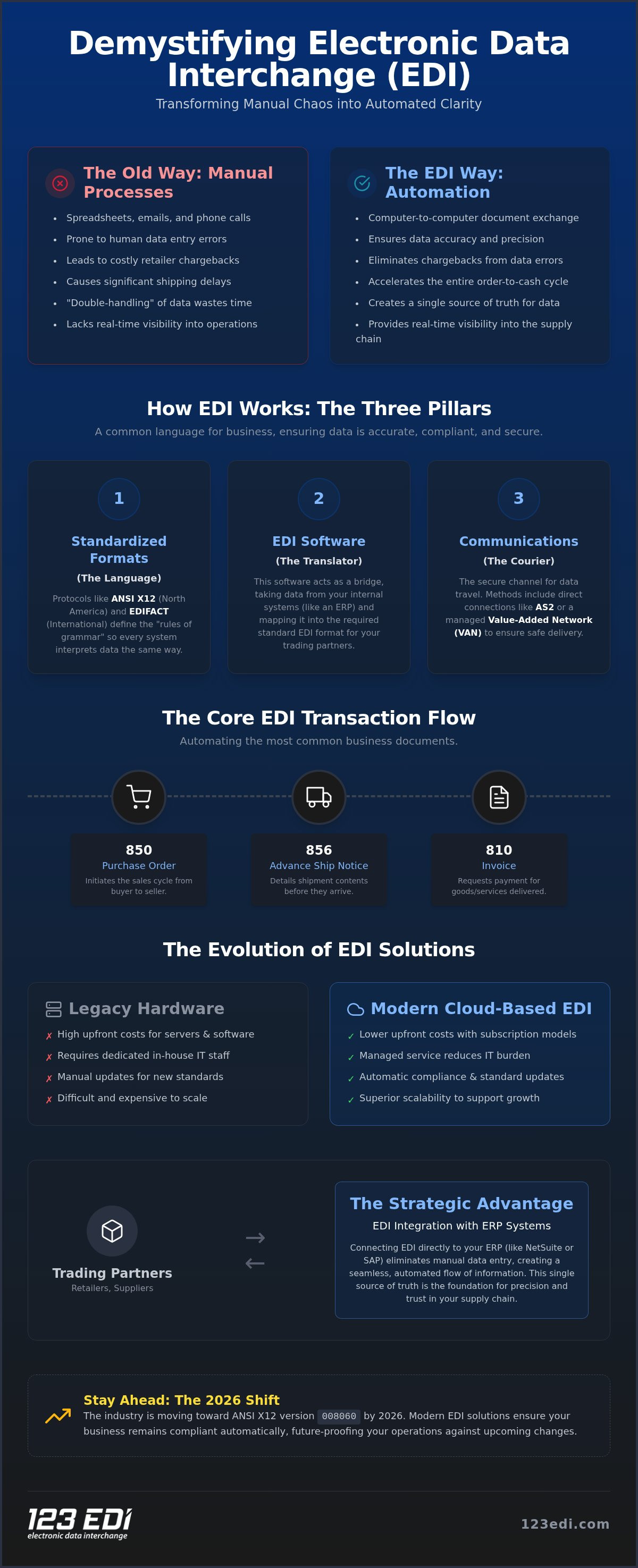
At its simplest level, Electronic Data Interchange (EDI) is the computer-to-computer exchange of business documents in a standardized electronic format. While the definition sounds technical, the reality is much more human. It’s about creating a common language so that two different businesses can speak to each other without the friction of manual translation. When asking what is edi, it’s helpful to view it as a digital handshake that ensures every purchase order, invoice, and shipping notice arrives exactly as intended, without a single keystroke from a human operator.
Unlike an email or a PDF, which still requires someone to read and type data into an ERP system, EDI removes the middleman. It creates a direct line between your system and your trading partners, the retailers or suppliers you work with daily. This automation serves as a stabilizing force. It eliminates the “double-handling” of data that leads to costly retailer chargebacks and shipping delays. By removing human intervention, you don’t just move data faster; you move it with a level of precision that manual processes can’t match.
The Evolution from Manual Processes to Digital Automation
EDI began in the 1960s within the military and transportation sectors to track complex logistics. Today, it’s the backbone of global retail. The shift from manual to digital wasn’t just about speed; it was about survival. Manual data entry remains the number one risk factor for supply chain errors. By 2026, the industry has moved beyond compliance-driven EDI, where you only use it because a big-box retailer demands it. Now, it’s efficiency-driven. Smart leaders use it to gain real-time visibility into their stock and cash flow, transforming a technical requirement into a strategic asset. For companies ready to take the next step, learning how to automate business transactions via EDI is the key to turning operational efficiency into a measurable competitive advantage.
Key Components of an EDI System
To understand what is edi in practice, you have to look at the three pillars that hold the system up. These components work in harmony to ensure your data is accurate, compliant, and secure.
- Standardized Formats (The Language): This involves specific protocols like ANSI X12, which is the standard in North America, or EDIFACT, used internationally. These standards ensure that an invoice means the same thing to a domestic supplier as it does to a partner on the other side of the country.
- EDI Software (The Translator): This software takes data from your internal systems and maps it into the required standard format. It’s the bridge that turns your internal record into a compliant business document.
- Communications (The Courier): This is how the data travels. Whether you use a secure direct connection like AS2 or a Value-Added Network (VAN), this layer ensures the data arrives safely and privately.
The Mechanics of EDI: Standards, Protocols, and Transactions
To understand how data moves without friction, we must look at the rules of grammar that govern these exchanges. When exploring what is edi in a technical sense, standards are the foundation. These predefined formats ensure that every system, regardless of the developer, interprets a date or quantity in the exact same way. Without these rules, the computer-to-computer exchange would result in digital gibberish. By following these strict structures, businesses can automate complex processes with total confidence in the data’s integrity.
Within these standards, we use specific edi transactions to handle different business events. The 850 Purchase Order initiates the cycle by detailing the items requested. The 810 Invoice concludes the financial aspect by requesting payment. Among these, the 856 Advance Ship Notice serves as the critical link in modern fulfillment, providing retailers with precise data on what’s inside a shipment before it ever reaches the warehouse dock. This transparency allows for better labor planning and faster shelf stocking, which is why it’s often a non-negotiable requirement for major trading partners.
Common EDI Standards: X12 vs. EDIFACT
While the goal of standardization is universal, the specific “language” used can vary by region. ANSI ASC X12 is the dominant standard in North America, covering everything from healthcare to retail. As of 2026, many industries are transitioning to updated versions like 008060 to handle more complex data fields. Conversely, EDIFACT is the international standard used for global trade and is essential for companies dealing with European or Asian markets. For a comprehensive breakdown of how these frameworks compare and which applies to your specific industry, our definitive guide to EDI standards in 2026 provides the clarity you need. At 123 EDI, we act as a steady hand for our clients, helping bridge the gap between these different standards so that multi-national trade remains seamless and compliant.
Secure Communication Protocols: AS2, SFTP, and FTP
Once a document is formatted correctly, it needs a secure courier to reach its destination. AS2 has become the gold standard for security because it uses encryption and digital certificates to ensure data hasn’t been tampered with. It also provides non-repudiation, which is a digital receipt confirming the partner received the file. While legacy FTP was common in decades past, it lacks the robust security features required for modern B2B file transfers. Choosing the right protocol is a strategic decision that impacts your long-term security posture. For businesses looking to eliminate the burden of managing certificates and routing in-house, AS2 communication software delivered as a managed service can centralize all your EDI communication in a single hub without the overhead of specialized IT staff. You can learn more about these technical choices in our guide on AS2 vs FTP for EDI: Choosing Your Supply Chain Protocol.
If you’re feeling overwhelmed by these technical requirements, our team is here to simplify the landscape. Our Cloud-Based EDI solutions handle the heavy lifting of mapping and protocols so you can focus on growing your partnerships.
Modern EDI Solutions: Cloud-Based vs. Legacy Hardware
In the past, answering what is edi usually meant discussing expensive servers and dedicated IT rooms. Today, the landscape has shifted toward agility. Legacy on-premise hardware is rapidly declining as businesses realize that maintaining internal infrastructure is a distraction from their core mission. Cloud-based EDI has emerged as the standard, offering a scalable environment where the technical heavy lifting is handled by experts. This transition represents more than just a change in technology; it’s a move toward a partnership model where your provider acts as a mentor, guiding you through complex data landscapes with a steady hand.
The Advantages of a Cloud-Based EDI Portal
Managing global trade shouldn’t require a computer science degree. A web-based EDI portal provides immediate visibility for non-technical users, allowing sales and warehouse teams to track orders without needing IT intervention. Because these systems are accessible from any device, you can confirm a shipment or verify an invoice from the warehouse floor or a home office. When your team asks what is edi in the context of daily operations, they’re looking for a tool that makes their jobs easier. User-friendly interfaces mask the underlying complexity, turning a technical requirement into a simple, collaborative workflow. For a deeper look at these advancements, see our Comprehensive Guide to Cloud-Based EDI Solutions in 2026.
Total Cost of Ownership (TCO) Comparison
When comparing legacy systems to cloud models, the financial benefit goes far beyond the initial price tag. Legacy hardware requires constant maintenance, manual security patches, and a specialized team to manage inevitable downtime. In contrast, cloud-based EDI operates on a subscription model that includes automatic updates and professional EDI communications support. According to industry research, cloud solutions can reduce the total cost of ownership by 40% to 60% in the first year compared to legacy systems. This is largely because the provider absorbs the costs of infrastructure and compliance updates. It’s a common misconception that data management is “set and forget.” The reality is that trading partner requirements evolve constantly, and staying current with the latest EDI standards and compliance requirements is essential for avoiding costly chargebacks. Managed cloud services provide the stability needed to adapt to these changes without forcing your internal IT team to become EDI experts overnight.
The Strategic Advantage: EDI Integration with ERP Systems
Moving beyond a standalone portal, the real power of digital transformation lies in connecting your data directly to your core business software. EDI integration with ERP systems like NetSuite, SAP, or QuickBooks creates a seamless flow of information that eliminates the need for human intervention. When businesses ask what is edi in a strategic context, they’re really asking how to remove the “double-handling” of data that leads to errors and delays. By automating this connection, you ensure that inventory levels and financial reports are updated in real time, providing a clear window into your operational health. Effective EDI integration turns a traditional cost center into a strategic asset by accelerating cash flow and enhancing supply chain visibility.
The Workflow: From Purchase Order to ERP
The beauty of an integrated system is its logical, hands-off progression. The process begins when your system receives an EDI 850 Purchase Order from a retailer. Instead of a staff member manually typing this into your sales order module, our EDI software automatically translates and injects the data directly into your ERP. This ensures that the order is captured exactly as the customer intended. Once the order is fulfilled, the system generates the EDI 810 Invoice using the existing ERP data. This ensures perfect consistency between what was shipped and what is billed, which is essential for maintaining healthy partner relationships. Companies looking to fully automate business transactions with EDI find that this end-to-end workflow dramatically reduces order-to-cash cycle times and eliminates the costly penalties associated with manual errors.
Best Practices for Successful Integration
Precision is the cornerstone of a successful integration. Even a minor mapping error can result in significant retailer chargebacks or inventory discrepancies. It’s vital to work with a partner who understands the nuances of your specific ERP and the requirements of your trading partners. We recommend choosing an ERP-agnostic partner who possesses the institutional knowledge to support your business even if you switch software platforms in the future. This flexibility ensures your what is edi strategy remains robust as your company evolves. For a deeper dive into these strategies, read our Mastering EDI Integration with ERP: The Comprehensive 2026 Guide.
If you’re ready to remove the manual burden from your team and scale your operations, explore our options for EDI Integration with ERP Systems. Our team acts as a collaborative partner to ensure your integration is seamless, secure, and built for long-term growth.
Implementing EDI: How to Start Your Digital Transformation
Embarking on a digital transformation journey requires more than just adopting new software; it requires a fundamental shift in how you manage your business relationships. When you’re first investigating what is edi, the technical hurdles can seem high. However, the implementation process is actually an opportunity to bring order to your operations. At 123 EDI, we position ourselves as a stabilizing force for businesses navigating their first implementation. We don’t just provide tools; we offer a collaborative partnership that simplifies complex data landscapes and builds a foundation for long-term trust.
The transition begins by choosing the right model for your current stage of growth. For some, a standalone EDI portal provides the necessary visibility without the complexity of a full system overhaul. For others, full EDI integration with an ERP system is the logical step to eliminate manual data entry entirely. Regardless of the path, the focus remains on creating a reliable, hands-off workflow that satisfies your partners and protects your bottom line.
Defining Your EDI Requirements
Your roadmap starts with a clear assessment of your trading partner mandates. Major retailers such as Walmart, Amazon, and Target have strict compliance requirements that dictate exactly which transaction sets you must use. You’ll need to identify whether they require standard 850 Purchase Orders, 810 Invoices, or more complex documents like the 856 Advance Ship Notice. Additionally, evaluating your expected transaction volume is vital for selecting the correct service tier. Planning for future growth ensures that your EDI system scales alongside your business, preventing the need for a costly migration just as your sales begin to accelerate.
Selecting the Right EDI Provider
In the world of data interchange, industry experience and reliable technical support are far more valuable than the lowest price point. Technical issues in a supply chain can lead to immediate financial penalties, making a provider’s responsiveness a critical factor. With more than 30 years of institutional knowledge since our founding in 1994, we provide the seasoned reliability that growing companies need. Our US-based expertise ensures that you’re never navigating domestic supply chain standards alone. A wise mentor-led approach helps you understand what is edi in the context of your specific industry, turning a technical requirement into a competitive advantage. Partner with 123 EDI for a seamless, mentor-led EDI implementation.
Future-Proofing Your Supply Chain with Modern EDI
The journey to understanding what is edi begins with a simple definition but ends with a complete transformation of how you conduct business. By moving away from manual data entry and embracing standardized, computer-to-computer communication, you protect your company from the risks of human error and retailer chargebacks. We’ve explored how the shift toward cloud-based infrastructure and seamless ERP integration provides the scalability needed to thrive in a complex global market. This transition isn’t just about technical compliance; it’s about building a foundation for sustainable growth.
As you move forward, remember that the technology is only as effective as the support behind it. With 30+ years of EDI integration expertise, we act as a steady hand to guide you through secure AS2 communications and robust cloud-based infrastructure. Whether you need deep integration with NetSuite, SAP, or QuickBooks, our team is dedicated to your long-term success. We invite you to Streamline Your Data Exchange with 123 EDI Solutions and take the first step toward a more efficient, automated future. Your business is ready for the next level of operational clarity, and we’re here to help you achieve it.
Frequently Asked Questions
What is the main purpose of EDI in business?
The primary purpose of Electronic Data Interchange is to enable the computer-to-computer exchange of business documents in a standardized format. By removing human intervention from the process, companies eliminate manual data entry errors and accelerate their supply chain cycles. This automation is essential for meeting the strict compliance mandates of major retailers, as it ensures that purchase orders and invoices are transmitted with total precision and security between trading partners.
Is EDI still used in 2026, or has it been replaced by APIs?
While APIs have gained popularity for real-time data lookups, EDI remains the global backbone for high-volume business transactions in 2026. Major industries like retail and healthcare continue to rely on established standards such as ANSI X12 version 008060 for their reliability and depth. Modern solutions often combine both technologies; however, when businesses ask what is edi in a modern context, they find it’s a mature, secure system that provides the stability necessary for global trade.
What is the difference between EDI and an EDI portal?
EDI refers to the underlying technology and standardized protocols used to exchange data, while an EDI portal is the web-based interface that allows users to interact with that data. A portal is ideal for companies that need visibility into their transactions without managing complex backend infrastructure. It provides a user-friendly way to view purchase orders or send invoices, masking the technical complexity of the underlying data interchange while maintaining full compliance with trading partner requirements.
How much does it cost to implement an EDI system?
The cost of an EDI system depends on several factors, including your transaction volume, the number of trading partners, and whether you choose a standalone portal or full ERP integration. Subscription-based cloud models have made these solutions more accessible by eliminating the need for expensive on-premise hardware. While legacy systems often require significant upfront capital, modern cloud-based EDI allows businesses to scale their costs alongside their growth, providing a more predictable and manageable investment.
What are the most common EDI transaction codes I need to know?
Navigating what is edi requires familiarity with key transaction sets that drive the supply chain. The most common codes include the 850 Purchase Order, which initiates a sale; the 810 Invoice, used for billing; and the 856 Advance Ship Notice, which provides detailed shipping information. Other vital codes include the 997 Functional Acknowledgement, which serves as a digital receipt to confirm that your trading partner successfully received and processed your transmitted document. For a comprehensive breakdown of these codes and how they drive business flow, our essential guide to EDI transactions, codes, and standards provides the complete reference you need.
Can I use EDI with small business software like QuickBooks?
Yes, EDI can be seamlessly integrated with small business software like QuickBooks to automate your accounting workflows. At 123 EDI, we specialize in bridging the gap between standard business software and complex retailer requirements. This integration allows you to sync your orders and invoices automatically, which prevents the need for manual “double-handling” of data. It provides smaller businesses with the same level of operational efficiency and compliance as their larger competitors.
What is AS2 and why do I need it for EDI?
AS2, or Applicability Statement 2, is a secure communication protocol used to transmit EDI data over the internet. It’s the industry gold standard because it uses digital certificates and encryption to protect sensitive information from unauthorized access. You need AS2 because it provides non-repudiation, which is a verifiable electronic receipt that proves your document was delivered. Most major retailers require this protocol to ensure the highest level of security and accountability in their supply chains. For businesses that want to avoid managing certificates and MDN routing in-house, AS2 communication software as a managed service offers a fully centralized solution that keeps you compliant without the technical overhead.
How long does a typical EDI integration project take?
The timeline for an EDI project varies based on the complexity of your requirements and the responsiveness of your trading partners. A standalone EDI portal can often be deployed quickly, while a full ERP integration with systems like NetSuite or SAP typically takes longer to ensure data mapping accuracy. We work as a collaborative partner to guide you through each stage, from initial testing to final go-live, ensuring a steady and reliable transition for your business.