

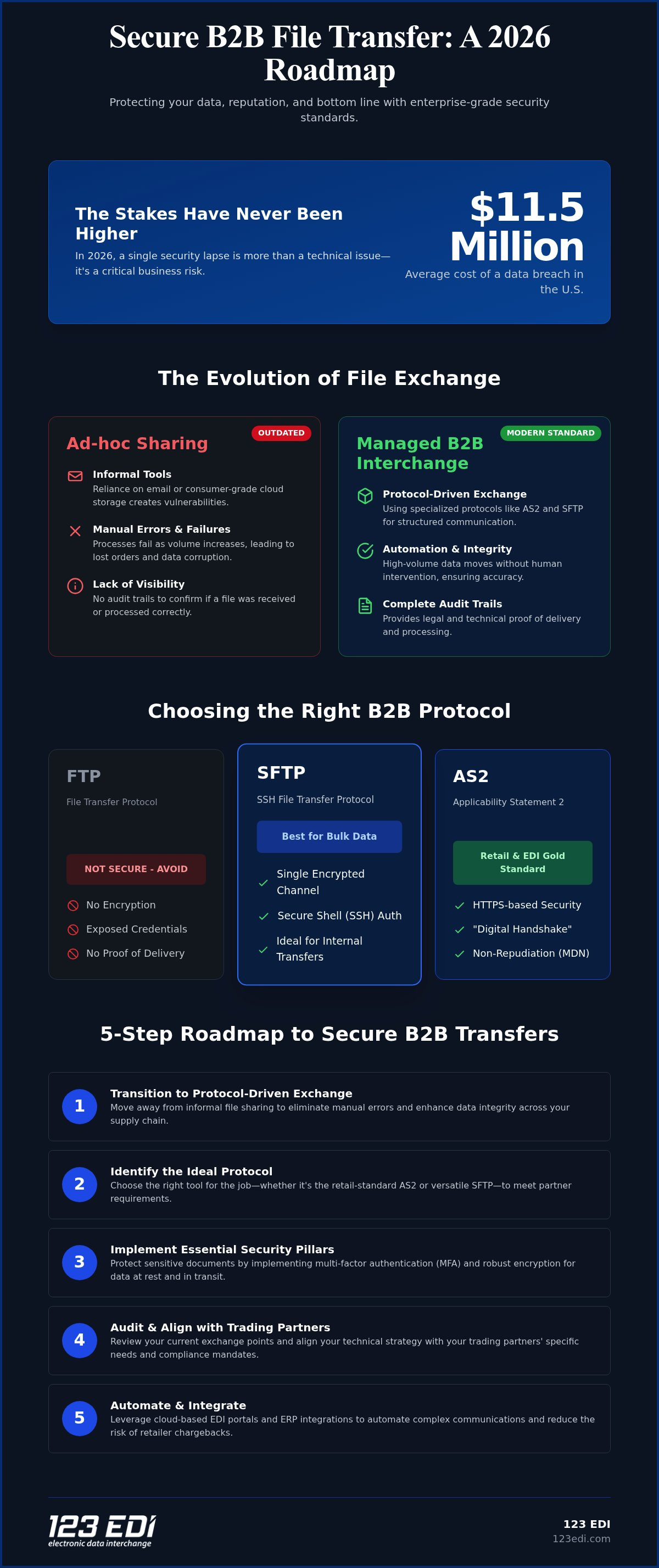
In 2026, the average cost of a data breach in the United States has climbed to a record $11.5 million. For any growing enterprise, a single security lapse during a secure B2B file transfer isn’t just a technical hurdle; it’s a significant risk to your reputation and bottom line. At 123 EDI, we understand the pressure you face to protect sensitive information while meeting the strict demands of your trading partners. It’s common to feel overwhelmed by the technical differences between AS2, SFTP, and FTP, especially when a simple mistake can lead to costly retailer chargebacks or compliance failures.
Our goal is to provide you with a clear path forward. This guide will help you master these exchanges by identifying the right protocols for your needs and implementing enterprise-grade security standards. We’ll explore the mandatory requirements of PCI DSS 4.0, discuss the latest updates to the AS2 protocol, and show you how to automate your communications. By the end, you’ll have a reliable roadmap to simplify your data management and build lasting trust with every partner in your supply chain.
Key Takeaways
- Transition from informal file sharing to a protocol-driven approach to eliminate manual errors and enhance data integrity across your supply chain.
- Identify the ideal protocol for your business, whether that involves the retail-standard AS2 or versatile SFTP, to ensure a secure B2B file transfer every time.
- Protect your sensitive documents by implementing multi-factor authentication and robust encryption for data both at rest and in transit.
- Follow a clear five-step roadmap to audit your current exchange points and align your technical strategy with your trading partners’ specific needs.
- Leverage cloud-based EDI portals and ERP integrations to automate complex communications and reduce the risk of costly retailer chargebacks.
What is Secure B2B File Transfer and Why Does It Matter in 2026?
Secure B2B file transfer refers to the protocol-driven exchange of business documents between organizations using advanced encryption and authentication. It’s a far cry from the days of simple file sharing. In 2026, protecting your enterprise data requires a sophisticated approach that ensures every transaction is verified and encrypted at every stage. This isn’t just about security; it’s about building a digital foundation for trust between trading partners. Relying on outdated methods can leave your business vulnerable to the sophisticated cyber threats that now define the global marketplace.
Ad-hoc Sharing vs. Managed B2B Interchange
Many businesses start their journey by using ad-hoc tools like email or consumer-grade cloud storage. While these services work for a one-time document share, they quickly become a liability for recurring business transactions. Manual processes tend to fail as your trading partner volume increases. When you’re managing dozens of daily purchase orders or invoices, a password-protected link simply doesn’t provide the oversight needed to prevent errors. Without a structured interchange, you lose visibility into whether a file was actually received or processed in a timely manner.
Managed B2B interchange provides the audit trails and automated acknowledgments that modern supply chains demand. By utilizing specialized methods like the SSH File Transfer Protocol (SFTP) or AS2, companies can ensure that high-volume data moves without human intervention. This shift from manual to automated exchange is what allows businesses to scale without increasing their administrative burden. At 123 EDI, we help our partners move toward these structured systems to ensure long-term stability.
The High Cost of Insecure Data Exchange
The financial risks associated with insecure transfers have never been higher. With the average cost of a data breach in the United States reaching $11.5 million in 2026, the stakes for your infrastructure are immense. Beyond the immediate threat of cyberattacks, businesses also face significant operational risks. Data corruption or a failed transfer can lead to lost orders and cascading supply chain disruptions. If your data isn’t moving reliably, your entire production schedule could grind to a halt.
Retailer chargebacks represent another hidden cost that can impact your bottom line. Major partners often impose strict penalties for non-compliant data transfers. If your documents don’t arrive in the correct format or through the required secure channel, you may find your margins eroded by administrative fines. Protecting your reputation with Tier-1 trading partners requires a commitment to excellence in your secure B2B file transfer strategy. We believe that a steady hand in data management is the best way to remove the stress of these intricate technical requirements.
Comparing Key B2B Protocols: AS2, SFTP, and Beyond
Selecting the right protocol is the first step in establishing a robust secure B2B file transfer environment. While the technical names can feel like an alphabet soup, each serves a distinct purpose in the 2026 landscape. Traditional FTP is no longer an acceptable choice for business transactions. It lacks the basic encryption necessary to protect data in transit, leaving your credentials and sensitive documents exposed to anyone on the network. Modern standards have moved toward systems that ensure non-repudiation. This provides the legal and technical proof that a file was sent by the specific sender and received by the intended recipient without any alteration during the journey.
Why AS2 is the Preferred Choice for EDI
AS2 (Applicability Statement 2) has become the gold standard for the retail and consumer goods industries. It creates a “Digital Handshake” that allows two servers to communicate in real time over the internet using HTTPS. One of its most powerful features is the Message Disposition Notification (MDN). This electronic receipt confirms that the partner received the data and that the decryption was successful. It eliminates the disputes that can occur when a file goes missing. If you’re weighing your options, you might find our detailed comparison of AS2 vs FTP for EDI: Choosing Your Supply Chain Protocol helpful for mapping out your specific supply chain needs.
SFTP and FTPS: When to Use Them
While AS2 is transaction-focused, SFTP is often the workhorse for bulk data movements and internal server-to-server transfers. It relies on the official SFTP protocol architecture based on Secure Shell (SSH) to provide a single, encrypted channel for both commands and data. This makes it a robust choice for legacy systems that need to move large volumes of files securely without the overhead of AS2. However, SFTP lacks the built-in non-repudiation receipts that AS2 provides, which is why retailers often prefer the latter for purchase orders and invoices.
FTPS (FTP over SSL) is another option, often favored in financial sectors. It uses certificate-based authentication to verify the identity of the server and the client. Choosing the right protocol depends entirely on your trading partner’s requirements and your own internal infrastructure. Most Tier-1 retailers will mandate AS2 because of its high reliability and specialized tracking. If you feel stuck between these technical standards, our team at 123 EDI can help you implement EDI communications that bridge the gap between your internal systems and your partners’ requirements. We aim to act as a steady hand, ensuring your data moves with precision and speed.
The Essential Pillars of B2B Data Security
Establishing a secure B2B file transfer environment requires a multi-layered approach that goes far beyond simple password protection. It involves a holistic strategy to protect data at rest on your servers and in transit across the internet. Encryption acts as the primary shield, but identity verification ensures that only authorized entities hold the keys. Digital certificates play a vital role in this process, acting as electronic passports that verify your trading partners’ identities before a single byte of data is exchanged.
Beyond encryption, granular access controls within a B2B portal allow you to define exactly which users can view or transmit specific documents. When you combine these permissions with multi-factor authentication (MFA), you create a formidable barrier against unauthorized access. If a dispute ever arises regarding a shipment or an invoice, a tamper-proof audit trail provides the definitive record needed for a quick resolution. These logs aren’t just a technical requirement; they’re a business asset that ensures transparency and accountability across your entire supply chain.
Advanced Encryption Standards (AES) and TLS
In 2026, AES-256 remains the industry benchmark for protecting sensitive documents at rest. It’s the standard we rely on to ensure that even if data is intercepted, it remains unreadable to anyone without the proper authorization. For communication channels, TLS 1.3 is the baseline necessity for maintaining secure connections. While these technical measures are incredibly powerful, it’s easy to fall for common misconceptions about how they function. We recommend exploring our detailed guide on 5 Dangerous Myths About Secure EDI Communications Debunked to better understand the realities of modern data protection.
Compliance Frameworks: SOC 2, HIPAA, and GDPR
Meeting global standards like GDPR or SOC 2 Type II is a fundamental requirement for any enterprise-grade secure B2B file transfer strategy. These frameworks provide a roadmap for maintaining data integrity and protecting privacy. For those in the healthcare sector, HIPAA requirements add a layer of complexity that demands specialized oversight. Similarly, retailers must navigate the mandatory requirements of PCI DSS 4.0 for any data related to payments. Choosing a partner that understands these intricate global standards is essential. At 123 EDI, we act as a seasoned mentor, helping you navigate these regulations so you can focus on growing your business with confidence.
5 Steps to Implementing a Secure B2B Transfer Strategy
Moving from manual file sharing to a structured environment requires a methodical approach. It’s not just about installing software; it’s about creating a reliable pipeline that supports your business growth. By following a clear roadmap, you can eliminate the guesswork and ensure your data exchange meets the highest industry standards. We view this process as a collaborative journey where technical precision meets operational efficiency. Establishing a secure B2B file transfer strategy involves these five essential steps:
- Audit current exchange points: Identify every manual email, shared folder, or legacy server currently used to move business data. Spotting these vulnerabilities is the first step toward a more stable system.
- Define partner requirements: Every trading partner has specific needs regarding protocols like AS2 or SFTP, file standards, and the frequency of transmissions.
- Select your platform: Determine whether on-premise EDI software or a scalable cloud-based EDI solution fits your internal capabilities and long-term goals.
- Exchange digital certificates: Secure the connection by exchanging public keys with your partners. This establishes the “Digital Handshake” we discussed earlier.
- Automate through integration: Connect your transfer system to your internal business logic to ensure data flows without human intervention.
Assessing Your Technical Infrastructure
Before you commit to a specific path, you must evaluate your team’s ability to maintain the necessary infrastructure. Managing your own AS2 servers requires significant IT oversight and a budget for constant security updates. For many organizations, a cloud provider offers a more attractive balance of scalability and reliability. This approach removes the burden of server maintenance while ensuring your system remains compliant with the latest 2026 encryption standards. Evaluating these factors early prevents technical debt and ensures your infrastructure can grow alongside your partner list.
The Importance of ERP Integration
A truly effective secure B2B file transfer strategy shouldn’t exist in a vacuum. If you’re still manually typing data from a secure portal into your accounting software, you haven’t fully removed the risk of error. Connecting your transfers directly to platforms like NetSuite, SAP, or QuickBooks creates a seamless flow of information. This integration reduces manual entry and accelerates your order-to-cash cycle. To dive deeper into this process, we recommend reading our Mastering EDI Integration with ERP: The Comprehensive 2026 Guide. If you’re ready to modernize your workflow, our team at 123 EDI can help you implement EDI integration with ERP systems tailored to your specific business needs.
Streamlining Operations with 123 EDI Secure Solutions
Implementing the protocols and security measures we’ve discussed is a significant step toward enterprise-grade stability. However, the true value lies in how these technologies integrate into your daily business life. At 123 EDI, we specialize in simplifying the complexities of AS2 and EDI communications so you can focus on what you do best. Our approach moves beyond just providing a secure B2B file transfer; we focus on the entire business workflow. By automating the exchange of documents, we help you reduce the risk of manual data entry errors and the subsequent retailer chargebacks that can erode your margins.
Our web-based EDI portal serves as a stabilizing force for your operations. It provides a clear, organized view of all your trading partner interactions, making it easy to manage diverse requirements from a single location. This transparency builds a foundation of long-term trust, both within your organization and with your external partners. We believe that a successful data strategy should be invisible, working quietly in the background to accelerate your results and remove the stress of intricate data management.
Cloud-Based EDI: Security Without the Overhead
In 2026, the shift toward cloud-native platforms has become a standard for businesses looking to remain agile and secure. Our Cloud-Based EDI solutions remove the burden of local server maintenance, allowing your IT team to stay focused on strategic goals. We provide a resilient infrastructure that includes automatic security patching and ensures 24/7 availability for your critical transactions. This means you don’t have to worry about downtime or outdated encryption standards. Our scalable pricing models are designed to support your growth, providing a professional depth of service that fits businesses of all sizes.
Your Partner in Supply Chain Success
With a history as an industry veteran since 1994, 123 EDI offers more than just software. We position ourselves as a wise mentor and a trusted consultant, bringing over 30 years of institutional knowledge to every engagement. We understand that every business has a unique roadmap, which is why our expert integration support is tailored to your specific ERP system. Whether you are connecting to NetSuite, SAP, or QuickBooks, we ensure your secure B2B file transfer strategy is fully aligned with your internal logic. This collaborative partnership is what sets us apart from detached technology providers. We invite you to contact us for a personalized secure transfer audit, where we can help you identify a path toward greater clarity and efficiency in your data exchange.
Building Your Foundation for Digital Trust in 2026
Mastering the technical landscape of data exchange is no longer just an IT requirement; it’s a strategic necessity for business growth. By moving away from ad-hoc file sharing and adopting protocol-driven automation, you protect your organization from the rising costs of data breaches. Implementing a robust secure B2B file transfer strategy ensures your data moves with precision. This movement is backed by the reliability of SOC 2 compliant cloud infrastructure and the “Digital Handshake” of the AS2 protocol.
At 123 EDI, we’ve served as industry veterans since 1994. We provide the institutional knowledge needed to simplify complex integrations and act as your collaborative partner. Our team connects secure communications directly to your ERP system, providing national support for ERP-integrated EDI to ensure your operations remain fluid. If you’re ready to remove the stress of intricate data management, we’re here to help. We invite you to Schedule a Secure B2B Transfer Consultation with 123 EDI. Let’s work together to secure your supply chain’s future.
Frequently Asked Questions
What is the most secure protocol for B2B file transfer?
AS2 is widely considered the gold standard for secure B2B file transfer in the retail and supply chain sectors. It uses digital certificates and encryption to ensure that only the intended recipient can read the data. Unlike basic protocols, it includes a “Digital Handshake” that provides real-time confirmation of receipt. This level of verification is essential for businesses that need to maintain high compliance standards and avoid costly disputes with their trading partners.
Is SFTP secure enough for EDI compliance in 2026?
SFTP remains a robust and secure option for many EDI applications in 2026, especially for bulk data movements. It uses Secure Shell (SSH) to encrypt both the commands and the data being transferred, which prevents eavesdropping. While it’s highly secure, it doesn’t offer the built-in non-repudiation receipts that come with AS2. Many organizations use it successfully for internal transfers or with partners who don’t require the specific tracking features that major retailers often demand.
What is the difference between AS2 and SFTP?
The primary difference lies in how these protocols handle verification and communication. AS2 is designed specifically for EDI and provides an electronic receipt called an MDN to confirm successful delivery and decryption. SFTP is a more general-purpose protocol that focuses on securing the transmission channel itself. While both use strong encryption, AS2 is often mandated by major retailers because it offers superior tracking and legally binding proof of receipt for every individual transaction.
Do I need a dedicated server for secure B2B file transfer?
You don’t necessarily need your own physical hardware to manage these transfers effectively. While some enterprises choose to maintain on-premise servers, many businesses now prefer cloud-based EDI solutions. These platforms provide the same level of security without the high costs of hardware maintenance or manual patching. Using a cloud provider like 123 EDI allows you to scale your operations quickly while ensuring your infrastructure meets the latest 2026 security benchmarks and encryption standards.
How does encryption protect my B2B data during transit?
Encryption protects your data by scrambling the information into an unreadable format using complex mathematical algorithms. In 2026, standards like TLS 1.3 ensure that even if a cybercriminal intercepts the transmission, they can’t access the actual content without the unique decryption key. This process creates a secure tunnel between you and your trading partner, maintaining the confidentiality and integrity of sensitive documents like purchase orders, invoices, and shipping notices during the exchange.
Can secure file transfer be automated with my ERP system?
Yes, automation is a core benefit of modern secure B2B file transfer environments. By integrating your protocol directly with your ERP system, you can eliminate the need for manual data entry. This connection allows documents to flow seamlessly from your partner’s server into your accounting or management software. 123 EDI specializes in these integrations, helping you connect with platforms like NetSuite, SAP, or QuickBooks to improve your overall operational efficiency and accuracy.
What is non-repudiation in B2B data exchange?
Non-repudiation is a security principle that ensures a sender cannot deny sending a message and a recipient cannot deny receiving it. In a secure B2B data exchange, this is achieved through digital signatures and timestamped receipts. It provides the technical and legal proof needed to resolve disputes in the supply chain. If a partner claims they never received a critical invoice, your system’s non-repudiation logs serve as the definitive, tamper-proof record of that specific transaction.
Why is email considered insecure for B2B file transfers?
Email is inherently insecure because it often transmits data in plain text across multiple servers before reaching its destination. It lacks the end-to-end encryption and strict authentication required for modern compliance. Additionally, email doesn’t provide a reliable audit trail or automated acknowledgments. Relying on it for sensitive documents increases the risk of data breaches and human error, which is why professional organizations insist on using dedicated, protocol-driven methods like AS2 or SFTP instead.