

What if the software license is the least expensive part of running EDI in-house? The hidden costs of in-house EDI often sit outside the IT budget: staff time spent maintaining integrations, knowledge lost when specialists leave, chargebacks caused by compliance errors, and delays onboarding new trading partners.
It’s understandable to favor an internal system when the software appears manageable and your team already knows how it works. But that view can miss the ongoing work required to keep transactions accurate, connections reliable, and partner requirements up to date. When experienced staff move on, the cost can show up as operational disruption as well as recruitment and training time.
This 2026 Total Cost of Ownership analysis offers a practical framework for comparing the full internal burden with an outsourced approach. You’ll learn which expenses to include, how to account for risks that rarely appear on a software invoice, and how to present the business case clearly to stakeholders. We’ll also examine how cloud-based EDI and ERP integration can reduce internal overhead and make monthly costs more predictable.
Key Takeaways
- Look beyond software and hardware to uncover the hidden costs of in-house EDI, including staff time, maintenance, and operational risk.
- Assess how partner-specific mappings and infrastructure upkeep affect the resources your team needs to keep EDI running.
- Identify where compliance errors could lead to retailer chargebacks, and include that exposure in your cost review.
- Use a step-by-step Total Cost of Ownership framework to bring direct and less-visible expenses into one comparison for stakeholders.
- Explore how cloud-based EDI and ERP integration could reduce internal workload and make costs more predictable.
Beyond the License Fee: Why In-House EDI Often Overspends
An EDI license is visible, easy to budget for, and rarely the whole story. The hidden costs of in-house EDI are the ongoing expenses and business impacts required to keep transactions flowing: staff time, partner-specific configuration, infrastructure upkeep, troubleshooting, and the risk of errors or disruption.
Think of the license as the visible tip of an iceberg, not a reliable measure of total cost. There’s no universal rule that it represents exactly 20% of expenditure. The proportion varies by system, transaction volume, partner requirements, and how much internal support is needed. A sound comparison counts the work and resources behind the software, not just the purchase price.
The Illusion of In-House Control
Internal ownership can offer direct access to system decisions. But that control also means your team is responsible for maintaining mappings, communications, and connections as trading-partner requirements change. Electronic Data Interchange (EDI) relies on structured business documents and standards; operating it well takes focused expertise. As this guide to what EDI is explains, EDI involves more than sending files from one system to another.
And internal staff aren’t free simply because they’re already on payroll. Count the hours they spend on EDI support, maintenance, partner onboarding, and troubleshooting, along with the time required to train replacements when experienced employees leave. The work still has a cost, even if it doesn’t appear as a separate vendor invoice.
Opportunity Cost: What Your IT Team Isn’t Doing
Opportunity cost is the value of work your team could have advanced if its time weren’t assigned elsewhere. For an enterprise IT department, EDI maintenance may displace ERP improvements, security work, or product development. Track the hours spent on recurring EDI tasks, then identify which planned initiatives are delayed or receive fewer resources as a result.
Technical debt adds another layer. Temporary fixes and undocumented integrations can make each future change more difficult, slowing responses to new business needs. That burden can grow when system knowledge is concentrated in a small number of employees.
Reframe the Cost Decision
In 2026, assess the choice between capital expenditure (CAPEX) and operating expenditure (OPEX) as a planning decision, not a guaranteed savings claim. Compare owned software and infrastructure with the recurring costs and scope of a cloud-based option, including internal labor and transition considerations. 123 EDI offers cloud-based EDI, ERP integration, EDI communications, and AS2. With institutional experience dating to 1994, it can serve as a knowledgeable partner as businesses evaluate a more stable operating model.
The Technical Maintenance Tax: Maps, Protocols, and Infrastructure
EDI maintenance isn’t a one-time implementation task. Each trading partner can have distinct document requirements, validation rules, and connection settings. When a retailer changes a specification or your business adds a partner, the corresponding maps and workflows may need updates, testing, and troubleshooting. That recurring work is easy to underestimate if you budget only for the original setup.
Mapping Maintenance and Partner Onboarding
A “set it and forget it” approach is risky because a map that works for one partner may not meet another’s requirements. Onboarding can involve configuring document flows, testing sample transactions, resolving errors, and confirming that data reaches the right business system. Track staff hours for each change and onboarding effort to see how this work accumulates across the year.
A managed hub can centralize connections and communications, helping reduce the need to maintain separate processes internally. Learn how a managed hub centralizes EDI communication and consider whether that model fits your partner network.
Infrastructure and Protocol Responsibilities
Running EDI internally also means accounting for the environment that supports it. Include server and network resources, monitoring, software updates, backup storage, recovery planning, and the staff time needed to test restoration procedures. These aren’t only purchase costs; they require ongoing attention and clear ownership.
Secure AS2 connections add their own configuration and operational considerations, including certificates, communication settings, and troubleshooting failed exchanges. For a closer look at the protocol, review secure AS2 data transfer. Data handling also deserves governance: ISACA’s discussion of regulatory and compliance risks highlights why organizations should consider retention and access practices alongside system upkeep.
The Human Factor: Training and Turnover
In 2026, specialized EDI knowledge can be difficult to replace. ZipRecruiter reported a U.S. average annual salary of $76,849 for an EDI Specialist on September 21, 2026; this is a specialist benchmark, not a complete measure of hiring or retention costs. Recruitment, onboarding, and the time required to learn a legacy setup add to the total.
There’s also the single point of failure: one employee may hold undocumented knowledge about maps, partner quirks, and past fixes. If that person leaves, the business inherits a knowledge gap just as transactions still need attention. Document processes and include cross-training in your cost review. Alternatively, compare internal responsibilities with 123 EDI’s cloud-based EDI and AS2 options to assess whether a managed approach could make operations less dependent on individual staff members.
Regulatory and Compliance Risks: The High Cost of Errors
EDI errors can turn into more than a correction task. A missing or inaccurate transaction may disrupt order fulfillment, require manual follow-up, or trigger a retailer chargeback. The financial impact depends on the partner’s rules and the transaction involved, but penalties can become substantial when high-value orders or repeated errors are affected. Include chargebacks and the staff time spent investigating disputes in your TCO, rather than treating them as isolated exceptions.
The Chargeback Trap: A Case for Automation
Common trouble spots include inaccurate invoice details, missing or late transaction documents, and data that doesn’t match a purchase order. Retailer requirements vary, so teams need to validate each partner’s rules and monitor acknowledgments and exceptions. Manual correction adds another cost: an employee must identify the mismatch, update records, resend the transaction, and confirm the fix.
Automating transaction flows can reduce repetitive handling and help catch inconsistencies earlier, though it can’t eliminate every compliance risk. Consider how you could automate business transactions with EDI as part of a broader effort to reduce preventable errors, not as a guarantee against chargebacks.
Standards, Security, and Audit Readiness
Maintaining compliance also takes ongoing attention to the formats and requirements your trading partners use, including applicable X12 or EDIFACT standards. A change can require map updates, testing, and review of downstream system behavior. In-house teams may respond quickly when expertise and capacity are available, but that work still competes with other priorities.
Security brings its own operational responsibilities. For AS2 connections, teams must manage certificates and encryption keys, track renewal dates, and ensure configurations remain current. Compare AS2 versus FTP for EDI in light of your trading partners’ requirements and your organization’s security practices. An unpatched system or poorly controlled credentials can increase exposure; the potential impact of an incident includes investigation, recovery, and business disruption, though costs depend on the circumstances.
Compliance obligations also depend on the data and standards that apply to your business. If HIPAA or SOC 2 requirements are relevant, account for the people, processes, and infrastructure needed to support them rather than assuming the EDI server alone determines compliance. Maintain accessible transaction records, timestamps, acknowledgments, and error histories. When a dispute arises, clear audit trails can help staff reconstruct what happened; manual reporting across separate systems can slow that work.
These are among the hidden costs of in-house EDI: not only the penalty itself, but also the effort required to prevent errors, manage security responsibilities, and document a defensible response.
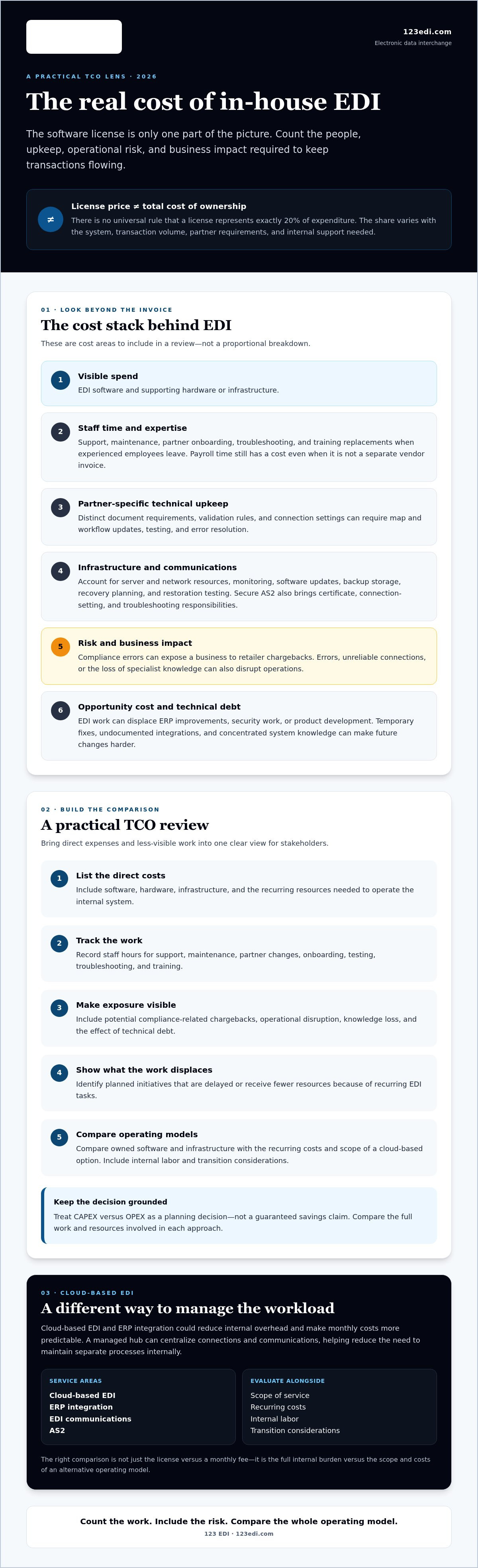
Calculating Your Total Cost of Ownership (TCO)
Total Cost of Ownership (TCO) is the sum of all direct and indirect lifecycle costs of a technology asset. For EDI, the goal is to compare the full cost of operating your current system with a managed cloud option, not to assume one model is always cheaper.
Build the comparison from your own records and a written provider quote. Use the same transaction volume, trading partners, and three-year period for both options. Then follow these steps:
- Gather direct costs: Record software, infrastructure, and dedicated personnel expenses, including benefits and time spent on EDI work.
- Add ongoing operating costs: Include maintenance, updates, backups, recovery planning, and communications.
- Estimate indirect costs: Review downtime, chargebacks, manual corrections, and the staff hours required to onboard partners.
- Account for strategic impact: Note delayed initiatives, slower market entry, and IT capacity diverted from other priorities.
- Compare over three years: Separate one-time transition costs from recurring costs, then calculate each option’s cumulative total.
Build a Three-Year, Line-by-Line Comparison
Use a worksheet like this with finance, IT, and operations. Enter actual internal figures and the provider’s quoted scope; leave uncertain items flagged for validation rather than filling gaps with assumptions.
| Cost category | In-house EDI | Managed cloud EDI |
|---|---|---|
| Software and infrastructure | Licenses, servers, storage, backups, and recovery resources | Quoted cloud EDI fees and any infrastructure retained internally |
| People and maintenance | EDI staff time, training, updates, troubleshooting, and turnover | Internal oversight plus provider fees and responsibilities stated in the quote |
| Partner operations | Mapping, testing, onboarding, and communications effort | Quoted partner scope, onboarding terms, and any work retained by your team |
| ERP integration | Build and maintenance effort for connections to business systems | Quoted EDI integration with ERP scope and related internal effort |
| Risk and opportunity | Documented disruption, correction, chargeback, and delayed-project impacts | Remaining internal exposure and transition-related impacts |
To estimate a break-even point, compare cumulative totals period by period. Outsourcing reaches break-even when the costs avoided or released from the in-house model equal the managed option’s fees and transition costs. The result depends on your baseline, contract, and actual workload.
Test the Model Against Growth
Each new trading partner can add mapping, testing, and communication work in-house, so costs may rise with volume or complexity. Cloud pricing structures vary; verify whether the quote is flat-fee, partner-based, transaction-based, or a combination. Recalculate the comparison as partners and transaction volumes change. To assess your requirements, request a review of your EDI and ERP integration needs.
Transitioning to a Managed Cloud EDI Strategy with 123 EDI
Moving EDI out of an internal environment doesn’t have to mean giving up visibility. A well-planned transition starts with understanding how transactions flow today, which trading partners and ERP connections are involved, and what your team needs to monitor after migration. 123 EDI approaches this work as a collaborative partner, helping businesses assess their requirements and consider a path forward based on their systems and workflows.
With more than 30 years of institutional experience, 123 EDI provides cloud-based EDI, EDI portals, communications, AS2, and integration with ERP systems. Read this guide to cloud-based EDI solutions to understand the model and the questions to consider before changing platforms.
Plan the Transition Around Your ERP and Partners
Start by documenting current transaction types, partner requirements, maps, communication methods, exception workflows, and dependencies on systems such as NetSuite or SAP. Then agree on responsibilities, testing criteria, and a rollout sequence with your EDI partner. This inventory helps preserve operational oversight and reduces the chance that an important workflow is overlooked during migration.
ERP integration is central to the design. The aim is to connect EDI transactions with the business systems that use them, so teams can evaluate where data should enter or leave the ERP and how exceptions will be handled. Onboarding timelines depend on partner requirements, testing, and readiness, so establish realistic milestones rather than assuming every connection can move from weeks to days.
Keep Visibility While Reducing Internal Burden
A cloud-based model can change who maintains the EDI environment, but your organization still needs clear access to transaction status, exception handling, and partner communications. Define what your team will monitor through the EDI portal, which issues need escalation, and how responsibilities are shared. This creates a more stable operating model without leaving staff unsure about what happens to an order or invoice.
As you assess the hidden costs of in-house EDI, gather software and infrastructure expenses, staff hours, onboarding work, and the costs of disruptions or corrections. Use that baseline to frame a practical discussion about scope, integration, migration steps, and ongoing oversight. A dependable partner should explain the process clearly and help your team make informed decisions, not ask you to surrender visibility.
Take the Next Step
Prepare a current-state inventory and your TCO worksheet, then discuss your EDI and ERP requirements with 123 EDI’s team. A focused conversation can help clarify what a transition may involve and which responsibilities would remain with your organization.
Make Your EDI Costs Clearer and More Predictable
The hidden costs of in-house EDI are easier to evaluate when your TCO includes more than the software invoice. Staff time, ongoing technical upkeep, compliance exposure, and delayed projects all shape the real cost of keeping EDI internal. A consistent three-year comparison can help stakeholders weigh those expenses against the scope and recurring costs of a managed cloud approach.
The right decision depends on your trading partners, transaction needs, ERP environment, and internal capacity. But it should be based on the full operating picture, not assumptions that in-house resources are cost-free or that outsourcing is automatically less expensive.
With more than 30 years of B2B integration expertise, 123 EDI brings a collaborative, human-centric approach to complex data management, including integration with major ERP systems. If you’re ready to assess your options, discover the true value of managed EDI with a 123 EDI consultation.
A clearer cost picture is a practical first step toward a more stable EDI strategy. With the right information and an experienced partner, your team can move forward with confidence.
Frequently Asked Questions
What is the most significant hidden cost of in-house EDI?
For many organizations, the largest hidden cost is the cumulative staff time needed to maintain maps, resolve errors, onboard partners, and keep connections working. Its impact depends on transaction volume, partner requirements, and system complexity. That time also has an opportunity cost: employees handling EDI can’t spend those hours on other IT priorities. Include labor, turnover risk, and delayed work when calculating the hidden costs of in-house EDI.
How much does it cost to hire a dedicated EDI coordinator in 2026?
ZipRecruiter reported a U.S. average annual salary of $76,849 for an EDI Specialist on September 21, 2026, with a typical range of $63,000 to $88,500. Salary.com reported a higher average of $96,809 on September 1, 2026. These estimates differ by source and methodology. They also don’t represent total employment cost, which may include benefits, recruiting, training, and coverage during turnover.
Can we keep our existing ERP if we switch to a managed EDI provider?
Usually, a change in EDI provider doesn’t automatically require replacing your ERP. The important question is whether the provider can support integration with your specific ERP, workflows, and trading-partner requirements. Before deciding, document how transactions move between systems, what data is mapped, and how exceptions are handled. 123 EDI provides EDI integration with ERP systems, including NetSuite, SAP, and QuickBooks; confirm the proposed scope for your environment.
What are retailer chargebacks and how do they impact EDI ROI?
Retailer chargebacks are financial penalties a retailer may apply when a supplier doesn’t meet specified requirements, such as sending accurate documents on time. EDI formatting or data errors can contribute, depending on the retailer’s rules. To understand their effect on ROI, review chargeback records alongside correction labor, delayed transactions, and the cost of prevention. Don’t assume automation eliminates penalties; assess how it may reduce avoidable errors and manual rework.
Is cloud-based EDI more secure than an in-house server?
Not automatically. Security depends on how each environment is configured, maintained, monitored, and governed. With an in-house server, your organization is responsible for activities such as patching, access management, backups, and AS2 certificate handling. For a cloud provider, ask about security controls, data access, incident processes, and responsibilities in the service agreement. Compare documented practices against your company’s requirements rather than assuming either model is inherently safer.
How long does it typically take to migrate from in-house to cloud EDI?
There isn’t one reliable timeline for every migration. Duration depends on the number of trading partners, transaction types, existing maps, ERP connections, testing needs, and the availability of documentation. Begin with an inventory of current workflows and agree on a phased plan with clear testing and cutover criteria. Ask the provider to estimate milestones after reviewing your setup, and avoid scheduling a switch before critical transactions have been validated.
Do I lose control over my data mapping with a managed service?
Not necessarily. A managed arrangement changes who performs some EDI work, but your business can still define partner requirements, review transaction flows, and establish approval and visibility expectations. Clarify in writing who maintains maps, how changes are reviewed, what access your team has, and how documentation is retained. These questions help preserve operational oversight while reducing the amount of technical maintenance handled internally.
What happens if my in-house EDI expert leaves the company?
Without clear documentation and cross-training, the business may lose important knowledge about partner-specific maps, connection settings, and past fixes. That can make troubleshooting and onboarding harder while a replacement gets up to speed. Reduce the risk by documenting workflows, keeping configuration records current, and training more than one employee. A managed EDI partner can also provide continuity, but define responsibilities and knowledge-transfer expectations before relying on that arrangement.