

What if you could outsource EDI management without handing over every decision? That distinction matters when internal teams spend valuable time maintaining maps, connections, and partner-specific requirements, while unclear ownership makes transaction issues harder to resolve. Outsourcing can shift defined tasks to an external team, but your business still needs visibility into performance, exceptions, and escalation paths.
The right model depends on what you want to transfer and what you need to retain. This guide explains which responsibilities an outsourced arrangement may cover, the trade-offs of internal, outsourced, and blended approaches, and how to assign ownership so issues reach the right people. You’ll also see how cloud-based EDI, portals, secure communications such as AS2, and ERP integration can support a well-governed operation. Clear boundaries and a suitable integration approach can reduce day-to-day EDI maintenance without leaving your team in the dark about the transactions your business depends on.
Key Takeaways
- Separate EDI software and connectivity from ongoing management, then define which responsibilities belong to your team and which may be handled externally.
- Before you outsource EDI management, map ownership for platform operations, maps, partner changes, transaction monitoring, and issue escalation.
- Compare outsourced, in-house, and blended models by workload, expertise, visibility, scalability, and accountability to find a fit for your organization.
- Build a readiness inventory of transaction flows, ERP connections, documents, maps, communication methods, exceptions, and process owners.
- Use cloud-based EDI, portals, AS2 communications, and ERP integration as technology components that support a clearly governed operating model.
What Does It Mean to Outsource EDI Management?
Buying EDI software gives your team a tool. Outsourcing EDI management means assigning an external provider responsibility for agreed parts of operating that tool and coordinating electronic transactions. The distinction matters: software alone doesn’t determine who maintains maps, responds to rejected documents, or manages partner-specific changes. Those responsibilities depend on the operating model you establish.
Outsourced EDI management is an arrangement in which an external provider handles defined EDI technology and operational tasks. The scope may range from platform and communications support to mapping, partner onboarding, monitoring, and changes. The agreement should identify not only what the provider does, but also what your team approves, monitors, and resolves. Without clear boundaries, routine technical work can become a question of ownership.
EDI connects business systems through structured electronic documents. The Electronic Data Interchange (EDI) overview explains how these exchanges replace paper-based business documents with standardized formats. Outsourcing changes how parts of that exchange are operated. It doesn’t automatically transfer every business decision or responsibility for the information your company sends and receives.
Which EDI responsibilities can an external provider handle?
Depending on the agreed scope, a provider may configure EDI software and communications, translate documents between your business format and a trading partner’s required format, and maintain the maps that define that translation. The scope may also include coordinating partner connections, onboarding and testing, monitoring transactions, or updating processes when partner requirements change.
Your business still owns decisions such as whether an order can be accepted, how fulfillment should proceed, and which policies govern pricing or substitutions. For example, a technical team may identify and route a rejected order document, while your order or customer-service team decides how to address the underlying business issue. Clear escalation rules connect the technical investigation to that business decision.
How does outsourced EDI connect with everyday business systems?
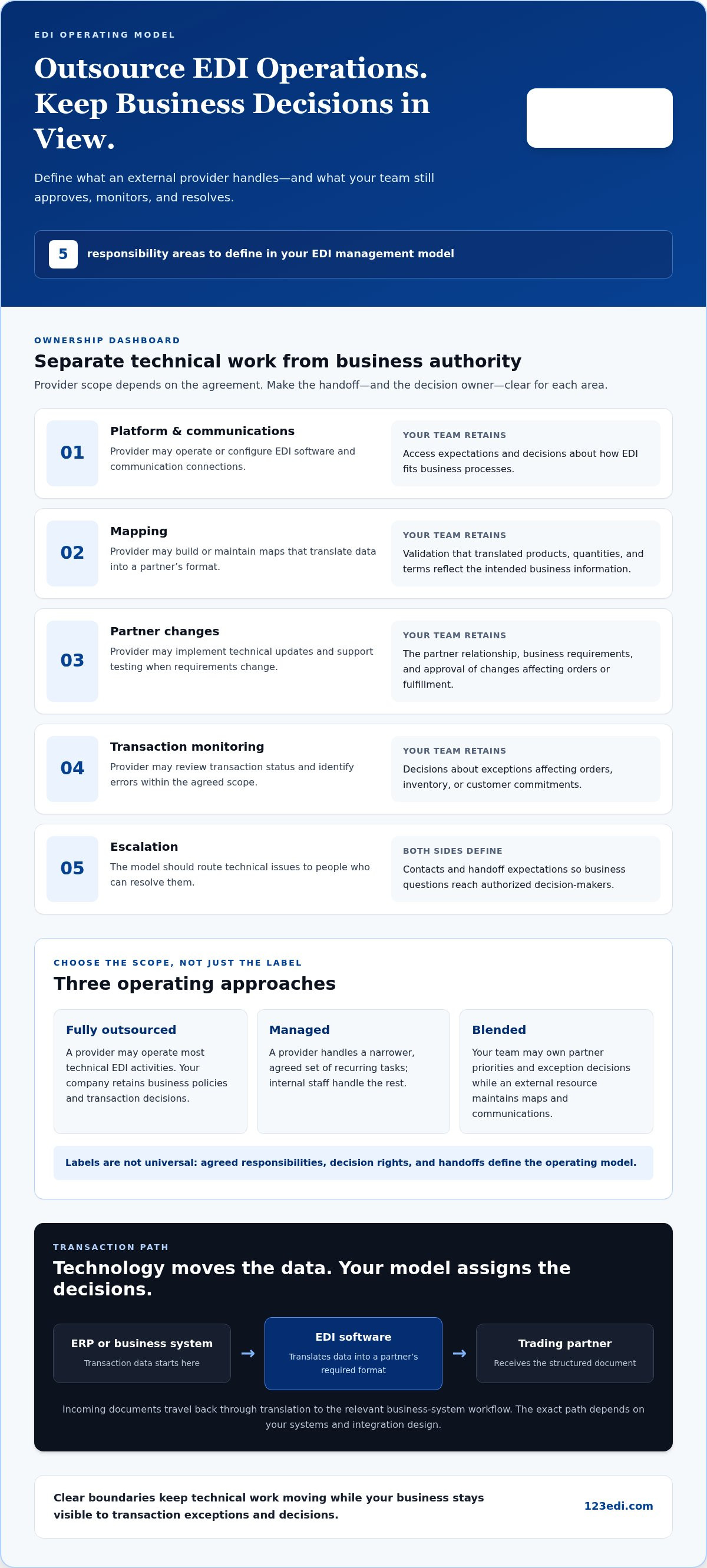
A typical transaction starts in an ERP or another business system. EDI software converts the business data into the structured document and format required by a trading partner, then sends it through an agreed communication method. In the reverse direction, an incoming document is translated and delivered to the business system for the relevant workflow. The exact path depends on your systems and integration design.
A web-based EDI portal can provide a browser-based workflow for users to work with transactions, particularly when a direct connection to an ERP isn’t part of the process. In either approach, decide who can access transaction information and who is responsible for acting on exceptions. For a closer look at how system connections fit together, see this EDI integration with ERP guide. Cloud-based EDI, portals, communications including AS2, and ERP integration can support the technology side of a governed model, while your team retains business ownership.
What Does an EDI Management Model Include?
An EDI management model is the practical division of work behind each transaction: who operates the technology, who checks what happens, and who can make business decisions when something goes wrong. Scope can vary by agreement and partner, so don’t rely on labels such as “managed” or “fully outsourced” to explain who owns a task.
An EDI service label alone does not define operational ownership; the agreed responsibilities, decision rights, and handoffs do. Use those details to establish a model your internal teams and any external provider can follow consistently.
- Platform and communications: An external provider may operate or configure the EDI software and communication connections. Your company sets access expectations and decides how EDI fits into its business processes.
- Mapping: A provider may build or maintain maps that translate business data into a partner’s format. Your subject-matter team validates that the translated information reflects the intended products, quantities, and terms.
- Partner changes: A provider may implement technical updates and support testing when requirements change. Your team owns the partner relationship, confirms business requirements, and approves changes that affect how orders or fulfillment are handled.
- Transaction monitoring: A provider may review transaction status and identify errors within the agreed scope. Your business decides which exceptions affect orders, inventory, or customer commitments and determines the appropriate response.
- Escalation: The model should route technical issues to the people who can resolve them and business questions to the people authorized to decide. Both sides need clear contacts and handoff expectations.
How do fully outsourced, managed, and blended arrangements differ?
In a fully outsourced arrangement, an external provider may operate most technical EDI activities, while your company retains business policies and transaction decisions. A managed arrangement can cover a narrower, agreed set of recurring tasks, with internal staff handling the rest. In a blended model, your team might own partner priorities and exception decisions while an external resource maintains maps and communications. These labels aren’t universal, so document the actual division rather than inferring it from the name.
What should an EDI responsibility matrix document?
Build a matrix that names an owner, an approver, and an escalation contact for each recurring activity. Include who reviews transactions, who authorizes map or partner changes, and who responds when an issue crosses from technical work into business operations. Record how status is shared and what information must accompany each handoff.
Make the matrix reflect the real transaction path. If an order travels from an ERP through EDI translation and communications, identify who can investigate each step and who decides whether the order should proceed. That clarity helps teams outsource EDI management without losing operational visibility or confusing technical resolution with business authority.
Once ownership is defined, cloud-based EDI, portals, communications, and ERP integration can provide technology components for the model. Explore how cloud-based EDI and ERP integration can support a governed workflow.
Outsourced vs. In-House EDI: Can You Keep Control?
Yes. Outsourcing technical EDI work doesn’t have to mean giving up business ownership. Separate execution from authority: an external resource may maintain technology or help investigate transaction issues, while your team retains access to activity, approves business-impacting changes, and decides how orders and customer commitments are handled.
Compare the models by how work and visibility are organized, rather than assuming one is always cheaper or performs better. The right fit depends on your internal capacity, need for technical expertise, transaction environment, and the oversight you want to retain.
| Consideration | In-house | Outsourced |
|---|---|---|
| Internal workload | Your staff handle technical operations and business coordination. | Agreed technical tasks move outside; your team still owns business decisions. |
| Expertise | Knowledge is built and maintained internally. | External technical capabilities can supplement internal experience. |
| Visibility | Direct access depends on your systems and review practices. | Access depends on agreed reporting, records, and transaction visibility. |
| Scalability | Capacity depends on available internal resources. | Work allocation can shift within the agreed scope as needs change. |
| Accountability | Internal owners coordinate technical and business follow-through. | Responsibilities must be clearly divided across company and provider. |
To outsource EDI management while preserving oversight, establish practical safeguards before work begins. Make sure the appropriate staff can review transaction statuses and exceptions. Define who approves map, partner, or process changes, keep current documentation accessible, and specify how issues are escalated. Agree on what status updates include and which team acts when a technical issue has a business consequence. Visibility isn’t simply receiving a report. It means having the records and authority needed to understand an issue and make the next decision.
What visibility and decision rights should remain with your team?
Your team should be able to see whether transactions were sent, received, accepted, or rejected, along with relevant exceptions and partner changes. A provider may perform agreed technical work, but your designated business owner should approve changes to business rules or workflows. Documenting ownership and keeping records accessible also helps maintain continuity when staff or responsibilities change.
When can an in-house or blended model be a better fit?
An in-house model may suit a company with established EDI expertise and a clear preference for direct operation. A blended approach can work when internal staff want to retain governance, partner priorities, and exception decisions while drawing on external technical capabilities. Neither model is best for every organization. Assess actual workload, internal skills, and required visibility before deciding where responsibilities should sit.
How to Assess Readiness for Outsourced EDI Management
Before changing who operates EDI, establish a reliable picture of how transactions move through the business today. This assessment helps you define a realistic scope, preserve important knowledge, and choose an operating model based on actual workload rather than assumptions.
- Trace current transaction flows and partner requirements. Follow a typical document from its source system through EDI processing and communication to the trading partner, then trace the response back. Note partner-specific specifications, testing steps, and any distinct processes.
- Inventory systems and connections. Record ERP connections, other business systems involved, communication methods, and the teams that rely on each flow. Identify where data enters and exits the process.
- List documents, maps, and volumes. Capture the EDI documents exchanged, the maps used to translate them, and transaction volumes or patterns that affect workload. Include the person responsible for validating each map’s business meaning.
- Document exceptions and workarounds. Note recurring errors, manual corrections, and the people who currently investigate them. Identify business dependencies, such as order processing or fulfillment steps that may be affected by a delayed or rejected transaction.
- Assign process owners and decision rights. Name who reviews transaction activity, approves process changes, communicates with partners, and makes business decisions when an exception requires action.
What information should you gather before changing EDI ownership?
Bring partner specifications, transaction volumes, current maps, and communication details together in one accessible record. Add exception patterns, manual workarounds, internal owners, and ERP data flows. Also identify which approvals are needed before changing a map or business process. A complete inventory helps distinguish technical tasks from decisions that should remain with business teams.
How can you plan a controlled transition?
Define scope first, then document systems and responsibilities before configuration begins. Sequence partner testing and the operational handoff so staff understand the new workflow before responsibilities shift. Set measures for transaction accuracy, exception handling, visibility, and ownership. Share milestones, escalation routes, and role changes with affected teams.
Use the inventory to compare the operating model that fits your situation. A high technical workload with limited internal expertise may point toward more external technical support; established in-house expertise and a preference for direct operation may favor internal ownership. A blended arrangement can suit teams that want to retain governance while supplementing technical capacity.
| Current situation | Model to consider |
|---|---|
| Internal capacity is limited and technical work is substantial | Outsourced technical responsibilities with defined internal decision owners |
| EDI expertise and operating processes are established internally | In-house operation with documented ownership and escalation |
| Business governance is strong, but technical capacity needs support | Blended ownership, with responsibilities assigned task by task |
For platform context as you evaluate systems and workflows, explore this cloud-based EDI solutions guide. To shape an approach around your integration needs, explore 123 EDI’s EDI integration capabilities.
How 123 EDI Capabilities Support a Governed EDI Operation
Once you’ve mapped transaction flows, ownership, and visibility needs, assess which technology components fit the operating model. 123 EDI provides cloud-based EDI, EDI software and portals, EDI communications including AS2, and integration with ERP systems. These capabilities can support a defined EDI workflow; they don’t, by themselves, assign business decision rights or determine who manages every ongoing task.
Start with the work your systems need to support. Identify which documents move between your ERP and trading partners, how users need to access transaction workflows, and which communication methods partner processes require. Then align the configuration and integration approach with your documented approvals, exception review, and escalation responsibilities.
How can cloud EDI and ERP integration support daily operations?
ERP integration connects EDI workflows with the business system where transactions are created or processed. That connection can organize data movement between internal processes and partner exchanges, rather than requiring teams to treat every step as a separate activity. The appropriate design depends on your ERP data flows, documents, and ownership rules. A cloud-based EDI solution can provide platform context as you assess those needs.
An EDI portal offers a browser-based way to access electronic document workflows. This can be relevant when users need portal access as part of how they work with EDI transactions. Define which roles need access and how portal activity fits into your established review and approval processes.
How do EDI communications fit into the operating design?
Communication methods should match partner requirements and the transaction process you’ve documented. 123 EDI offers EDI communications, including AS2, as part of its EDI capabilities. In your operating design, record which methods apply to each workflow and where related status or exceptions should be visible. This AS2 communication hub overview provides context for considering AS2 in your communication approach.
What is a practical next step for evaluating your EDI setup?
Bring your workflow map, partner requirements, ERP connections, communication needs, and responsibility assignments together. Use them to identify gaps in integration, transaction visibility, approvals, or escalation. This gives your team a concrete basis for considering which technology components fit, without confusing a platform decision with a transfer of business ownership.
As you evaluate how to outsource EDI management, match each capability to a defined requirement: cloud-based EDI and software for the platform, portals for browser-based workflows, communications such as AS2 for partner exchange, and ERP integration for system connections. Keep internal owners involved in decisions about business rules and process changes, and define how transaction records and exceptions will be reviewed.
With those requirements in hand, explore 123 EDI solutions to consider how its cloud, communication, portal, and ERP integration capabilities may fit your documented EDI operation.
Set Your EDI Model Up for What Comes Next
The operating model you choose today should remain understandable as partners, processes, and transaction needs change. Turn your responsibility map into a working reference: note who approves changes, where teams can review transaction status, and how exceptions reach the person who can act. Revisit the map when a partner requirement or business workflow changes, so ownership stays clear rather than becoming an assumption.
This gives your team a practical basis for deciding whether to outsource EDI management fully, retain selected work internally, or use a blended approach. The goal isn’t to transfer responsibility for its own sake. It’s to match technical capabilities with internal decision-making and preserve the visibility your business needs.
Ready to connect your requirements with an EDI platform and integration approach? Explore 123 EDI’s cloud and integration solutions to take the next step toward an EDI operation with clearly defined ownership.
Frequently Asked Questions
What EDI tasks can a company outsource?
A company may assign platform operation, document translation, map maintenance, communications configuration, partner onboarding, or technical troubleshooting. The right scope depends on the operating model and agreement. For instance, an external resource could investigate why a document failed to process, while an internal order team determines whether to correct or reject the underlying order. Before implementation, list each task, its accountable owner, and who has authority to approve changes.
Is outsourcing EDI management worth it for a small business?
It can make sense if partner requirements and ongoing EDI maintenance take time your team needs for other work, or if internal technical expertise is limited. Consider a small distributor managing several partner-specific document formats: the effort involved may matter as much as transaction volume. Outsourcing can provide access to technology and specialized capabilities, but it doesn’t automatically lower total costs or remove internal duties. Compare the work involved with your available staff and desired level of control.
Can you outsource EDI and still keep control of your transactions?
Yes. A company can assign defined technical work externally and retain authority over business rules and approvals. For example, agree that your operations lead reviews rejected order transactions before any business-process change is made. Preserve access to transaction records, define the status information your team needs, and document who approves changes and receives escalations. Spell out the required visibility rather than assuming it.
How much does it cost to outsource EDI management?
There isn’t one standard price; the amount depends on the agreed scope, transaction requirements, partner count, integration needs, and operating arrangement. To compare options fairly, account for more than external fees. Include staff time spent on partner changes, troubleshooting, map upkeep, and transition planning, as well as technology and communications. Assessing the full effort helps your team compare like-for-like models without assuming that outsourcing automatically reduces total cost.
What is the difference between managed EDI and fully outsourced EDI?
The terms aren’t used consistently, so the distinction depends on which activities the arrangement assigns externally. One agreement might cover platform operation and technical maintenance, while another also includes partner coordination or troubleshooting. In a blended model, internal staff may retain governance and business approvals while external resources handle selected technical activities. Compare the actual task owners, decision rights, and escalation routes, not the label used to describe the arrangement.
How do you transition EDI management to an external provider?
Begin by documenting transaction flows, partner requirements, system connections, and current maps. Then define who owns each activity, configure the agreed integrations, and test representative transactions with affected partners before handing over day-to-day tasks. Set measures for transaction accuracy, exception handling, visibility, and accountability. Keep internal stakeholders informed about milestones and escalation routes, and maintain access to relevant records. Testing and clear sequencing help teams understand the change without assuming a universal transition timeline.
Does outsourcing EDI management include ERP integration?
Not automatically. The term outsourcing doesn’t specify whether connecting EDI workflows to an ERP system is part of the arrangement, so treat integration as a defined requirement. Identify which business-system data needs to move into or out of EDI workflows and who approves changes to those flows. 123 EDI provides EDI integration with ERP systems, alongside cloud-based EDI solutions and communications capabilities, which can support a clearly scoped operating design.