

What if the weakest point in your EDI security isn’t the gateway itself, but a partner connection or the business workflow around it? A secure EDI gateway helps protect B2B data exchange, but its effectiveness depends on how messages are secured in transit, handled during processing, and connected to business systems. Before trusting it with sensitive transactions, it helps to understand exactly what it does and who manages each part.
This article explains the gateway’s role in a secure EDI architecture and how to assess whether a solution fits your organization. You’ll find practical questions to ask about encryption, authentication, monitoring, and responsibility for partner connections, without assuming that every provider handles these areas the same way.
We’ll also look at how protocols such as AS2 fit different exchange requirements and how a gateway can connect with existing EDI workflows and ERP systems. Cloud-based EDI, EDI communications, and ERP integration may all play a part. Use the guidance to compare capabilities, identify gaps, and plan your next steps.
Key Takeaways
- Understand what a secure EDI gateway protects and where its role ends within your wider security architecture.
- Assess protection across the full message journey, including partner connections, identity checks, routing, and monitoring.
- Compare gateway options by responsibility, protocol fit, ERP integration, and visibility. Don’t assume one deployment model is automatically safer.
- Before implementation, map trading partners, document flows, existing protocols, ERP connections, and ownership so you can test the right workflows.
- Cloud-based EDI, communications, AS2, and ERP integration may support your gateway approach. Verify specific capabilities and responsibilities with providers.
What Is a Secure EDI Gateway, and What Does It Protect?
A secure EDI gateway is a controlled connection point for exchanging business documents between trading partners and an organization’s internal EDI processes. It can manage how messages enter, move through, and leave an exchange workflow. It doesn’t automatically secure every connected system: the ERP, user accounts, endpoints, and other applications still need appropriate protections of their own.
Electronic Data Interchange (EDI) lets organizations exchange structured business information electronically. This overview of Electronic Data Interchange (EDI) provides background on its history and standards. In a typical workflow, a trading partner sends a document through an agreed communication connection. The gateway or connected EDI process receives and handles the message, then may translate or route it to the appropriate internal application. In the other direction, business data can move from an ERP or another application through EDI processing and out to a partner.
Which EDI exchanges pass through a gateway?
Exchanges may include orders, invoices, shipment details, and other routine business documents. The documents depend on the trading relationship and systems involved. The gateway supports the exchange between a partner and the organization’s EDI workflow. It isn’t the application where staff manage inventory, approve orders, or record financial activity. Those tasks generally belong in connected business applications.
What does a secure gateway need to safeguard?
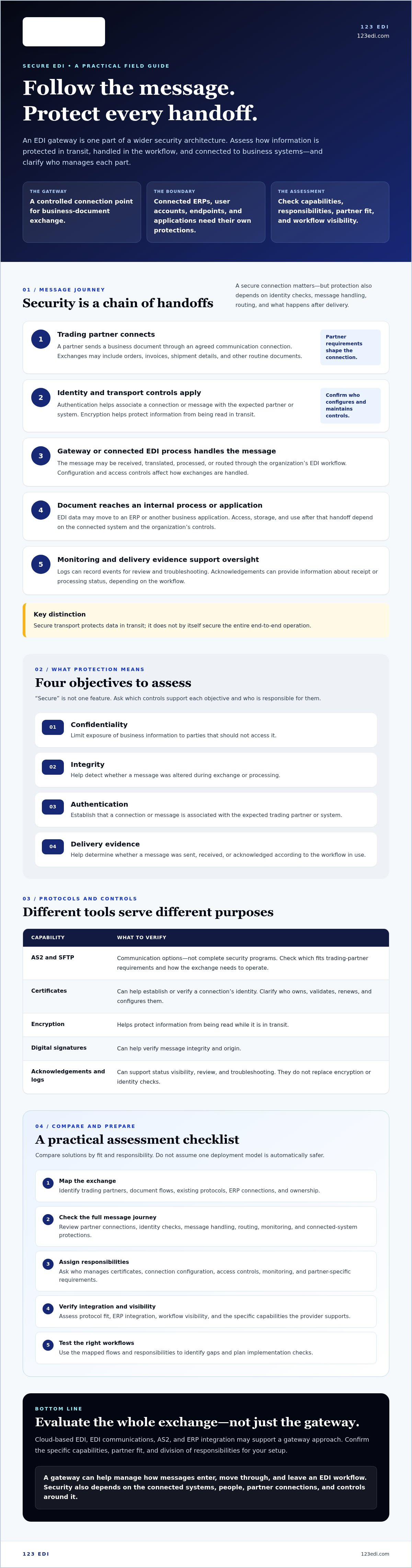
Assess protection as several distinct objectives, rather than treating “secure” as a single feature:
- Confidentiality: Limit exposure of business information to parties that should not access it.
- Integrity: Help detect whether a message was altered during exchange or processing.
- Authentication: Establish that a connection or message is associated with the expected trading partner or system.
- Delivery evidence: Provide a way to determine whether a message was sent, received, or acknowledged, according to the workflow in use.
These objectives can involve different layers. A communication protocol may protect data traveling between endpoints, while gateway configuration governs how exchanges are handled and routed. Organizational access controls help determine who can administer systems or view message information. Capabilities and responsibilities vary by setup, so ask which controls apply and who manages each one.
Protection in transit is only part of the picture. Once a message reaches an ERP or another application, its access, storage, and use depend on that system and the organization’s controls. Evaluate a secure EDI gateway as one component of a broader exchange architecture, not as a guarantee that every connected endpoint is protected.
How Secure EDI Gateway Protection Works Across the Data Journey
A message’s security depends on what happens at each handoff, not just on the connection that carries it. A secure EDI gateway workflow typically begins when a trading partner connects, continues through identity checks and message handling, and then routes the document to an internal EDI process or business application. Monitoring can help teams spot failed exchanges and other issues along the way.
Secure transport protects data in transit, but it doesn’t by itself secure the entire end-to-end operation. Protocols, gateway settings, and organizational access controls address different parts of the process. For a broader framework, WEDI’s cybersecurity and infrastructure security resources point readers to security guidance relevant to EDI environments.
Where do AS2, SFTP, and certificates fit?
AS2 and SFTP are communication options, not complete security programs. The right fit depends on trading-partner requirements and how an exchange needs to operate. Certificates can help establish or verify a connection’s identity. Encryption helps protect information from being read in transit, while digital signatures can help verify message integrity and origin. Confirm with the relevant provider and partner who owns certificates, validates them, renews them, and configures the connection.
These controls serve different purposes. An acknowledgement can provide information about a message’s receipt or processing status, while logs record events that support troubleshooting and review. Neither replaces encryption or identity checks. Businesses evaluating AS2 can also review guidance on secure AS2 data transfer and verify which controls are supported in their particular setup.
How should data move between the gateway and ERP?
After EDI processing, a document may be passed to an ERP system for business use or prepared for outbound delivery. Define which system is responsible at each handoff. Limit permissions to the access needed for the task, and validate that incoming or outgoing data meets agreed expectations before it moves onward. The details depend on the integration, so confirm them with the teams responsible for the gateway and ERP.
Monitoring should help teams identify failed transfers, unexpected changes in message flow, and delivery status. Decide who investigates and resolves each issue. Logs can support that work, but their availability, contents, access, and retention depend on the implementation. For more context on planning the system handoff, see EDI integration with ERP systems.
123 EDI’s service areas include EDI communications, AS2, and ERP integration. Reviewing 123 EDI’s EDI services may help you consider how communications and integration fit your wider gateway approach. Verify specific security capabilities and management responsibilities directly before making a decision.
How to Compare Secure EDI Gateway Options Without Overlooking Risk
A vendor’s broad promise of “secure EDI” doesn’t tell you which protections are in place, who manages them, or how they fit your trading-partner and ERP workflows. Compare secure EDI gateway options against your actual requirements. Ask vendors to demonstrate capabilities and clarify responsibilities. A useful comparison covers technical controls and day-to-day operations.
Which security and operational criteria should buyers assess?
Ask how identities and certificates are validated and maintained, how permissions are assigned, and what happens when credentials change or access needs to be removed. Request a walkthrough of monitoring, alerting, audit evidence, incident communication, and recovery procedures. For each task, establish whether the provider, your organization, or a trading partner is responsible. Verify claims about certifications and controls against current, relevant vendor evidence rather than relying on a label alone.
| Criteria | Questions to ask |
|---|---|
| Security controls | How are identities, certificates, permissions, and credential changes handled? What evidence can the vendor provide? |
| Protocol fit | Does the option support the communication methods required by each partner? Who configures and maintains them? |
| ERP integration | How does data move between EDI processing and the ERP? Where are validation and access permissions managed? |
| Visibility | Can authorized staff review transaction status, failures, alerts, and relevant audit records? |
| Support and ownership | Who handles routine changes, investigates incidents, and coordinates with partners? What response and escalation process is documented? |
How do cloud, software, and portal approaches differ?
Deployment affects how work is divided, not whether a setup is automatically secure. With a managed cloud service, clarify which platform and exchange tasks the provider handles and which remain yours. With a software-managed environment, determine who is responsible for configuration, updates, access, and ongoing operations. A portal may offer a user-facing way to work with EDI processes, but confirm which workflows and visibility it supports.
Across all approaches, check how partners are onboarded, how exceptions appear to staff, and how information reaches internal applications. Match these details to your team’s capacity and integration needs. Reviewing an overview of cloud-based EDI solutions can help frame deployment questions, but you’ll still need to confirm specific responsibilities and controls with the vendor.
How to Assess and Prepare a Secure EDI Gateway Implementation
A smooth implementation starts with a clear picture of how your current EDI exchanges work. Before selecting a secure EDI gateway, bring business, EDI, ERP, and security stakeholders together to document partner requirements, data flows, dependencies, and ownership. This discovery can surface gaps early and give vendors a consistent set of requirements to address.
What should teams document before selecting a gateway?
Build an inventory of each trading partner, the documents exchanged, current protocols, connected ERP or business applications, and the people responsible for each workflow. Include how information enters and leaves the organization, where validation occurs, and which integrations depend on the exchange. Record data sensitivity, access boundaries, retention needs, and the evidence your team must be able to review.
Then define what a successful exchange looks like. Specify how staff should see delivery status, identify and resolve errors, and contact the responsible party if a workflow is interrupted. Confirm partner requirements and technical or contractual conditions with the relevant parties. Because security and implementation requirements vary by organization and exchange, have qualified technical and security professionals review the plan where appropriate.
How should gateway connections be tested and maintained?
Plan testing with each relevant partner and the teams responsible for connected systems. Work through the expected exchange, then check how the workflow handles a rejected or invalid message, an acknowledgement, and recovery after a failure. Confirm that status information and audit evidence are available to the appropriate people, and document how exceptions should be escalated. Base the test plan on actual partner specifications and business needs rather than assuming one process fits every connection.
Before moving into routine operation, assign named owners for:
- Configuration changes: Who approves, applies, and documents updates to partner connections and routing?
- Certificates and access: Who tracks certificate changes and reviews permissions when responsibilities or users change?
- Monitoring and exceptions: Who checks transaction status, investigates failures, and coordinates with partners?
- Incident escalation: Who communicates issues, and how are decisions and follow-up actions recorded?
Review these arrangements periodically and after a material change, such as a new partner, altered document flow, or ERP integration update. Revisit test results and ownership so procedures stay aligned with the live environment. For organizations assessing EDI connections to business systems, explore EDI integration options as part of the implementation discussion.
How 123 EDI Can Support Secure EDI Communications and Integration
Choosing a provider is one part of building a secure EDI gateway approach. Determine how its services align with your trading partners, document flows, and business systems. 123 EDI offers cloud-based EDI, EDI software, EDI communications, AS2, and integration with ERP systems. These service areas may support partner exchanges and the movement of EDI data into existing workflows. Confirm the specific security controls and management responsibilities for the solution you’re considering.
Where can EDI communications and ERP integration fit?
EDI communications and AS2 may be relevant when partners require particular methods for exchanging business documents. ERP integration connects EDI processes with the business system that uses incoming data or supplies information for outgoing transactions. Together, these capabilities may help organize the handoff between partner exchanges and internal operations. The precise scope depends on the systems, partner requirements, and responsibilities agreed with the provider. For more background on the communication method, consult the AS2 communication services article.
Keep the boundaries clear as you assess fit. An EDI provider’s communications or integration services don’t automatically secure every endpoint or replace controls managed by your organization or trading partners. Ask how the proposed setup relates to the wider gateway architecture and which party owns each part of the workflow.
What should you ask an EDI provider before moving forward?
Bring your partner inventory, protocol requirements, ERP details, and workflow ownership questions into the discussion. Ask the provider to describe the service scope and document responsibilities. In particular, clarify:
- Security evidence: Which controls are included, and what current documentation can the provider share about them?
- Operational records: What transaction, delivery, or audit information is available, and who can access it?
- Partner onboarding: What information and coordination are needed to establish an exchange with each trading partner?
- Integration scope: Which ERP connections and workflow handoffs are covered, and where does your team retain responsibility?
- Ongoing ownership: Who manages configuration changes, access, exceptions, and communication if an issue arises?
Clear answers help you compare the proposed services with your requirements without relying on broad security labels or assumptions. The discussion can also identify which requirements need further technical or security review before implementation.
If you’re evaluating EDI communications or ERP integration for your workflows, discuss your EDI requirements with the 123 EDI team.
Make Your Next EDI Security Decision with Clarity
A secure EDI gateway works best as part of a well-defined exchange process, with clear ownership from the partner connection through the business-system handoff. Focus on the requirements that matter to your organization: which connections and workflows are in scope, what evidence you need, and who will manage each responsibility.
123 EDI offers cloud-based EDI solutions and software, EDI communications and AS2, and EDI integration with ERP systems. These services may be relevant as you evaluate how to connect trading partners with existing business workflows. Confirm specific controls, service scope, and operational responsibilities with any provider before deciding.
Discuss your EDI communication and integration needs with the 123 EDI team to explore how your requirements align with its offerings. A clear inventory, thoughtful questions, and defined responsibilities can help you choose an approach suited to your workflows and security priorities.
Frequently Asked Questions
What is a secure EDI gateway?
A secure EDI gateway is a controlled connection point for exchanging electronic business documents with trading partners. It can support the movement of messages into EDI processing and onward to systems such as an ERP. Its scope is limited: it doesn’t automatically protect every connected application, user account, or endpoint. Assess it as one part of a broader security setup, with responsibilities defined across your organization, provider, and trading partners.
How does an EDI gateway protect data?
An EDI gateway can help manage connections, identity checks, message handling, routing, and exchange visibility. Specific protections depend on the protocols, configuration, and operating practices in place. Encryption can help keep data private in transit, while signatures may help verify message integrity or origin. Acknowledgements and logs serve different purposes, such as showing delivery status or recording events. Ask which controls are provided, how they’re configured, and who manages them.
Is AS2 a secure EDI gateway?
No. AS2 is a communication protocol used to exchange data, not a complete EDI gateway or security program. It can support secure partner communication when correctly configured, but the overall setup also depends on identity validation, certificate management, access permissions, message handling, and monitoring. Confirm that AS2 meets your trading partner’s requirements and clarify who is responsible for configuring and maintaining the connection.
Can a secure EDI gateway connect to an ERP system?
Yes. An EDI workflow can route processed messages between trading partners and an ERP system, where the data may support activities such as order handling or invoicing. The integration design determines how information is validated, transferred, and made visible to the appropriate teams. Confirm which systems and workflows are included, what access permissions apply, and which party manages each handoff. The gateway doesn’t replace the ERP’s own security controls.
What should I look for when choosing a secure EDI gateway?
Compare the gateway against your partner protocols, security requirements, ERP connections, visibility needs, and support expectations. Ask how identities, certificates, permissions, alerts, transaction records, and exceptions are handled. Clarify responsibilities among your organization, the provider, and trading partners. Request current evidence for security controls or certifications rather than relying on broad claims. A good fit should match your actual workflows and make operational ownership clear.
How do I secure EDI connections with trading partners?
Start by confirming each partner’s communication requirements, identity and certificate expectations, document flows, and testing process. Agree on who configures and maintains the connection, monitors delivery status, handles errors, and communicates during an incident. Test expected exchanges as well as rejected messages and recovery scenarios before relying on the workflow. Limit partner and system access to appropriate roles, and revisit connection settings when requirements or integrations change.
Does a cloud-based EDI gateway need additional security controls?
Cloud deployment doesn’t remove the need to understand how security responsibilities are shared. Ask the provider which controls and operational tasks are included, and identify what your organization must manage, such as user permissions, connected ERP access, partner requirements, and internal procedures. Confirm what monitoring and records are available and who can review them. Appropriate safeguards depend on the service design, integrations, and sensitivity of the data being exchanged.