

Believing that your current file transfer protocol is a “set it and forget it” solution is the fastest way to invite a multi-million dollar data breach in 2026. As cyber threats evolve and global mandates like the October 2026 HIPAA front-end updates take effect, simply having a digital connection isn’t enough. Many logistics leaders feel overwhelmed by the complexity of managing secure EDI communications while trying to avoid costly retailer chargebacks. It’s a heavy burden to carry, especially when the stability of your supply chain depends on every single transmission being flawless.
We understand that the technical jargon surrounding encryption can feel like a barrier to growth. You likely want to focus on your core business rather than worrying if your data is exposed. This guide will help you strip away the misconceptions that leave businesses vulnerable. You’ll gain a clear understanding of modern security layers and the confidence to choose between AS2, SFTP, or VANs based on your unique needs. We’ll provide a practical roadmap for secure ERP integration that turns your data exchange into a resilient asset rather than a source of anxiety.
Key Takeaways
- Differentiate between data formatting and transport security to ensure your business documents aren’t just well-structured, but truly protected during exchange.
- Evaluate the critical differences between AS2, SFTP, and VANs to choose the protocol that best safeguards your specific trading partner relationships.
- Master the three pillars of secure EDI communications, including confidentiality, integrity, and availability, to build a framework that goes far beyond simple encryption.
- Explore how cloud-based EDI portals and ERP integrations can actually strengthen your security posture by automating complex tasks and reducing manual data entry risks.
- Follow a structured 2026 roadmap to audit your current setup and implement a “security-first” approach when onboarding new trading partners.
Myth #1: Secure EDI Communications are ‘Built-In’ to the Standard
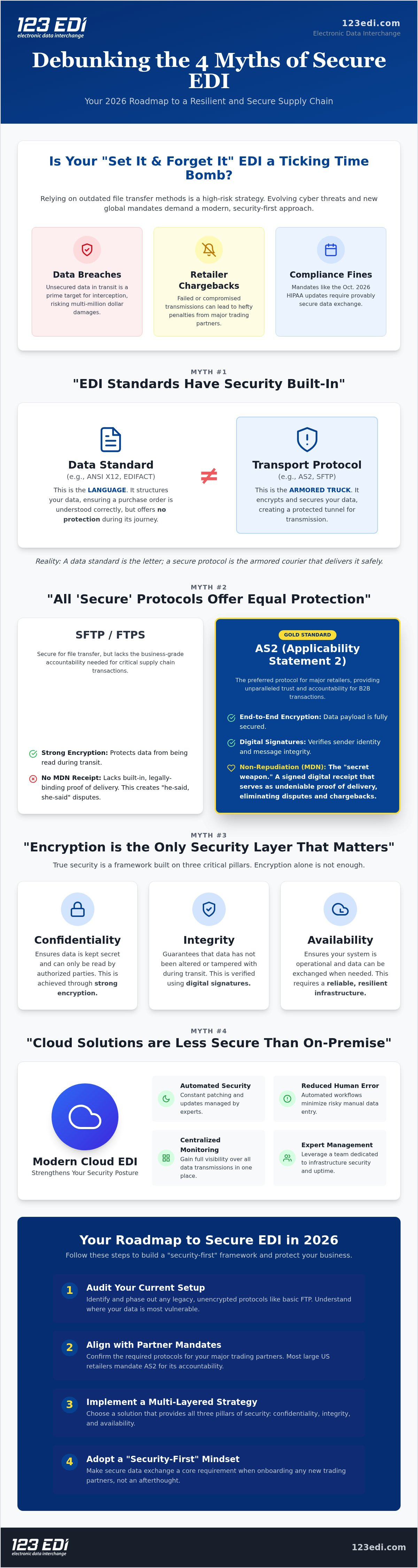
One of the most common misconceptions we encounter is the belief that Electronic data interchange (EDI) is inherently secure because it follows a standardized format. This simply isn’t the case. While standards like ANSI X12 or EDIFACT provide a rigorous structure for your data, they don’t offer a protective shield during the journey from your server to your trading partner. Think of your EDI file as a sensitive letter. The standard ensures the letter is written in a language both parties understand, but it doesn’t provide the envelope or the courier to keep it safe.
True secure EDI communications require a two-part framework. First, you have the data standard, which organizes information like purchase orders or invoices. Second, you have the transport protocol, which acts as the armored truck. Without a secure transport layer like AS2 or SFTP, your business documents are essentially being sent on a postcard for anyone to read. Relying on legacy setups without modern protocols is a high-risk strategy that leaves your most sensitive transaction data exposed to interception and unauthorized access.
The Difference Between Data Standards and Transport Protocols
It’s helpful to view X12 and EDIFACT as the languages of global commerce. They ensure that when you send a quantity of 500, your partner’s system doesn’t interpret it as a price. However, a perfectly formatted file can still be intercepted or tampered with if it’s traveling over an unencrypted channel. Specialized EDI software, like the solutions offered by 123 EDI, bridges this gap by wrapping your structured data in layers of encryption and digital signatures before it ever leaves your environment. This creates a secure tunnel for your data, ensuring that the message remains confidential and unchanged during transit.
Why ‘Good Enough’ is a Risky Strategy in 2026
In the current climate, relying on legacy setups or basic FTP is a gamble you can’t afford to take. Cyber threats targeting supply chains have become more sophisticated, and the financial consequences of a data breach are steeper than ever. Beyond the threat of hackers, major US retailers now mandate specific secure protocols to protect their own ecosystems. If your transmission fails or is compromised, you aren’t just looking at a technical glitch; you’re facing retailer chargebacks, compliance fines, and a damaged reputation. Moving toward a “security-first” mindset with secure EDI communications ensures your operations remain stable and your partnerships stay strong, providing the peace of mind needed to scale your business.
Myth #2: All Secure Protocols (AS2, SFTP, FTP) Offer Equal Protection
Many decision-makers believe that as long as a protocol includes encryption, it provides a sufficient foundation for secure EDI communications. This assumption often leads to friction when technical capabilities don’t align with business requirements. While SFTP (Secure File Transfer Protocol) and FTPS (FTP over SSL) provide strong encryption, they don’t offer the same level of business-grade accountability as AS2. Choosing the wrong method can lead to “he-said, she-said” disputes when a transmission goes missing. Identifying which protocols are preferred by your major US trading partners in 2026 is the first step toward a more stable data exchange framework.
AS2: The Gold Standard for Trading Partner Trust
AS2 stands apart because it introduces the concept of non-repudiation, a critical layer of accountability for B2B transactions. According to the official AS2 protocol specification, this method uses digital certificates to sign and encrypt data, ensuring the sender’s identity is verified. AS2 is a protocol that ensures both data payload security and sender identity. The real “secret weapon” is the Message Disposition Notification (MDN). This signed digital receipt proves exactly when a partner received and processed a file. This receipt of delivery is essential for resolving payment disputes or avoiding chargebacks. If a retailer claims they never received an invoice, your MDN serves as undeniable proof that the data was delivered intact and on time.
SFTP and FTPS: Secure File Transfer Alternatives
SFTP and FTPS are often used for internal data movement or simpler partner exchanges where high-volume tracking isn’t a priority. These protocols are secure in transit, but they don’t naturally provide the same level of automated, receipt-based tracking that modern supply chains demand. While these are valid tools, they don’t always meet the rigorous standards of secure EDI communications required by Tier-1 retailers. Without built-in non-repudiation, your IT team may spend hours digging through server logs to prove a file was sent. You can explore a deeper comparison in our guide on AS2 vs FTP for EDI: Choosing Your Supply Chain Protocol.
As you evaluate your current setup, remember that the goal is more than just moving data; it’s about building trust. Choosing a protocol that matches your partner’s expectations reduces administrative overhead and protects your bottom line. If you’re looking to simplify your protocol management, our team at 123 EDI offers specialized EDI software that handles these complexities for you, ensuring every transaction is backed by the highest level of security.
Myth #3: Encryption is the Only Security Layer That Actually Matters
While encryption is a vital component of any data strategy, treating it as the sole guardian of your sensitive information is a strategic oversight. Encryption primarily addresses confidentiality by ensuring that if a file is intercepted, its contents remain unreadable to unauthorized parties. However, encryption alone doesn’t verify the identity of the sender or guarantee that the data arrived exactly as it was intended. For a truly resilient framework, secure EDI communications must be built upon three distinct pillars: confidentiality, integrity, and availability. This holistic approach ensures your supply chain isn’t just hidden from prying eyes, but is also authentic and consistently accessible.
Digital signatures and multi-layered authentication act as the critical secondary defenses that encryption lacks. Without these layers, your business remains vulnerable to sophisticated spoofing attempts where a malicious actor could send a perfectly encrypted, yet fraudulent, file. By looking beyond simple ciphers, you move from a reactive security posture to one of steady confidence, ensuring that every transaction is both private and legitimate. For a deeper look at how these principles apply across all your data exchanges, our comprehensive guide to secure B2B file transfer covers enterprise-grade standards including PCI DSS 4.0 compliance and the latest AS2 protocol updates.
Beyond the Cipher: The Role of Authentication
Knowing exactly who sent a purchase order is just as critical as the order details themselves. In an unauthenticated stream, your system might accept a file that looks correct but originated from a compromised source. Digital certificates serve as a verified digital passport for your business, establishing a foundation of trust before a single byte of data is exchanged. These certificates ensure that the “handshake” between your server and your partner’s server is genuine. This level of verification effectively neutralizes “man-in-the-middle” attacks, where an intruder attempts to insert themselves into your data flow to redirect or steal information.
Ensuring Data Integrity with Hashing
What happens if a single digit in a quantity field is altered while an 850 Purchase Order is in transit? Even a minor corruption can lead to massive logistical errors, incorrect shipments, and painful financial disputes. This is where data integrity becomes paramount. We use hashing algorithms to create a unique digital fingerprint of your EDI file at the moment it’s sent. When the file reaches its destination, the receiving system generates its own hash and compares it to the original. If even a single character has changed, the hashes won’t match, and the system will reject the file. This precision is essential for maintaining a clean EDI integration with your ERP system, preventing corrupted data from triggering automated errors in your inventory or accounting modules.
By implementing these diverse security layers, you protect your business from the rising costs of data breaches and the operational chaos of failed transmissions. A robust system doesn’t just hide data; it validates every interaction to keep your supply chain moving without interruption.
Myth #4: EDI Portals and Cloud Solutions are Less Secure Than On-Premise
Many logistics professionals feel a lingering anxiety about moving their transaction data off-site, fearing that a loss of physical control leads to a loss of security. However, in the context of secure EDI communications, this physical proximity doesn’t always equate to digital safety. Managing an on-premise environment requires a mid-sized IT department to stay ahead of zero-day vulnerabilities, patch schedules, and certificate renewals simultaneously. In contrast, a dedicated EDI provider allocates specialized resources specifically to these tasks, often providing a level of oversight that internal teams simply cannot match. By choosing a web-based EDI portal, even smaller suppliers can benefit from enterprise-grade security without the overhead of managing complex hardware.
Adopting a cloud solution involves a shared responsibility model. The provider secures the infrastructure, while you manage user access controls. This collaboration actually strengthens your posture by offloading the complex technical maintenance to veterans who live and breathe data exchange. It allows your team to focus on business growth while we ensure the underlying pipes remain impenetrable.
The Security Advantages of Managed Cloud EDI
Specialized cloud environments provide continuous monitoring and automated threat detection that are often cost-prohibitive for individual businesses to implement on their own. When you utilize a professional EDI cloud, security certificates and protocol versions are updated automatically. This ensures you never fall out of compliance with trading partners or leave a door open for legacy exploits. This proactive approach is a cornerstone of a modern strategy, as detailed in our Comprehensive Guide to Cloud-Based EDI Solutions in 2026.
Closing the Gap: Secure ERP Integration
One of the most overlooked security risks in the supply chain is manual data entry. Every time a staff member re-keys a purchase order from a screen into an ERP, there’s a risk of data leakage or unauthorized access. By implementing a direct EDI integration with your ERP, you secure the “last mile” of data movement. This automation removes the human element from the transmission chain, significantly reducing the surface area for potential breaches. High-quality providers also undergo rigorous SOC 2 compliance audits to verify that their internal controls meet the highest industry standards for security and privacy. If you want to eliminate these manual vulnerabilities, our team can help you build a resilient, automated bridge between your partners and your back-office systems.
Building a Roadmap for Secure EDI Communications in 2026
Moving beyond the myths requires a deliberate shift in strategy. While understanding the technical layers of secure EDI communications is essential, the real value lies in how you apply that knowledge to your daily operations. A resilient framework isn’t built overnight; it’s the result of consistent auditing and a commitment to high standards. By treating security as a foundational business requirement rather than a technical checkbox, you protect your partnerships and your profitability. It’s about creating a culture where every data exchange is handled with precision and care.
Adopting a “security-first” mindset when onboarding new trading partners ensures that you aren’t just meeting their requirements, but also shielding your own internal systems. This proactive approach transforms EDI from a simple requirement into a strategic asset. As you look toward the future, having a clear plan for your data exchange architecture will provide the stability needed to scale without increasing your risk profile. Understanding the full scope of your obligations, including how your secure B2B file transfer practices align with current PCI DSS 4.0 requirements, is a critical part of that planning process.
Step-by-Step: Auditing Your EDI Security
A thorough audit serves as your baseline. It’s often surprising how many legacy connections remain active long after they’ve outlived their usefulness. We recommend a methodical review to identify potential gaps before they can be exploited. Focus on these three critical areas:
- Identify every active communication protocol and any lingering legacy FTP connections that may be creating hidden vulnerabilities.
- Review digital certificate expiration dates and establish a proactive renewal process to prevent unexpected downtime and expired handshakes.
- Evaluate the security of your EDI-to-ERP data flow to ensure the internal movement of your business documents is as protected as the external exchange.
Partnering for Long-Term Reliability
Technical solutions are only as effective as the people who support them. At 123 EDI, we believe that seasoned reliability comes from a blend of advanced technology and human-centric mentorship. We don’t just provide EDI software; we act as a steady hand to help you navigate the complexities of modern data exchange. Our team possesses the deep institutional knowledge required to simplify technical landscapes and build a foundation of long-term trust.
Our scalable, cloud-based platform is designed to grow with your business. As your trading partner list expands, our infrastructure ensures your security posture remains unshakeable. We value your understanding of the technical solution as much as the solution itself, providing the transparency and dedication your business deserves. Don’t wait for a transmission failure or a security audit to reveal the gaps in your system.
Taking a proactive step today can save your organization from the rising costs of data breaches and the frustration of failed transmissions. Speak with a 123 EDI expert today to secure your supply chain and build a foundation of long-term trust with your trading partners.
Securing the Future of Your Supply Chain Data
Building a resilient foundation for your data exchange requires moving past the myths that often leave businesses vulnerable. We’ve seen that true secure EDI communications rely on a sophisticated blend of data standards, encrypted protocols like AS2, and secondary layers of authentication. By shifting from on-premise anxieties toward the expert monitoring found in cloud-based portals, you can eliminate the manual errors that lead to costly chargebacks and breaches. A strategic roadmap isn’t just about technical compliance; it’s about ensuring your business remains a reliable partner in an increasingly complex digital landscape.
As an industry veteran since 1994, our team at 123 EDI is dedicated to providing the expert AS2 and cloud EDI support you need to thrive. We specialize in seamless ERP integration, acting as a steady hand to guide you through every technical challenge. You don’t have to manage these complexities alone. We invite you to secure your business transactions with a 123 EDI consultation today. Together, we can build a data exchange framework that is both unshakeable and ready for the growth ahead.
Frequently Asked Questions
What is the most secure protocol for EDI communications?
AS2 is generally recognized as the most secure protocol for B2B data exchange because it combines strong encryption with non-repudiation. While SFTP and AS4 are also highly secure, AS2 includes digital signatures and Message Disposition Notifications (MDNs) that provide a verifiable audit trail. This protocol ensures that your sensitive business documents remain confidential and that the identity of the sender is always confirmed through digital certificates.
How does AS2 provide non-repudiation in EDI?
Non-repudiation is achieved in AS2 through the use of digital signatures and Message Disposition Notifications, or MDNs. When a trading partner receives a file, their system automatically generates a signed electronic receipt. This receipt proves that the data was delivered and that the contents weren’t altered during transit. It provides your business with undeniable proof of delivery, which is essential for resolving disputes over missing invoices or purchase orders.
Is standard email secure enough for sending EDI documents?
Standard email is not a suitable medium for secure EDI communications because it lacks the necessary encryption and tracking capabilities. Emails often travel across the open internet in plain text, making them vulnerable to interception or spoofing. Additionally, email doesn’t provide a standardized audit trail or automated receipts, which are required by most major retailers to ensure compliance and prevent data breaches within the supply chain.
What is the difference between EDI encryption and EDI authentication?
Encryption focuses on the confidentiality of the data by scrambling the contents so only authorized parties can read them. Authentication, on the other hand, verifies the identity of the sender to ensure the data originated from a trusted source. While encryption protects the message during its journey, authentication prevents unauthorized actors from spoofing your partners and sending fraudulent transactions into your internal systems.
Do I need a VAN to have secure EDI communications?
You don’t strictly need a Value Added Network (VAN) to maintain secure EDI communications, especially if you use direct protocols like AS2. However, a VAN can simplify security by acting as a secure clearinghouse that manages multiple protocols and partner connections for you. Many modern businesses now prefer cloud-based EDI portals as a cost-effective alternative that provides similar security benefits without the complex per-transaction fees associated with legacy VANs.
How does EDI integration with ERP systems improve security?
Integrating EDI directly with your ERP system improves security by eliminating the need for manual data entry. When information flows automatically between systems, you reduce the risk of human error and unauthorized access that can occur when staff members handle sensitive data. This automated bridge ensures that your transaction data remains within a controlled environment, significantly lowering the potential for internal data leaks or accidental exposure.
What are the common security risks of legacy EDI systems?
Legacy systems often rely on outdated protocols like standard FTP, which lacks the encryption needed to protect data today. These older setups frequently suffer from unpatched vulnerabilities and lack modern authentication features like multi-factor authentication. Additionally, managing digital certificates manually on older hardware increases the risk of expired credentials, which can lead to sudden transmission failures and security gaps that leave your supply chain exposed to modern cyber threats.
How can a web-based EDI portal help with partner compliance?
A web-based EDI portal simplifies compliance by standardizing security requirements across all your trading partners. The portal handles the complex technical tasks, such as managing digital certificates and protocol updates, on your behalf. This ensures that your business always meets the latest security mandates from major retailers without requiring your team to become experts in every individual protocol. It provides a stable, user-friendly interface that maintains high security standards consistently.