

What if your most frustrating manual task became your strongest competitive advantage? For many growing suppliers in 2026, the mandate to use a web-based EDI portal feels less like a partnership and more like a looming threat of costly chargebacks. It’s exhausting to manage complex X12 standards and the latest 008070 updates when you’re already stretched thin. You know that manual data entry is a recipe for shipping errors, yet the leap to full automation often feels financially out of reach.
We understand that you need a solution that balances technical precision with operational simplicity. This definitive guide explores how modern cloud-native tools streamline your supply chain compliance and prepare your business for a future of seamless ERP integration. By adopting a secure, browser-based interface, you can achieve 100% compliance with your trading partners while protecting your data through proven protocols like AS2. We’ll walk through the essential transaction sets, from 850 purchase orders to 856 ship notices, and provide a clear roadmap for scaling your business without the burden of heavy IT infrastructure.
Key Takeaways
- Learn how a web-based EDI portal bridges the gap between manual processes and digital supply chain efficiency through secure, cloud-hosted technology.
- Identify the critical security features and real-time visibility tools necessary to stabilize your order-to-cash workflow in 2026.
- Understand the strategic role of compliance in preventing retailer chargebacks and protecting your bottom line from unnecessary penalties.
- Evaluate the logical progression from portal-based entry to full ERP integration to ensure your technology scales alongside your business growth.
- Discover how to leverage a reliable, cloud-native infrastructure to meet the rigorous standards of major trading partners without heavy IT investment.
What is a Web-Based EDI Portal? Bridging the Digital Supply Chain Gap
In the early days of supply chain management, exchanging business data often meant wrestling with heavy on-premise software and dedicated hardware. Today, the landscape has shifted toward accessibility and speed. A web-based EDI portal is a cloud-hosted interface that allows you to exchange essential business documents through a standard web browser. It removes the technical barriers that once kept smaller suppliers from participating in global trade, acting as a bridge between your internal processes and your partners’ requirements.
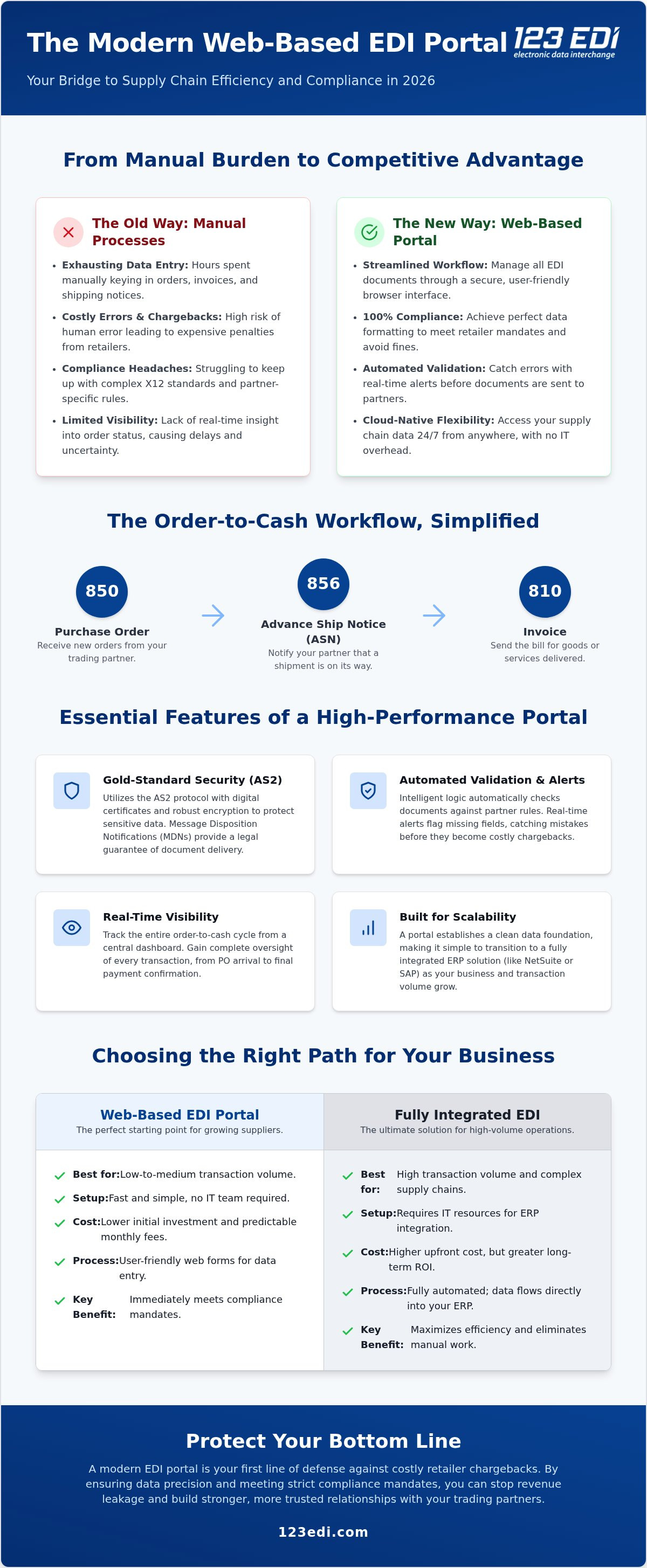
A web-based EDI portal serves as a centralized hub for managing Electronic Data Interchange (EDI) standards such as X12 and EDIFACT, translating complex data into a readable format for your team. Instead of managing stacks of paper or confusing faxed orders, you log into a secure website to view purchase orders and send invoices. While some might view a portal as a simplified version of automation, we see it as a strategic starting point. It’s a reliable entry point that provides the stability you need to grow without the immediate complexity of a full-scale IT overhaul.
How Cloud-Based EDI Portals Modernize B2B Communication
By moving to the cloud, you eliminate the need for expensive server maintenance or local software installations that drain your budget. This transition allows non-technical staff to manage transactions through a user-friendly interface that feels as familiar as online banking. You don’t need a dedicated IT team to oversee every transaction. Because the system is hosted in a secure cloud environment, your team can access orders and send invoices from any secure internet connection, 24 hours a day. This flexibility is vital for maintaining a steady flow of communication with trading partners across different time zones, ensuring your business never misses a beat.
The Strategic Role of Portals for Growing Suppliers
For many vendors, the primary driver for adopting a web-based EDI portal is meeting the strict compliance mandates of big-box retailers. These retailers require precise data formats to manage their massive inventories, and they won’t hesitate to issue penalties for errors. A portal helps you meet these requirements immediately, significantly reducing the risk of manual data entry errors that lead to costly chargebacks. Beyond immediate compliance, using a portal builds the operational discipline needed for future growth. It establishes a clean data foundation, making it much easier to transition toward deep EDI integration with ERP systems like NetSuite or SAP when your transaction volume begins to scale.
Essential Features of a High-Performance EDI Portal in 2026
Building a resilient supply chain requires more than just basic connectivity. A modern web-based EDI portal must act as a sophisticated command center that simplifies the complexities of Electronic Data Interchange (EDI). In 2026, high-performance portals go beyond simple document exchange. They provide real-time visibility into the order-to-cash cycle, allowing you to track a transaction from the moment a purchase order arrives to the final payment. This oversight removes the stress of intricate data management, positioning your business as a reliable partner to major retailers.
Secure Communications and the AS2 Protocol
Security is the foundation of trust in B2B relationships. While various methods exist for data transfer, the AS2 (Applicability Statement 2) protocol remains the gold standard for secure exchange. High-performance portals utilize digital certificates and robust encryption to protect your sensitive business information from unauthorized access. One of the most critical features of AS2 is the Message Disposition Notification (MDN). These digital receipts provide a legal guarantee of document delivery, ensuring that neither you nor your partner can claim a document was lost in transit. This level of verification is essential for maintaining accountability in high-stakes trading environments.
Automated Validation and Error Checking
Precision is paramount when dealing with high-volume trading partners. A quality web-based EDI portal acts as a steady hand, catching mistakes before they leave your system. Automated validation logic checks every document against the specific business rules of your retailers. If a required field is missing in a Purchase Order (850) or an Invoice (810), the system triggers real-time alerts. This proactive approach prevents the submission of incorrectly formatted documents, which is the primary cause of retailer penalties. By enforcing these rules at the point of entry, you ensure that every transaction is compliant and ready for processing.
Comprehensive Document Support
True operational efficiency comes from managing the entire document lifecycle within a single interface. Your portal should support the full range of transactions, including the 850 (PO), 855 (PO Acknowledgement), 856 (Advance Ship Notice), and 810 (Invoice). One of the most valuable time-saving features is the “turnaround” capability. This allows you to auto-populate an invoice directly from the original purchase order, eliminating manual entry and ensuring data consistency. Whether you are dealing with domestic partners using X12 or global entities following EDIFACT, your system must handle both standards seamlessly. If you’re ready to stabilize your operations, exploring a professional EDI portal is a logical next step.
Web-Based vs. Fully Integrated EDI: Choosing the Right Path
Deciding between different technology paths often feels like a high-stakes crossroads for growing businesses. In our experience, it’s more helpful to view the choice between a web-based EDI portal and full integration as a natural progression rather than a permanent destination. A portal isn’t a “dead end” where your growth stops. Instead, it serves as a vital precursor that allows you to stabilize your operations and master the fundamentals of trading partner requirements before committing to a deeper technical overhaul.
As you assess your current needs, consider the volume of transactions and the complexity of your internal workflows. Research on the Application of EDI and its impact on information quality suggests that the primary goal should always be the accuracy and timeliness of data. Whether you choose a manual entry portal or a fully automated system, the objective remains the same: maintaining a high standard of communication that protects your reputation with retailers. At 123 EDI, we support both approaches, acting as a steady hand whether you’re just starting out or ready to connect your ERP system.
When a Web-Based Portal is the Optimal Solution
For businesses handling low to moderate transaction volumes, typically between 10 and 50 orders per month, a portal is often the most sensible choice. It’s particularly effective when you’re facing a sudden deadline to achieve compliance with a new retailer mandate. If your team lacks a dedicated internal IT department, a web-based EDI portal provides the necessary tools without requiring you to manage complex software. It allows you to focus on fulfilling orders while the cloud-based system handles the heavy lifting of data translation and secure delivery.
The Case for Full ERP Integration
As your success grows, manual data entry can eventually become a bottleneck that hinders your efficiency. This is the moment to consider transitioning to full EDI integration. By connecting your EDI data directly with systems like NetSuite, SAP, or QuickBooks, you reduce the “human touch” to nearly zero. This automation is essential for high-volume trading partners where even a small percentage of manual errors can lead to significant operational delays. Businesses evaluating a modern EDI platform will find that selecting the right solution is critical to eliminating manual entry and integrating flawlessly with your ERP ecosystem. For production-focused businesses, exploring cloud EDI for manufacturers can provide a clear roadmap for synchronizing your shop floor operations with your back-office data flows. Transitioning to an integrated workflow ensures that your data flows seamlessly from the purchase order through to the final invoice, allowing your team to focus on strategic growth rather than repetitive data entry.
Achieving Compliance: How Portals Prevent Retailer Chargebacks
Chargebacks are the silent killer of supplier margins. These financial penalties often appear as unexpected deductions on a remittance advice, penalizing minor errors in data formatting or document timing. A web-based EDI portal serves as a stabilizing force by enforcing the specific business rules of major retailers like Walmart or Target before a document is ever transmitted. By acting as a digital guardrail, the portal ensures that your data matches their expectations exactly. In modern retail, the cost of non-compliance is often the difference between a profitable partnership and a net loss on every shipment.
Mastering the EDI 856 Advance Ship Notice (ASN)
The Advance Ship Notice (856) is frequently the most common source of retailer penalties. It requires a perfect alignment between the physical contents of a box and the digital data file. Portals simplify the complex packing structures required by different partners, such as Standard (SOPI) or Tare (SOTPI) configurations, which can be overwhelming to manage manually. By using a web-based EDI portal, you can ensure the physical shipment and the digital ASN arrive in perfect sync. This synchronization is critical; if the data arrives after the truck reaches the distribution center, the retailer’s warehouse cannot process the goods, leading to immediate fines and potential delivery rejections.
Meeting Strict Retailer Timelines
Compliance isn’t just about accuracy; it’s about timing. Many retailers mandate that an ASN be sent within a narrow window, sometimes as little as 30 minutes after the truck leaves your dock. Our portal uses automated notifications and status alerts to keep your team on track, ensuring documents are sent within these mandated windows. Because our infrastructure is cloud-native, it provides 24/7 availability to meet global time-zone requirements without interruption. Leveraging 123 EDI’s veteran experience, which dates back to 1994, helps you navigate the varied protocols of different retailers with confidence. If you’re ready to eliminate the stress of penalties and protect your margins, it’s time to explore our EDI portal solutions.
Scaling Your Operations with 123 EDI’s Portal Solutions
Since our founding in 1994, we’ve seen the supply chain landscape evolve from paper ledgers to real-time digital ecosystems. At 123 EDI, we believe that technology should support your growth rather than complicate it. Our web-based EDI portal is designed with this philosophy in mind, offering a solution that’s both sophisticated in its capability and accessible in its daily use. We don’t just provide software; we offer a collaborative partnership that scales as your business matures, ensuring you have a steady hand to guide you through every technical milestone.
A Roadmap from Compliance to Automation
Starting your journey with a web-based EDI portal allows you to meet immediate retailer mandates without the burden of high upfront costs or complex infrastructure. It’s a pragmatic first step that secures your place on the shelf while you focus on product quality and fulfillment. As your transaction volume increases, our team is ready to help you transition toward full EDI integration with ERP systems like NetSuite, SAP, or QuickBooks. This progression is handled through our professional services, where we provide custom workflow mapping to ensure your data flows exactly where it’s needed. We don’t believe in one-size-fits-all solutions; instead, we work closely with you to identify the specific bottlenecks in your order-to-cash cycle and resolve them through targeted automation.
The 123 EDI Advantage: Seasoned Reliability
What sets our approach apart is the human connection behind our technology. When you work with us, you gain access to industry veterans who understand both the technical nuances of AS2 protocols and the practical realities of your business. We take pride in being a patient educator, helping your internal team understand the logic behind EDI standards rather than just the mechanics. Our national support across the United States ensures that your supply chain remains operational around the clock, providing the reassurance you need to manage complex trading relationships. We’ve spent decades refining our processes to ensure that our partners feel supported at every turn. Whether you’re a small supplier sending your first 850 or a large enterprise optimizing a global network, we provide the same level of dedicated, expert oversight and institutional knowledge that has been our foundation for over 30 years.
Empowering Your Supply Chain for 2026 and Beyond
Transitioning to a modern web-based EDI portal is more than a technical requirement; it’s a commitment to your business’s long-term stability. We’ve explored how these cloud-native tools bridge the gap between manual entry and automation, providing the validation logic needed to eliminate retailer chargebacks. By mastering transaction sets and leveraging secure AS2 protocols, you transform a complex mandate into a reliable workflow that builds trust with your partners. This strategic foundation ensures your operations remain agile as the digital landscape evolves.
As an industry veteran since 1994, 123 EDI has spent decades helping thousands of US-based suppliers navigate the intricacies of B2B data exchange. We specialize in secure communications and seamless ERP integration, ensuring that your technology path remains clear and manageable as you scale. Whether you’re just starting with your first portal or preparing for deep system connectivity, we’re here to act as your steady hand and trusted consultant. We invite you to speak with a 123 EDI specialist to find your perfect portal solution today. Your operational success is our priority, and we’re eager to help you build a more efficient, resilient future.
Frequently Asked Questions
What is the difference between a web-based EDI portal and EDI software?
EDI software typically requires local installation on your own servers and management by an internal IT team. In contrast, a web-based EDI portal is hosted in the cloud, allowing you to access your business documents through any standard internet browser. This eliminates the need for maintenance and updates on your end. While traditional software offers deep customization, the portal provides a user-friendly interface that’s ideal for teams focusing on operational speed rather than managing complex technical infrastructure.
Do I need to install any hardware to use a web-based EDI portal?
No, you don’t need to install any specialized hardware to utilize our portal solutions. Since the system is cloud-based, your only requirement is a reliable device with a secure internet connection. This approach removes the significant upfront costs often associated with on-premise servers or dedicated communication lines. It allows your business to remain agile and focus resources on fulfillment and growth while we handle the backend technical requirements and server maintenance on your behalf.
Is a web-based EDI portal secure enough for sensitive financial data?
Yes, modern portals are designed with enterprise-grade security to protect your sensitive financial and business data. We utilize robust encryption and secure communication standards to ensure that information remains private during transit and at rest. As specialists in secure B2B file transfers since 1994, we implement protocols that meet or exceed the requirements of major retailers. This provides a stabilizing force for your operations, allowing you to exchange documents with complete confidence in their integrity.
Can I integrate my web-based EDI portal with my ERP system later?
Absolutely, a web-based EDI portal is a strategic precursor to full automation rather than a permanent limitation. As your transaction volume grows, you can transition to a fully integrated workflow with systems like NetSuite, SAP, or QuickBooks. We specialize in these transitions, helping you map custom workflows that connect your EDI data directly to your ERP. This logical progression ensures that your technology investment scales alongside your business success without requiring a total system replacement or data loss.
How long does it take to get set up with an EDI portal for a major retailer?
The timeline for setup typically depends on the specific requirements of the trading partner, but most portals can be active within a few business days to a few weeks. This process includes configuring the necessary transaction sets and completing testing to ensure compliance with the retailer’s unique business rules. Our veteran team guides you through each step, leveraging our deep institutional knowledge to accelerate the onboarding process and get your products moving to market as quickly as possible.
What happens if my internet goes down while I am using the portal?
Because the portal is hosted in the cloud, your data remains secure and accessible even if your local connection is temporarily interrupted. Once you regain internet access, you can log back in to see all received documents and pending tasks exactly where you left them. Trading partners send documents to the cloud mailbox, not your physical computer, so you won’t miss any orders. This 24/7 availability ensures that your supply chain communication stays active regardless of local technical issues.
Are web-based EDI portals compliant with AS2 and other secure protocols?
Yes, high-performance portals are fully compliant with the AS2 protocol and other industry-standard communication methods. AS2 is the gold standard for secure data exchange, utilizing digital certificates and MDN receipts to guarantee document delivery and non-repudiation. We’ve focused on these secure communications for over 30 years, ensuring that every transaction meets the rigorous standards of global retailers. This technical precision protects your business and maintains the high level of trust required for successful B2B partnerships.
Will a web-based portal help me avoid retailer chargebacks and penalties?
Yes, the portal is specifically designed to act as a digital guardrail against retailer chargebacks. It enforces strict validation rules, preventing you from sending incomplete or incorrectly formatted documents like the 856 Advance Ship Notice. By catching these errors at the point of entry, the system ensures that your data matches the retailer’s requirements perfectly. This proactive approach removes the stress of compliance, protecting your margins from the deductions that often plague manual data entry processes.