

If your current EDI setup still requires a team to manually key data into your ERP, is it actually automating anything? For many businesses, the search for a modern EDI platform begins when they realize their legacy systems have become a bottleneck rather than a bridge. You’re likely all too familiar with the stress of costly retailer chargebacks or the sinking feeling of realizing a transaction failed hours after it was sent. At 123 EDI, we believe it’s a heavy burden to carry when your technology should be the one doing the heavy lifting.
Finding the right solution is about building a foundation of trust and visibility within your supply chain. In this 2026 guide, we’ll share the essential criteria for selecting a platform that eliminates manual entry and integrates flawlessly with your NetSuite, SAP, or QuickBooks ecosystem. We’ll walk through how to transition from reactive troubleshooting to proactive error detection, ensuring your order-to-cash cycles run without friction. By the end, you’ll have a clear roadmap to a solution that acts as a stabilizing force, allowing you to focus on growth rather than data management.
Key Takeaways
- Understand why moving to cloud-native automation is essential for replacing failing legacy systems and manual portals in today’s supply chain.
- Identify the core security protocols, such as AS2 and SFTP, that are non-negotiable for maintaining data integrity and compliance in 2026.
- Learn how a modern EDI platform creates a seamless flow for document types like 850 POs and 810 Invoices directly within your existing ERP ecosystem.
- Discover the critical differences between generic connectors and specialized ERP integrations that eliminate the need for constant manual oversight.
- Recognize the value of a collaborative partnership model that provides deep institutional knowledge to help you navigate complex technical landscapes with confidence.
The Evolution of the Modern EDI Platform: Beyond Data Translation
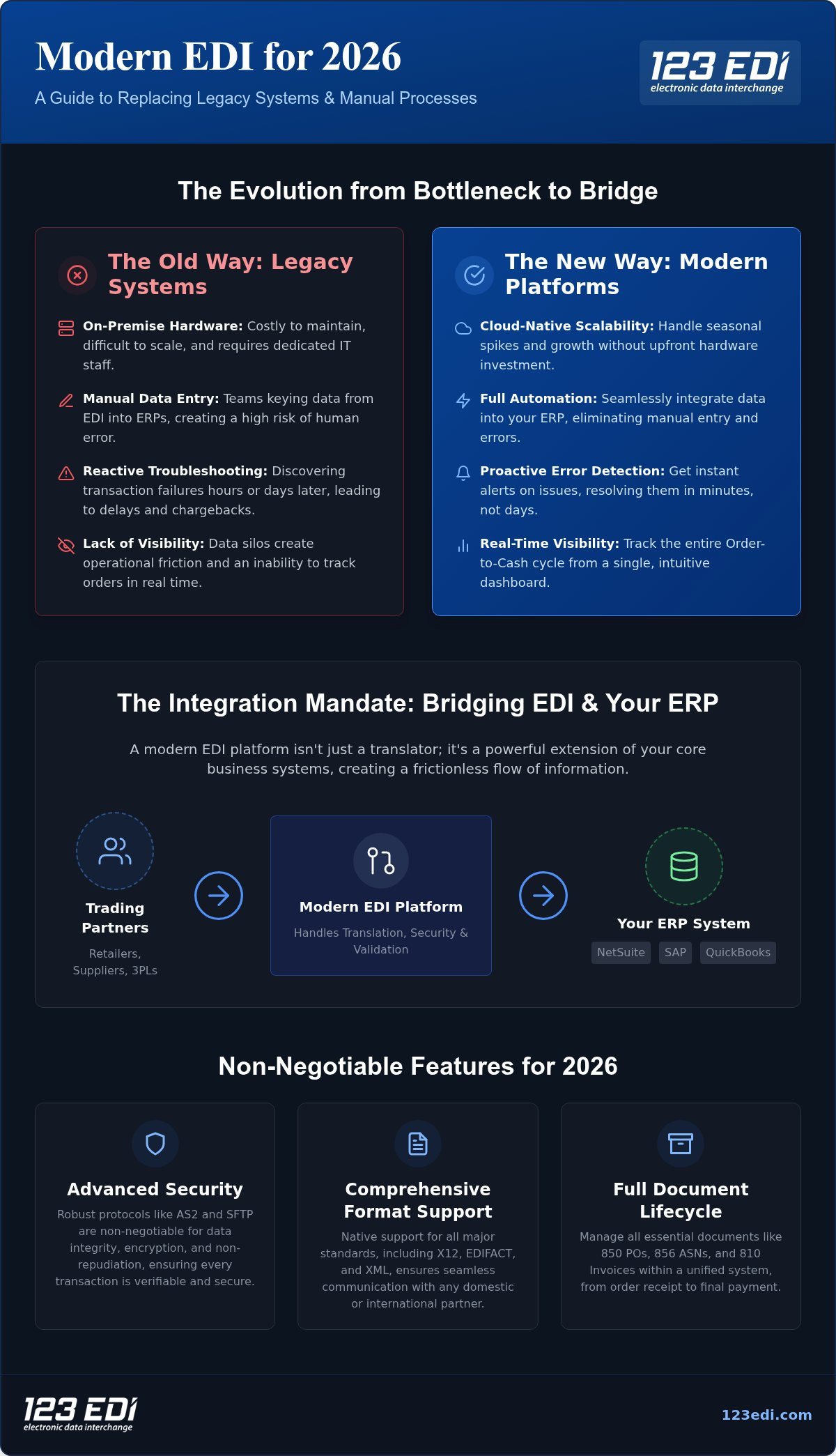
Building a resilient supply chain requires more than just moving files from one point to another. In the past, Electronic Data Interchange (EDI) was often treated as a necessary evil, a rigid requirement imposed by big-box retailers. Today, a modern EDI platform acts as a strategic partner in your growth. It automates the entire B2B transaction lifecycle, from the moment an order arrives to the final payment. Legacy VANs and manual portals are failing modern supply chains in 2026 because they lack the speed and transparency required for just-in-time inventory and rapid fulfillment.
Operational friction often stems from a lack of visibility. When you can’t see the status of a transaction in real time, you’re constantly reacting to errors after they’ve already caused delays. Modern platforms remove this stress by providing a clear, proactive view of every exchange. This clarity acts as a stabilizing force, ensuring that complex data interchange doesn’t derail your daily operations. By simplifying these technical hurdles, you can focus on building stronger relationships with your partners.
The Shift from On-Premise to Cloud-Based EDI Solutions
Scaling a business shouldn’t mean scaling your hardware budget. Cloud-based EDI software provides the scalability needed to handle sudden seasonal spikes without a massive upfront investment in local servers. These systems outperform traditional local converters by centralizing management and reducing the burden on your internal IT team. By moving to the cloud, you gain access to sophisticated tools that are always up to date and accessible from anywhere. You can learn more about this transition in our Comprehensive Guide to Cloud-Based EDI Solutions in 2026.
The Integration Mandate: Why EDI Must Talk to Your ERP
Efficiency dies in the gap between your trading partners and your internal accounting. If your team is still manually typing order details into your system, your risk of error increases with every keystroke. Breaking down these data silos is the primary goal of a modern EDI platform. By creating automated workflows, you ensure that information flows directly into your business logic. Simply put, EDI integration is the bridge between external partners and internal ERP logic. This connection transforms your EDI from a simple communication tool into a powerful extension of your NetSuite, SAP, or QuickBooks environment.
Essential Features of a Modern EDI Platform in 2026
Technical versatility is the first mark of a modern EDI platform. In a global supply chain, your business must be prepared to communicate using a variety of formats. This starts with comprehensive support for domestic X12 EDI standards, but it also extends to international EDIFACT and flexible XML schemas. A robust system doesn’t just translate these files; it ensures they’re perfectly formatted for your specific business logic. By standardizing these diverse data streams, you create a consistent foundation for all your trading partner relationships.
Beyond data translation, the platform must serve as a sentinel for your operations. Automated error detection and proactive alerting systems are no longer optional features. They’re essential tools that notify your team of a mismatch or a failed transmission before it results in a costly retailer chargeback. This proactive approach allows you to resolve issues in minutes rather than discovering them days later when a shipment is rejected. If you’re looking for a steady hand to guide your technical transition, our team at 123 EDI is ready to help you navigate these requirements.
Advanced AS2 Data Transfer and Security
Security is the bedrock of trust in B2B relationships. While some providers focus solely on API speed, we recognize that high-stakes business documents require the non-repudiation and encryption that AS2 provides. A modern EDI platform must handle AS2 certificates and digital handshakes automatically, removing the technical burden from your internal staff. At 123 EDI, we’ve spent decades perfecting secure communications software to ensure your data remains protected. This automation ensures that every document sent or received is legally verifiable and secure, providing peace of mind for both you and your partners.
Real-Time Transaction Visibility and Analytics
True efficiency comes from seeing the whole picture at once. Tracking the entire “Order-to-Cash” cycle from a single, intuitive dashboard allows you to identify bottlenecks in real time. This visibility helps you monitor vendor performance and ensure that every 850 Purchase Order leads to a timely 810 Invoice without manual interference. This level of oversight transforms EDI from a back-office utility into a powerful strategic asset. You can explore how this transparency drives long-term growth in our guide on The Strategic Benefits of EDI: Transforming Supply Chain Efficiency in 2026.
For smaller trading partners who may not have sophisticated ERP systems, a modern solution should also offer user-friendly web-based EDI portals. These portals ensure that even your smallest vendors can participate in your automated ecosystem. This inclusivity strengthens your entire supply chain, ensuring that no partner is left behind due to technical limitations.
Evaluating Vendors: A Buying Guide for Modern EDI
Selecting a vendor is a high-stakes decision that impacts every corner of your supply chain. It’s not merely a software purchase; it’s the selection of a long-term partner who will safeguard your data. When you evaluate a modern EDI platform, you should look beyond the flashy interface and focus on the technical fit with your existing ERP ecosystem. A platform that doesn’t align with your specific internal logic will eventually create more work for your team, defeating the purpose of automation.
Assessing the depth of ERP integration is your first priority. Whether your business relies on NetSuite, SAP Business One, or QuickBooks, the connection must be seamless. You don’t want a generic connector that only pushes files; you need a system that understands your accounting workflows. At 123 EDI, we prioritize this deep connectivity to ensure that data moves accurately without manual intervention. This collaborative approach helps remove the stress of intricate data management, positioning us as a stabilizing force for your operations.
You should also consider the support model that best fits your internal resources. Some vendors offer a DIY “software-only” tool that leaves the heavy lifting to your IT team, while others provide a completely detached managed service. We believe the most effective model is a collaborative partnership. This allows you to leverage our decades of institutional knowledge while maintaining visibility and control over your transactions. It’s about having a wise mentor by your side to help you navigate the complexities of B2B communication.
Compliance Readiness and Chargeback Prevention
Adhering to the strict requirements of major US retailers like Walmart, Amazon, and Target is a constant challenge. A modern EDI platform should offer pre-built mappings for these partners to ensure rapid, accurate onboarding. Compliance is not just about data formats; it’s about adhering to specific business rules, such as the precise timing of an Advance Ship Notice (ASN) relative to a physical shipment. By using a platform that enforces these rules automatically, you protect your bottom line from costly retailer chargebacks and compliance errors.
Scalability and Future-Proofing Your Investment
Your chosen solution must be able to grow alongside your business. A cloud-native architecture is essential for supporting long-term expansion, as it allows you to handle increasing transaction volumes without upgrading physical hardware. Looking ahead ensures that your investment remains relevant as new standards and partners emerge. If you’re managing a diverse network of suppliers, you might also explore The Definitive Guide to Web-Based EDI Portals in 2026 to see how portals can bridge the gap for smaller partners.
Overcoming the ERP Integration Hurdle
Many businesses view ERP integration as the final, most difficult hurdle in their digital transformation. While generic connectors often promise a quick fix, they frequently struggle with the nuances of real-world business logic. A modern EDI platform should do more than just link two systems; it must synchronize them to ensure data remains consistent across your entire organization. By automating the flow of 850 Purchase Orders, 810 Invoices, and 856 Advance Ship Notices (ASNs), you can reduce manual data entry by up to 90%.
This level of synchronization is about more than just moving files. It requires a system that can handle custom fields and unique business rules without breaking the connection. When your modern EDI platform is correctly aligned with your internal processes, it removes the stress of data management and allows your team to focus on high-value tasks. If you’re ready to bridge the gap between your partners and your internal systems, explore our EDI integration services to find a strategy tailored to your needs.
Specialized Integration for Mid-Market ERPs
For users of NetSuite and SAP Business One, the nuances of EDI connectivity are particularly critical. These mid-market ERPs often feature highly customized instances that generic “plug-and-play” tools simply cannot support. At 123 EDI, we simplify the mapping between complex EDI standards and your specific ERP tables, ensuring that every data point lands exactly where it should. You can find a deeper dive into these technical requirements in our Mastering EDI Integration with ERP: The Comprehensive 2026 Guide.
Case Study Insights: Manufacturing and 3PL
In the manufacturing and logistics sectors, speed is the ultimate competitive advantage. Modern EDI accelerates fulfillment by ensuring that production schedules and shipping notifications are updated in real time. For manufacturers, this means less time spent reconciling paper trails and more time meeting production goals. Third-party logistics (3PL) providers also benefit from automated ASN generation, which allows them to scale operations without a proportional increase in headcount. Learn more about these specific benefits in our guide on Cloud EDI for Manufacturers: ERP Integration & Scaling.
Why 123 EDI is the Modern Choice for Strategic Partnership
Choosing a technology provider is often seen as a cold, transactional process. However, when you select a modern EDI platform, you aren’t just buying code; you’re choosing the team that will stand by you during your most critical business cycles. At 123 EDI, we position ourselves as a seasoned mentor with decades of institutional knowledge dating back to 1994. We’ve seen the industry evolve from basic file transfers to complex, real-time ecosystems, and we use that experience to guide our partners through every technical shift.
The value of a collaborative service model cannot be overstated, especially when compared to a “software-only” approach. While many competitors treat EDI as a purely technical API problem, we recognize that your business relies on human connection and mutual respect. We aim to be a stabilizing force that removes the stress of intricate data management through expert oversight. This partnership ensures that your transition from legacy systems to a future-proof cloud platform is handled with precision and care.
The Human Element in Technical Integration
Technical issues don’t follow a 9-to-5 schedule, and they certainly don’t wait for a ticket queue to clear. Having access to dedicated support matters because it allows you to resolve production issues in seconds rather than days. Our commitment to transparency and client education means we don’t just fix problems; we explain the “why” behind the solution. This builds a foundation of long-term trust, positioning 123 EDI as a reliable, steady hand that decision-makers can count on when the stakes are high.
Getting Started: Your Modern EDI Roadmap
Moving to a modern EDI platform is a journey that requires a clear, methodical roadmap. We begin with an initial assessment to identify your high-priority trading partners and the specific requirements of your supply chain. From there, we implement a phased approach to ERP integration. This strategy ensures zero downtime, allowing your business to maintain its momentum while we modernize your workflows. We focus on getting the most critical connections live first, providing immediate relief from manual data entry and compliance errors.
Your business deserves a solution that acts as a bridge to your partners rather than a barrier to your growth. If you’re ready to simplify your technical landscape and build a more resilient supply chain, we’re here to assist. Contact 123 EDI for a personalized consultation and let us help you map out a path to seamless integration.
Securing Your Supply Chain for the Future
Modernizing your data exchange is about more than technical compliance; it’s about reclaiming your team’s time and focus. Transitioning to a modern EDI platform moves your business away from the fragility of legacy systems and toward a future defined by automated, error-free order-to-cash cycles. We’ve discussed how specialized ERP integration and proactive visibility can eliminate the vast majority of manual entry while shielding your bottom line from costly chargebacks. These tools don’t just move data; they provide the stability you need to scale your operations without friction.
With decades of experience in ERP integration and a secure cloud-based infrastructure, 123 EDI is ready to serve as your strategic partner. Our dedicated consultative support ensures that even the most complex compliance requirements become manageable milestones rather than operational roadblocks. We’re here to act as a steady hand, providing the mentorship and technical oversight you need to lead your industry with confidence. Let’s work together to simplify your technical landscape and build a more efficient future.
Streamline your supply chain with the experts at 123 EDI.
Frequently Asked Questions
What is the difference between a legacy EDI system and a modern EDI platform?
Modern platforms are cloud-native and focus on end-to-end automation rather than simple data translation. Legacy systems often rely on on-premise hardware and manual portals that create bottlenecks. A modern EDI platform integrates directly with your ERP, providing real-time visibility and proactive error detection. This shift reduces the technical burden on your staff and allows for faster scaling as your partner network grows.
How long does it typically take to onboard a new trading partner on a modern platform?
Onboarding typically takes a few days to a few weeks, depending on the complexity of the partner’s requirements. Modern platforms use pre-built mappings for major retailers like Walmart or Amazon, which significantly accelerates the process. While legacy systems might take months of custom coding, a cloud-based approach allows for rapid testing and validation. This speed ensures you can start trading and generating revenue without long technical delays.
Can a modern EDI platform integrate with my custom ERP setup?
Yes, a robust platform can handle the unique business logic of customized ERP instances. Whether you use a tailored version of NetSuite, SAP Business One, or QuickBooks, specialized integration services map EDI standards directly to your specific tables. At 123 EDI, we focus on these nuances to ensure that data flows accurately without breaking your internal processes. This collaborative approach ensures your custom fields are fully supported.
Does modern EDI support both API and traditional EDI standards like X12?
Modern systems are designed to be hybrid, supporting both API-driven exchanges and traditional X12 or EDIFACT standards. This flexibility is crucial because while APIs offer real-time speed, many large retailers still mandate traditional EDI for core transactions. By supporting both, a modern EDI platform acts as a universal bridge for your supply chain. It allows you to maintain compliance with legacy partners while adopting faster technology for newer connections.
How does a modern EDI platform help prevent retailer chargebacks?
Chargebacks are prevented through automated validation and proactive alerting. The system checks every document, such as an 856 ASN, against the retailer’s specific business rules before it is sent. If a mismatch is detected, the platform alerts your team immediately, allowing for a correction before the shipment arrives. This layer of oversight acts as a stabilizing force, protecting your margins from avoidable penalties and compliance errors.
What are the security benefits of using AS2 protocols in a modern EDI system?
AS2 provides non-repudiation and high-level encryption, ensuring that business documents are legally verifiable and secure. Unlike simple file transfers, AS2 uses digital certificates to confirm that the sender and receiver are who they claim to be. This protocol is essential for high-stakes data interchange where integrity is paramount. Modern platforms automate the management of these certificates, removing the technical complexity while maintaining a secure communication environment.
Is a cloud-based EDI portal better than on-premise software for small businesses?
Cloud-based portals are generally superior for small businesses due to lower upfront costs and reduced IT overhead. On-premise software requires hardware maintenance and manual updates, which can drain limited resources. A web-based portal allows you to manage transactions from any location with an internet connection. This model provides the same level of sophistication as enterprise systems but with a scalable pricing structure that grows alongside your business.
What should I look for in an EDI provider’s support and service model?
Look for a collaborative partnership that offers more than just a software license. A provider should act as a wise mentor, offering deep institutional knowledge to help you navigate complex technical landscapes. Dedicated support is vital for resolving production issues in seconds rather than waiting in a ticket queue. Transparency and a commitment to client education ensure that you understand your solution, building a foundation of long-term trust.