

What if the secret to achieving 100% retailer compliance wasn’t adding more staff, but removing the human element from your data entry entirely? Most supply chain leaders know the stinging frustration of a costly chargeback or the bottleneck of a delayed payment caused by a simple typo. It’s exhausting to manage growing transaction volumes when your current systems feel like they’re held together by manual effort and hope. You’ll discover how the modern benefits of edi go far beyond simple data exchange to offer a strategic framework that slashes operational costs and strengthens your trading partner relationships.
By aligning your technology with the latest 2026 standards, you can finally gain real-time visibility into your order-to-cash cycle. We’ll explore how seamless ERP integration and the rise of Agentic AI are redefining efficiency, ensuring your business scales without the burden of extra headcount. This guide provides a clear roadmap to transform your supply chain into a stabilizing force for your entire organization, moving you from reactive troubleshooting to proactive partnership. With over three decades of experience helping businesses simplify complex data landscapes, we’re here to show you how modern integration creates a foundation for long-term trust and sustainable growth.
Key Takeaways
- Discover how transitioning to automated digital streams eliminates manual errors and provides a stabilizing force for your daily operations.
- Learn about the strategic benefits of edi for achieving total compliance with major retailers and securing your revenue against chargebacks.
- See why pairing your EDI software with an ERP like NetSuite or QuickBooks is essential for building a workflow that scales without adding headcount.
- Explore the advantages of cloud-based EDI and AS2 protocols for maintaining secure, real-time connectivity in a complex technical landscape.
- Gain a clear roadmap for transforming your supply chain from a source of stress into a competitive advantage through enhanced visibility.
What is EDI and Why is it Essential for Modern Business?
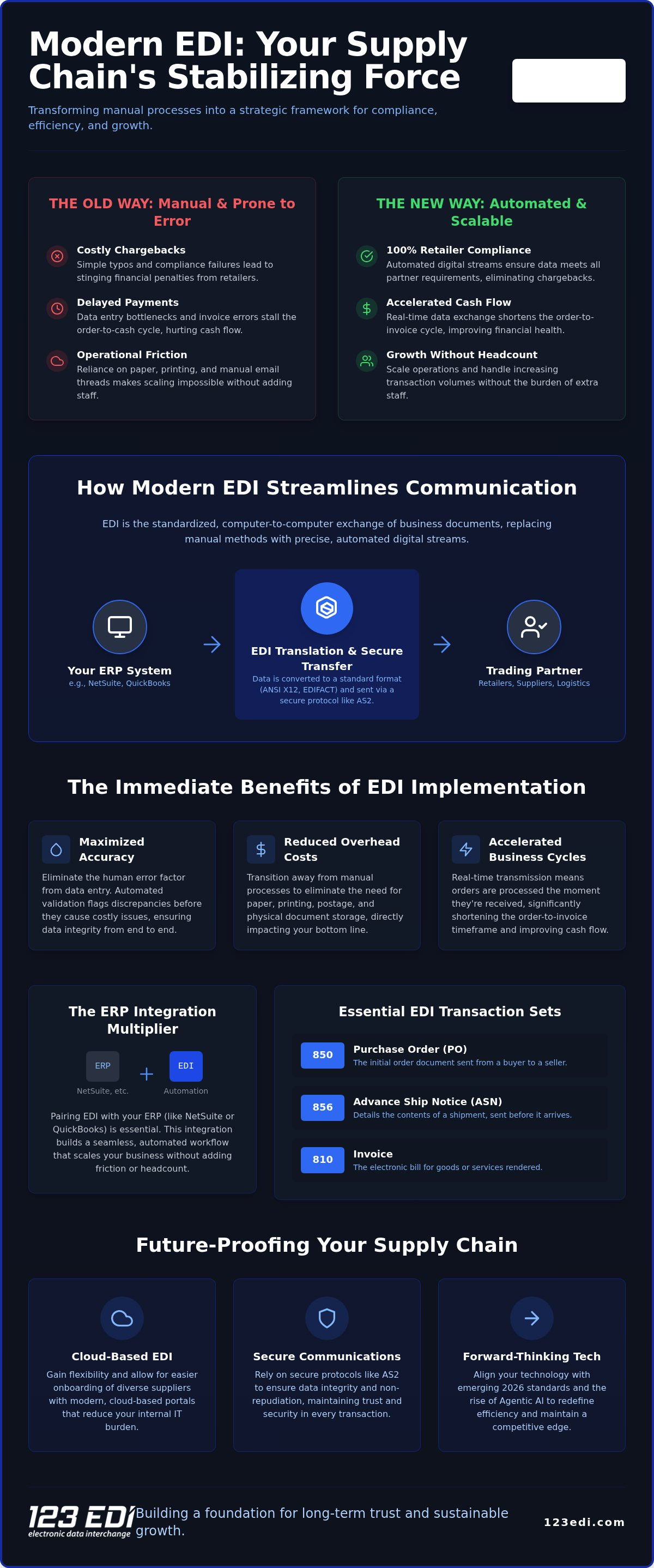
In the high stakes environment of global trade, What is Electronic Data Interchange (EDI)? is the standardized, computer to computer exchange of business documents. It serves as the silent backbone of modern B2B commerce, replacing the unreliable clutter of paper trails and manual email threads with precise, automated digital streams. While the technology has existed for decades, the 2026 landscape demands more than simple data transmission. Today, the primary benefits of edi lie in providing the operational agility necessary to pivot as market demands shift, ensuring your business remains a reliable link in the supply chain.
Mastering the intricate world of EDI standards like ANSI X12 or EDIFACT doesn’t have to be a solitary burden. Working with a seasoned mentor like 123 EDI, a veteran in the field since 1994, helps demystify these complex technical layers. It’s about moving beyond basic compliance to build a foundation of long term trust with your trading partners through clear, structured communication. This collaborative approach transforms a technical requirement into a strategic asset.
The Core Components of an EDI System
A robust EDI setup typically involves either specialized EDI software installed locally or more flexible, cloud based portals that allow for easier onboarding of diverse suppliers. Modern systems rely on secure communication protocols like AS2 to ensure data integrity and non repudiation during transit. The heavy lifting happens during EDI translation, where proprietary data from your internal systems is converted into a universal language that any global partner can understand and process instantly. This eliminates the need for manual intervention and reduces the risk of costly data entry errors.
Standardizing Business Transactions
Standardization is what allows disparate businesses to speak the same language. By utilizing essential transaction sets such as the 850 Purchase Order, the 810 Invoice, and the 856 Advance Shipping Notice (ASN), companies eliminate the guesswork that leads to fulfillment errors. One of the key benefits of edi is this inherent reliability. When you rely on a steady hand to maintain these connections, you ensure that every document arrives in the correct format, every time. This precision is what enables seamless communication across different ERP platforms, turning a complex technical requirement into a streamlined business advantage that supports your growth.
Operational Excellence: The Immediate Benefits of EDI Implementation
Achieving operational excellence begins with the removal of friction from your daily transaction flows. One of the most immediate benefits of edi is the drastic reduction in overhead costs. By transitioning away from manual processes, you eliminate the need for paper, printing, and physical storage. As Gartner defines EDI, it’s the automated exchange of business documents, which directly facilitates this transition. Beyond simple cost savings, business cycles accelerate when data moves at the speed of light. Real-time transmission means that orders are processed the moment they’re placed, significantly shortening the order-to-invoice timeframe and improving your organization’s cash flow.
Manual data entry is inherently prone to mistakes. Even a single transposed digit can lead to shipping errors or payment delays. By removing the human error factor, you ensure that the information entering your system is precise and reliable. This precision is a stabilizing force, allowing your team to focus on growth rather than correcting yesterday’s typos. Beyond the immediate cost savings, the long-term benefits of edi include the ability to scale your operations without the friction of manual oversight.
Maximizing Accuracy and Data Integrity
Automated validation acts as a vigilant gatekeeper, flagging discrepancies before they ever reach your trading partner. This level of oversight ensures that your inventory management remains accurate and your warehouse operations run without interruption. Clean data prevents the ripple effect where one small error creates a week of administrative cleanup. In the context of an 856 Advance Ship Notice, data integrity means that the physical contents of a shipment perfectly mirror the electronic information sent to the retailer.
Scaling Operations Without Increasing Headcount
Scaling a business shouldn’t require a proportional increase in administrative staff. Automation allows your existing team to handle significantly higher order volumes, which is especially vital during peak seasons. Research shows that EDI document traffic between trading partners increased by 23% from 2017 to January 2020, highlighting the need for systems that scale effortlessly. Exploring how cloud-based EDI provides this stability can help you prepare for rapid growth without the stress of managing a bloated back office.
Strengthening Partnerships: Compliance and Supply Chain Visibility
Building a resilient supply chain requires more than just internal efficiency; it demands seamless synchronization with your trading partners. For many growing businesses, the most tangible benefits of edi manifest in the ability to meet the rigorous compliance standards set by major national retailers. Organizations like Walmart, Amazon, and Target don’t just prefer digital communication; they mandate it. By adopting a robust EDI strategy, you position your brand as a reliable and sophisticated partner capable of keeping pace with the high volume demands of modern retail. This digital trust forms the bedrock of long term collaborative success.
Beyond simple compliance, enhanced visibility is a strategic advantage for both suppliers and buyers. When every transaction is digitized, both parties gain a clear window into the order to cash cycle. This transparency reduces the need for constant status inquiries and allows for more accurate forecasting. With a dedicated partner like 123 EDI, you gain the peace of mind that comes from decades of institutional knowledge. We ensure that your data flows are not just compliant, but optimized for mutual growth, acting as a stabilizing force in an often chaotic marketplace.
Avoiding Costly Retailer Chargebacks
Retailer chargebacks are a direct drain on your bottom line. These financial penalties often stem from avoidable errors such as late 856 Advance Ship Notices, incorrect GS1-128 labeling, or pricing discrepancies. One of the critical benefits of edi is the implementation of automated guardrails that prevent these mistakes before they ever leave your system. 123 EDI provides the technical oversight needed to ensure every document meets the exact specifications of your partner. Investing in a compliance first strategy delivers a significant long term ROI by protecting your margins from these unnecessary and expensive fees.
Onboarding Trading Partners with Ease
The speed at which you can onboard new partners directly impacts your time to market. Utilizing a web-based EDI portal allows you to connect with suppliers and buyers regardless of their own technical maturity. This flexibility is essential for businesses looking to scale rapidly or enter new markets without technical bottlenecks. 123 EDI serves as your dedicated integration support team, removing the stress of technical setup and allowing you to focus on the human side of the partnership. By streamlining the onboarding process, you can launch new products faster and respond to market opportunities with greater agility.
The ERP Integration Multiplier: Realizing the Full Potential of EDI
While earlier sections explored the immediate cost savings and compliance advantages of digital data exchange, the true transformation occurs when you integrate your data stream directly into your core business systems. Standalone EDI software often leaves a gap where data must still be manually moved into your accounting or warehouse management platform. This “swivel chair” data entry creates a bottleneck that limits your agility and invites the very errors you’re trying to avoid. One of the most significant benefits of edi is its ability to serve as a seamless bridge, automating the flow of information from the initial purchase order all the way to your financial ledger.
By connecting your transaction streams with your internal environment, you create a single source of truth for your entire organization. This multiplier effect turns a communication tool into a strategic asset. 123 EDI acts as a stabilizing force during this transition, providing the specialized support needed to handle complex data mappings and secure transfers. With a seasoned mentor guiding the setup, you move beyond basic data exchange to a fully synchronized operation that responds to market changes with steady confidence.
NetSuite and SAP EDI Integration Best Practices
For enterprises utilizing powerful platforms like NetSuite or SAP Business One, integration is about achieving total synchronization. You can maintain real-time inventory levels across every sales channel, which prevents the frustration of overselling or backorders. Automating financial reconciliation also reduces the grueling end of month processing time from days to just a few hours. Leveraging 123 EDI’s institutional knowledge ensures you avoid the common integration pitfalls that often plague complex ERP environments, allowing for a smooth and logical progression toward operational clarity.
QuickBooks EDI for Growing Businesses
Integrated EDI isn’t reserved solely for large corporations. For smaller manufacturers, connecting your EDI portal with QuickBooks is the key to competing on a national stage. It effectively bridges the gap between small business accounting and the sophisticated electronic requirements of major retail chains. Exploring cloud EDI for manufacturers shows how this approach reduces manual entry and keeps your team focused on product development and customer service rather than administrative paperwork. This level of automation provides the stability needed to scale your business without the fear of outgrowing your internal systems.
Ready to see how EDI integration with ERP systems can multiply your operational efficiency and secure your supply chain?
Future-Proofing with Cloud-Based EDI and Secure Communications
Establishing a resilient infrastructure is the final piece of the digital transformation puzzle. The shift from legacy on-premise EDI to flexible, cloud-based solutions represents a fundamental change in how businesses manage their data. While older systems often required significant hardware investment and localized maintenance, modern cloud environments offer the scalability needed to meet the demands of a $49.21 billion global market by 2027. The benefits of edi are most apparent when your system can grow alongside your ambitions without the friction of technical debt. Partnering with a veteran consultant like 123 EDI, who has navigated every major industry shift since 1994, ensures you aren’t just reacting to changes but anticipating them.
Maintaining 24/7 availability for critical business transactions is no longer optional in a global economy that never sleeps. As standards evolve, such as the recent HIPAA 008060 updates completed in late 2025 or the annual X12 releases every January, having a steady hand to guide your implementation is vital. This proactive approach to maintenance removes the stress of compliance updates and allows your leadership team to focus on high-level strategy. It’s about building a foundation of long-term trust through technology that is as reliable as the people behind it.
The Advantages of Cloud EDI Portals
Transitioning to a cloud-based EDI solutions portal significantly lowers your total cost of ownership by eliminating the need for expensive on-site server maintenance and dedicated IT staff for hardware upkeep. These web-based interfaces provide the freedom to access critical business data from anywhere, ensuring your team stays connected whether they’re in the office or in the field. Reliability is a cornerstone of this service, with 99.9% uptime becoming the expected standard for cloud-based communications. This level of stability ensures that your transaction flow remains uninterrupted, even during peak seasonal volumes or unexpected market surges.
Secure B2B Data Transfer and AS2
AS2 remains the gold standard for secure, direct EDI communication because it provides a robust framework for data integrity and non-repudiation. By utilizing digital certificates, businesses can verify the identity of their trading partners and ensure that documents haven’t been altered during transit. By employing encrypted channels and digital signatures, these secure protocols protect your intellectual property and proprietary trade data throughout the entire exchange process. This sophisticated layer of oversight is what allows the benefits of edi to include peace of mind, knowing that your most sensitive business information is shielded from unauthorized access while moving through the global supply chain.
Securing Your Supply Chain for the Future
Transforming your supply chain into a streamlined, automated engine is no longer a luxury; it’s a necessity for thriving in the 2026 marketplace. By embracing the strategic benefits of edi, you move from reactive troubleshooting to proactive growth. You’ve seen how digital data exchange eliminates manual errors, secures your revenue against retailer chargebacks, and creates a multiplier effect when integrated with your ERP. This transition provides the visibility and agility needed to scale without adding unnecessary headcount.
As a privately held industry veteran since 1994, 123 EDI understands that technology is only as good as the partnership behind it. We specialize in complex ERP integrations for NetSuite, SAP Business One, and QuickBooks, acting as a stabilizing force for your data management. We don’t just provide software; we provide a seasoned mentor to guide your journey toward efficiency. Let the experts at 123 EDI simplify your integration journey; get started today. We look forward to helping you build a foundation of long term trust and operational clarity.
Frequently Asked Questions
What are the primary business benefits of implementing EDI?
The primary benefits of implementing EDI include reduced operational costs, accelerated business cycles, and enhanced data accuracy by eliminating manual entry. By digitizing documents like purchase orders and invoices, companies can process transactions in real-time rather than waiting days for manual re-keying. This automation provides a stabilizing force for growing businesses, allowing them to scale without adding administrative staff while maintaining total compliance with trading partner requirements.
How does EDI help in avoiding retailer chargebacks?
EDI helps avoid retailer chargebacks by enforcing strict validation rules that catch errors before documents are sent. Retailers often penalize suppliers for late Advance Ship Notices, incorrect labeling, or pricing discrepancies. An integrated EDI system ensures that the data in your electronic documents perfectly matches the physical shipment and the original purchase order. This precision removes the human error factor that typically triggers these expensive financial penalties.
Can EDI be integrated with my existing ERP system like NetSuite or SAP?
Modern EDI solutions are designed specifically for seamless integration with major ERP systems like NetSuite, SAP Business One, and QuickBooks. By connecting your transaction data directly to your financial ledger and inventory management system, you create a single source of truth. This integration eliminates “swivel chair” data entry, ensuring that order information flows automatically into your ERP without manual intervention, which significantly increases your overall operational agility.
What is the difference between a cloud-based EDI portal and EDI software?
A web-based EDI portal is a web-accessible interface that requires no local hardware, while traditional EDI software is typically installed on your own servers. Cloud portals offer lower total cost of ownership because the provider handles all maintenance, security, and updates. This model is ideal for businesses that need to onboard partners quickly and access data from anywhere. Conversely, on-premise software provides more localized control but requires dedicated IT resources.
How much can a business save by switching from manual processes to EDI?
While exact savings depend on transaction volume, businesses typically see a dramatic reduction in overhead by eliminating paper, printing, and storage costs. One of the key benefits of edi is the reduction in labor costs associated with manual data entry and error correction. By automating the order-to-cash cycle, your team can focus on strategic growth rather than administrative tasks, effectively lowering the cost per transaction as your business scales.
Is AS2 the most secure way to transfer EDI data?
AS2 remains the gold standard for secure B2B data transfer because it uses digital certificates and encryption to protect information during transit. It provides non-repudiation, meaning both the sender and receiver have proof that the document was delivered and remained unaltered. While other methods like encrypted HTTPS are common, AS2’s established reliability and widespread adoption among major retailers make it a secure choice for protecting sensitive intellectual property.
How long does it typically take to onboard a new trading partner via EDI?
Onboarding times vary based on the complexity of the partner’s requirements, but a cloud-based EDI portal can significantly accelerate the process. Standard integrations might take a few weeks, while custom mappings for complex ERP environments can take longer. Working with an industry veteran like 123 EDI helps shorten this window. Our team uses established templates and deep institutional knowledge to navigate retailer specifications, getting your products to market faster.
Do I need a large IT team to manage an integrated EDI system?
You don’t need a large internal IT team when you partner with a managed EDI provider. Cloud-based solutions shift the technical burden to the service provider, who handles system maintenance, security updates, and compliance with evolving standards. This allows your business to leverage sophisticated technology without the overhead of dedicated IT staff. Our role is to act as your integration support team, simplifying the complex technical landscape for your leadership.