

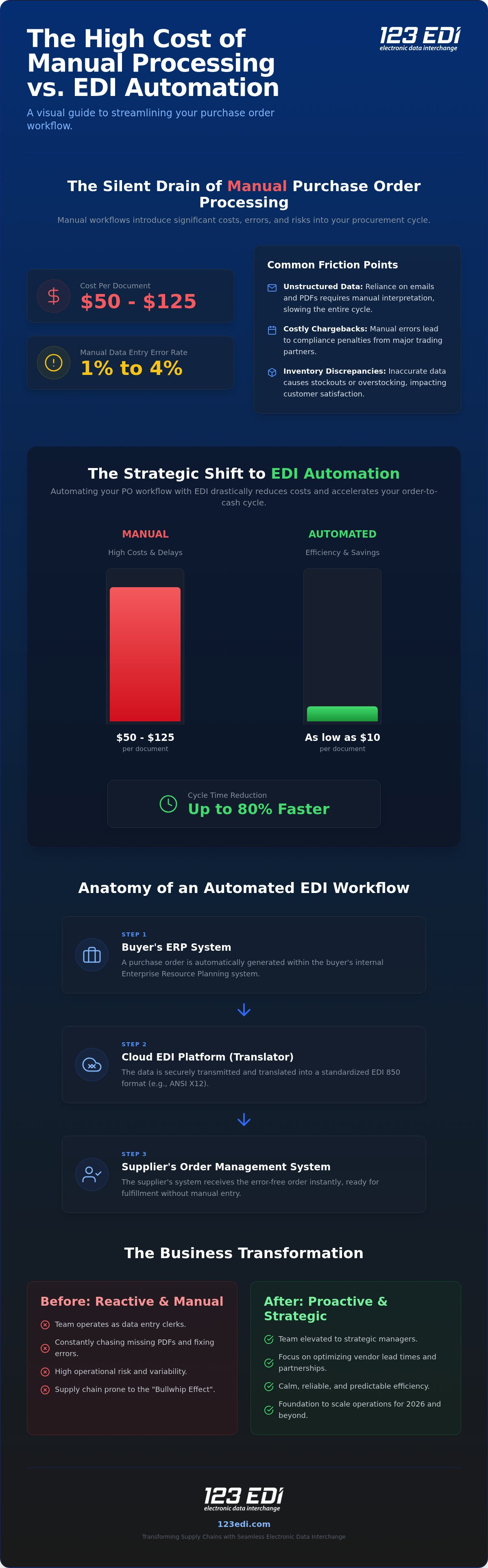
Did you know that manual purchase order processing can cost your business between $50 and $125 per document? When you factor in the 1% to 4% error rate typical of manual data entry, those costs quickly compound into significant operational strain. You likely recognize the frustration of slow order-to-cash cycles and the mounting difficulty of managing high volumes of supplier documents. It’s a heavy burden that often keeps your team from focusing on higher-value strategic partnerships. We understand that moving toward a more efficient system feels like a complex technical leap, but it’s a necessary step to stabilize your procurement cycle.
By choosing to automate purchase order workflow through modern EDI integration, you can reduce processing costs to as little as $10 per order while cutting cycle times by up to 80%. This guide provides the step-by-step process to eliminate manual entry and gain real-time visibility into your order status. We’ll explore how cloud-based EDI software and seamless ERP integration create a hands-off environment for your team. From understanding AS2 protocols to leveraging AI-enhanced data validation, you’ll discover how to transform your supply chain into a model of calm, reliable efficiency for 2026.
Key Takeaways
- Identify the hidden operational costs of manual data entry and how automation helps stabilize your procurement cycle.
- Learn how to automate purchase order workflow using the EDI 850 transaction set to enable a seamless, hands-off exchange of data.
- Follow a logical five-step guide to mapping your existing processes and selecting an EDI partner that fits your specific business needs.
- Discover the critical importance of ERP integration for maintaining a single source of truth and preventing redundant data management.
- Evaluate potential providers based on their seasoned reliability and their commitment to a collaborative, human-centered service model.
The High Cost of Manual Purchase Order Processing
Manual purchase order processing is often a silent drain on corporate resources. While many teams view it as a standard cost of doing business, the reality is that manual workflows introduce a high degree of variability and risk. Research indicates that manual data entry is prone to error rates between 1% and 4%, which might seem small until those errors propagate through your entire procurement cycle. These inaccuracies lead to countless labor hours spent on reconciliation rather than growth. When you choose to automate purchase order workflow, you remove the human-centric bottlenecks that hinder seasoned reliability.
Delayed processing also triggers the “Bullwhip Effect” within your supply chain. A small delay in issuing or confirming a PO can cause massive fluctuations in inventory levels for your suppliers, eventually leading to stockouts or overstocking at your own facilities. As we move through 2026, the ability to scale your operations depends on your technical foundation. Manual workflows simply fail to keep pace with high-volume demands, leaving your team in a reactive state where they’re constantly putting out fires instead of building partnerships. This shift from reactive fixing to proactive management is the hallmark of a mature, digitally enabled business.
Common Friction Points in Traditional PO Workflows
Unstructured data found in emails and PDFs remains a primary enemy of efficiency. These formats require manual interpretation, which slows down the order-to-cash cycle and creates room for miscommunication. For those working with major retailers, manual errors often result in costly chargebacks and compliance penalties. These financial drains occur when shipping labels or quantities don’t align perfectly with the original order. Beyond the fines, inventory discrepancies often stem from these manual gaps, causing stockouts that frustrate your end customers and damage your reputation for reliability.
The Strategic Shift to Digital Efficiency
Transitioning toward a paperless office requires a move away from the filing cabinet mentality. By adopting Electronic Data Interchange (EDI), your business establishes a standardized language for all transactions. This shift allows your procurement team to pivot from data entry clerks to strategic managers. Instead of chasing down missing PDFs, they can focus on optimizing vendor lead times and negotiating better terms. To begin this transition effectively, you should review our how to reduce manual data entry EDI checklist, which outlines the immediate steps for refining your operations and reclaiming your team’s time.
What is an Automated Purchase Order Workflow in EDI?
To truly automate purchase order workflow, you must look past simple email notifications and focus on the structural movement of data. At its core, PO automation refers to the seamless, electronic exchange of the EDI 850 transaction set between trading partners. Instead of a procurement officer manually entering details into a system, the information originates in the buyer’s Enterprise Resource Planning (ERP) system. It then travels through a secure communication channel and populates directly into the supplier’s order management software. This process relies on established standards like ANSI X12, common in North America, or EDIFACT, used globally, to ensure that disparate systems speak the same language without human intervention.
While technology drives the exchange, the goal is always to support the human partnerships that sustain your business. Cloud-based EDI has emerged as the stabilizing force in this landscape, providing a centralized environment where data remains consistent and accessible. By removing the “cold” feel of disconnected legacy systems, modern automation allows for a more transparent and collaborative relationship with your vendors. When your systems align perfectly, you spend less time troubleshooting data gaps and more time building trust with your suppliers.
The Anatomy of an EDI 850 Purchase Order
The EDI 850 contains all the vital instructions required to fulfill an order without ambiguity. Key data points include the unique PO number, specific line items with quantities, requested shipping dates, and precise delivery locations. An EDI translator serves as the bridge in this exchange; it takes the raw data from your internal ERP and maps it into the standardized EDI format that your partner’s system can interpret. The EDI 850 serves as the digital backbone of the modern procurement cycle, providing a legally binding and error-free instruction set for every transaction.
Cloud vs. On-Premise EDI Automation
Choosing the right delivery model is critical for long-term operational stability. While on-premise systems were once the norm, cloud-based infrastructure offers the agility to scale instantly as your transaction volumes grow in 2026. For smaller partners who may not have a full EDI setup, a web-based EDI portal provides a reliable way to receive and acknowledge orders through a simple browser interface. Secure data transfer is maintained through protocols like AS2, which creates a direct, encrypted connection between partners. If you’re looking for a steady hand to guide your transition, exploring EDI integration with ERP systems can help clarify the best path for your specific technical environment.
How to Implement an Automated PO Workflow: A 5-Step Guide
Implementing a digital shift in your procurement cycle requires a methodical approach that balances technical precision with human collaboration. To successfully automate purchase order workflow, your organization needs a clear roadmap that moves beyond simple software installation toward full system harmony. This structured path ensures that every stakeholder, from your internal IT team to your external suppliers, remains aligned with your efficiency goals.
Step 1: Audit and Mapping. Begin by mapping your current procurement process to identify exactly where manual touches occur. Pinpointing these bottlenecks allows you to design a digital workflow that addresses real-world friction rather than theoretical problems.
Step 2: Provider Selection. Focus on selecting an EDI provider that offers deep ERP integration. A partner with a seasoned history in systems like NetSuite, SAP, or QuickBooks ensures that data flows naturally between your master records and your communication channels without requiring custom development.
Step 3: Data Definition. You must define specific data requirements with your trading partners. This collaborative phase ensures that both sides agree on the mandatory fields, such as shipping windows and item codes, required for a successful exchange.
Step 4: Sandbox Testing. Before moving live business data, utilize a ‘sandbox’ environment to validate the EDI 850 transaction. This testing phase is the most critical step for catching configuration gaps before they impact your actual inventory or financial records.
Step 5: Launch and Oversight. Once you go live, maintain a period of close monitoring. Use this time to refine the workflow and ensure that the automated cycle provides the real-time visibility your team needs to manage by exception rather than by manual entry.
Mapping Your Data for Success
Precision in data mapping is the foundation of a hands-off procurement process. You must identify which specific ERP fields, such as warehouse locations and pricing tiers, align with the corresponding segments in the EDI document. Cross-referencing part numbers and units of measure is essential; if your ERP uses “EA” for each but your supplier expects “PCS,” the order will likely fail. By taking the time to harmonize these definitions, you prevent the common mapping errors that lead to rejected orders and the stress of manual rework.
Onboarding Trading Partners Efficiently
Your automation is only as strong as your weakest link. Communicating technical requirements to your vendors should be a transparent, helpful process that emphasizes mutual benefit. For partners who aren’t yet ready for full EDI integration, a cloud-based EDI portal allows them to participate in your automated workflow through a simple web interface. Partner compliance is the key to 100% automation across your entire supply chain.
The Power of EDI Integration with Your ERP System
Many businesses begin their automation journey by using a standalone EDI portal to meet a specific customer’s requirement. While this solves the immediate compliance hurdle, it often creates a “swivel-chair” environment where staff must manually copy data from the portal into their internal systems. To truly automate purchase order workflow, you must eliminate these disconnected silos. True efficiency is found when your EDI software is woven directly into the fabric of your existing infrastructure, ensuring that your Enterprise Resource Planning (ERP) system remains the single source of truth for your entire operation.
Maintaining your ERP as the master record ensures that inventory levels, pricing tiers, and vendor information remain accurate and synchronized across all departments. When a purchase order arrives, it should populate your system immediately, triggering the necessary internal workflows without human intervention. For high-volume environments in 2026, real-time synchronization is the gold standard for maintaining a competitive edge, though batch processing remains a viable option for businesses with less frequent transaction cycles. For a deeper look at these technical nuances, you can explore our resource on mastering EDI integration with ERP.
Connecting to NetSuite, SAP, and QuickBooks
Modern EDI software serves as a sophisticated translator that bridges the gap between different ERP languages. Whether you rely on the robust frameworks of NetSuite and SAP or the streamlined accessibility of QuickBooks, pre-built connectors reduce the need for expensive custom ERP development. These connectors facilitate a secure ‘handshake’ between systems, ensuring that data integrity is maintained as information moves from the outside world into your financial records. This steady, reliable connection removes the technical stress typically associated with system upgrades and migrations, providing a stable foundation for your business to grow.
Beyond the PO: The Full Transaction Cycle
The initial purchase order is merely the first step in a much larger, collaborative journey. A fully integrated system ensures that the receipt of an EDI 850 automatically triggers subsequent documents, such as the EDI 855 (Purchase Order Acknowledgement) and the EDI 810 (Invoice). This creates a closed-loop environment where invoices are reconciled against original orders and shipping notices automatically, significantly reducing the risk of payment disputes. By adopting this comprehensive approach, you move toward a future of complete operational clarity. You can learn more about this transition in our 2026 guide to digital efficiency.
If you’re looking for a steady hand to guide your technical transition, our team specializes in EDI integration with ERP systems that remove the burden of manual data management.
Choosing a Reliable Partner for Your PO Automation Journey
Selecting the right technology provider is a decision that extends far beyond a simple comparison of software features. While many platforms offer the basic ability to automate purchase order workflow, the true value lies in the seasoned reliability of the team behind the code. An experienced partner understands that your procurement cycle is a living part of your business, requiring more than just a cold, automated response. You need a collaborator that possesses deep institutional knowledge and a commitment to helping you navigate the technical nuances of modern supply chain management. To ensure you’re making the right choice, our ultimate evaluation checklist for choosing a reliable EDI provider in 2026 offers a comprehensive framework for assessing any potential partner.
Technical precision is vital, but the value of a human-in-the-loop service model cannot be overstated. When complex data exceptions arise, having access to a wise mentor or a trusted consultant ensures that your operations remain stable. This collaborative approach removes the stress of intricate data management, allowing your team to focus on growth while we handle the technical heavy lifting. As you add more trading partners, your EDI solution must scale with you, maintaining consistent performance without increasing the administrative burden on your staff.
What to Look for in an EDI Provider
Security and transparency should be at the forefront of your evaluation process. When you entrust a partner with your business transactions, they must adhere to the highest security standards, utilizing secure AS2 protocols to protect your sensitive data. Beyond security, consider the speed of implementation. A reliable provider should have a clear roadmap to get you EDI compliant quickly, avoiding the long delays that stall your digital transformation. Finally, look for transparent pricing models. Many providers in the industry still rely on hidden fees or per-character charges that make budgeting difficult. A partner that offers clarity in their costs demonstrates the respect and honesty required for a long-term relationship.
Simplifying the Complex with 123 EDI
At 123 EDI, we position ourselves as more than just a software vendor; we are a dedicated partner in your success. Drawing on decades of experience, we act as a patient educator, helping you understand the “why” behind your technical setup as much as the “how.” Our cloud-based EDI software is designed to integrate seamlessly with your ERP, removing the friction of manual entry and providing the steady hand you need to manage your global supply chain. We take pride in our ability to simplify complex technical landscapes, turning a daunting transition into a smooth, logical progression toward efficiency. Ready to streamline your procurement? Consult with a 123 EDI expert today.
Building a Resilient Procurement Future
Transitioning to a digital-first strategy is a critical step toward long-term operational stability. When you decide to automate purchase order workflow, you move beyond the inherent risks of manual data entry and reclaim your team’s time for higher-value strategic activities. We’ve explored how the right technical foundation creates a closed-loop system where data flows seamlessly from your ERP directly to your trading partners. This transformation doesn’t just improve your bottom line; it strengthens the human relationships and mutual trust that drive your business success.
With over 30 years of EDI integration expertise, 123 EDI provides the steady hand needed to navigate these complex technical landscapes with confidence. Our secure, cloud-based AS2 communication software and seamless ERP connectors for SAP, NetSuite, and other major platforms ensure your data remains accurate and protected. Streamline your supply chain with 123 EDI’s automation solutions. We’re here to help you simplify the complex and build a more efficient, stress-free procurement cycle for 2026 and beyond.
Frequently Asked Questions
What is the difference between a manual and an automated purchase order?
A manual purchase order requires human intervention to transcribe data from emails or PDFs into a system. This method is slow and carries a 1% to 4% error rate. In contrast, an automated purchase order moves directly between systems via Electronic Data Interchange. When you automate purchase order workflow, the information populates your ERP without human touch, reducing processing time by up to 80% and eliminating costly transcription mistakes.
Do my suppliers need to have EDI software for me to automate my POs?
Your suppliers don’t necessarily need their own full EDI software to participate in your automated system. While large vendors often have their own systems, smaller partners can use a cloud-based EDI portal. This web-based interface allows them to receive, view, and acknowledge your purchase orders using a standard internet browser. This approach ensures that 100% of your supply chain can participate in your digital transformation without requiring expensive technical investments.
How long does it typically take to implement an EDI PO workflow?
The timeline to implement an EDI PO workflow typically ranges from a few weeks to a couple of months. This duration depends on the complexity of your ERP integration and the number of trading partners you need to onboard. We focus on a methodical five-step process that includes mapping, testing in a sandbox environment, and final validation. This structured approach ensures a stable transition that minimizes disruption to your daily procurement activities.
Can I automate purchase orders if I use QuickBooks or a smaller ERP?
You can absolutely automate purchase orders if you use QuickBooks or other smaller ERP systems. Modern EDI software acts as a specialized translator that bridges the gap between your accounting software and your partners’ systems. 123 EDI has specialized in these integrations since 1994, providing pre-built connectors that remove the need for custom development. This allows smaller businesses to trade with major retailers on a level playing field while maintaining data integrity.
What is an EDI 850, and why is it essential for PO automation?
The EDI 850 is a standardized electronic document used specifically for purchase orders. It serves as the digital backbone of procurement by containing all necessary transaction details like item numbers, quantities, and shipping dates in a format systems can read. This transaction set is essential because it replaces unstructured data like emails with a precise, legally binding instruction set. It’s the primary tool used to automate purchase order workflow and ensure system-to-system compatibility.
Will automating my PO workflow help with retailer compliance?
Automating your PO workflow is a critical step for maintaining retailer compliance. Major retailers have strict requirements for data accuracy and delivery windows; failing to meet these often results in expensive chargebacks. By using EDI, you ensure that every document meets the specific formatting and communication standards required by your partners. This consistency builds trust with retailers and protects your margins from the penalties associated with manual processing errors. For suppliers navigating these demands, our 2026 strategic guide to simplify EDI compliance offers a detailed roadmap for eliminating chargeback risk through full automation.
What happens if a purchase order contains an error in an automated system?
When an error occurs in an automated system, the EDI software typically catches it during the validation phase before it reaches your ERP. Instead of allowing a faulty order to trigger a shipment, the system flags the discrepancy for human review. This “management by exception” model allows your team to focus only on the few orders that need attention. It prevents the propagation of bad data through your supply chain and ensures master records remain accurate.
Is cloud-based EDI secure for sensitive financial transactions?
Cloud-based EDI is highly secure and specifically designed for sensitive financial transactions. These systems utilize the AS2 protocol, which provides point-to-point encryption and digital certificates to verify the identity of both the sender and receiver. Unlike email or paper-based systems, cloud EDI offers a clear audit trail and follows rigorous security standards like SOC compliance. This technical foundation provides the seasoned reliability needed to protect your business data in a digital environment.