

What if the most expensive part of your supply chain isn’t your shipping logistics, but the silent failure of a data connection you thought was secure? Identifying a truly reliable EDI provider has become the difference between a fluid operation and one plagued by costly retailer chargebacks and missed opportunities. You’ve likely experienced the stress of an ERP update that unexpectedly breaks your communication flow, leaving your team to scramble while a support desk remains silent. It’s a frustrating cycle that compromises your growth and strains your most valuable partnerships.
Choosing the right partner in 2026 is about more than just checking a box for compliance; it’s about establishing a foundation of technical precision and long-term stability. By shifting your focus toward a collaborative partnership rather than a cold utility, you can reclaim control over your operations and reduce manual intervention. This article provides a comprehensive framework to help you identify a partner that ensures seamless ERP integration and offers the steady hand of an industry veteran. We will walk through a detailed evaluation checklist that covers technical security, support responsiveness, and the deep synchronization required to keep your business moving forward without interruption.
Key Takeaways
- Learn why secure AS2 protocols and high cloud uptime are essential foundations for protecting your data exchange in 2026.
- Discover the critical difference between simple “bolt-on” connectors and deep, bi-directional ERP synchronization for long-term stability.
- Identify how a reliable EDI provider uses pre-configured retailer maps to accelerate your onboarding and prevent expensive compliance chargebacks.
- Understand why prioritizing a provider with a mentor-led approach to support can transform your technical challenges into strategic advantages.
- Access a comprehensive checklist to evaluate the total cost of ownership and avoid hidden fees that often complicate EDI partnerships.
Checklist Item 1: Evaluating Technical Infrastructure and Security
When you begin your search for a reliable EDI provider, the technical foundation of their platform is the first place to look. It’s not just about moving data from point A to point B; it’s about ensuring that every transaction is encrypted, tracked, and resilient against system failures. In 2026, security standards have evolved. It’s now vital to verify that your partner utilizes SOC 2 compliance or equivalent certifications to protect sensitive supply chain information. A secure infrastructure acts as the stabilizing force your business needs to operate without the constant fear of data breaches or lost orders.
Beyond simple connectivity, a robust provider offers automated error detection and real-time transaction monitoring. This level of oversight ensures that if a document fails to process, your team is alerted immediately rather than discovering the issue days later through a retailer’s penalty notice. Technical precision here prevents the small glitches that often snowball into major supply chain disruptions. You want a partner that views security as a continuous commitment rather than a one-time setup.
The Role of Secure AS2 Communications
AS2 remains the gold standard for secure B2B file transfer because it offers direct, encrypted peer-to-peer communication. Unlike older methods, AS2 provides non-repudiation, which acts as a digital certified mail receipt. This ensures that neither party can claim they didn’t receive a document. A seasoned reliable EDI provider doesn’t just offer the protocol; they manage the complexity for you. This includes handling managed AS2 certificates and automated renewals so your connections don’t expire unexpectedly. During high-volume transaction peaks, your infrastructure must handle increased loads without latency, ensuring that your data moves as fast as your warehouse team.
Cloud Availability and Data Redundancy
A modern cloud-based EDI portal provides the 24/7 visibility your team needs to manage exceptions as they happen. When evaluating a provider, ask specific questions about their redundancy and uptime. A 99.9% uptime guarantee should be a baseline, but you should also look for failover systems that prevent downtime during maintenance. If a server goes down, the system should failover instantly to a secondary site. You should also inquire about disaster recovery and the frequency of data backups. For a deeper look into these requirements, you can explore our Comprehensive Guide to Cloud-Based EDI Solutions in 2026. This transparency builds the foundation of long-term trust you need from a technical partner.
- Redundancy: Check for geographically dispersed data centers to ensure regional outages don’t stop your business.
- Monitoring: Look for real-time dashboards that show the status of every inbound and outbound document.
- Security: Confirm that data is encrypted both at rest and in transit using current industry standards.
Checklist Item 2: Assessing ERP Integration Depth
A successful EDI strategy hinges on how well your external communications talk to your internal systems. When you evaluate a reliable EDI provider, you must look past the flashy dashboards and investigate the actual depth of their ERP connectors, specifically for systems like NetSuite, SAP, or QuickBooks. Many providers offer what’s essentially a “bolt-on” solution; a surface-level link that merely passes files back and forth without truly understanding your internal workflows. A deep, bi-directional sync ensures that data updated in your ERP is immediately reflected in your EDI portal and vice versa. This level of synchronization is what separates a mere vendor from a true technical partner.
One of the most immediate benefits of a robust integration is the ability to reduce manual data entry with EDI. By automating the mapping process, you eliminate the human error that leads to shipping delays or accounting discrepancies. You should also verify that the provider supports custom business logic within the connector. Your business likely has unique rules for handling backorders or split shipments; your EDI system should be flexible enough to respect those rules rather than forcing you to change your operations to fit the software.
Evaluating the ERP-EDI Connector
A critical question to ask is who owns the mapping process. If your internal IT team is responsible for every change, you’ll quickly face bottlenecks that slow down your response times. A reliable EDI provider with a mentor-led approach will handle the heavy lifting of mapping, ensuring your system stays current with retailer requirements. You should also look for native support across various modules like Inventory, Accounting, and Sales to ensure total visibility. Deep integration acts as the vital bridge that eliminates data silos by ensuring information flows seamlessly between your supply chain partners and your core business systems. If you’re looking for a partner that prioritizes this level of connection, you might explore our integration capabilities.
Scalability for Future Growth
Your business won’t stay the same size forever. An integration that works for 100 orders a month might crumble when that number hits 1,000 or 10,000. You need to confirm that the infrastructure can handle a 10x increase in transaction volume without a dip in performance. Along with this, check for the flexibility to add new ERP modules as your business evolves.
For a more detailed roadmap on achieving this, see our guide on Mastering EDI Integration with ERP. This foresight ensures your technical foundation remains a stabilizing force during periods of rapid expansion.
Checklist Item 3: Trading Partner Onboarding and Compliance
Once your internal systems are synchronized, the focus shifts to the speed and precision of your external connections. A reliable EDI provider distinguishes itself by maintaining an extensive library of pre-configured maps for major global retailers such as Walmart, Amazon, and Target. These templates aren’t just generic files; they’re refined technical blueprints that account for the unique requirements of each trading partner. By leveraging these existing maps, you can bypass the lengthy development cycles that often delay new product launches or partnership activations.
Compliance is a moving target. Retailers frequently update their specifications, and failing to adapt can lead to severe financial penalties. Your partner must demonstrate a deep mastery of various EDI standards, including X12 and EDIFACT, while supporting essential transaction sets like the 850 Purchase Order, 810 Invoice, and 856 Advance Ship Notice. This technical breadth ensures that no matter who you trade with, your data remains formatted correctly and arrives on time. It’s this level of comprehensive oversight that protects your margins from the friction of non-compliance.
Retailer-Specific Compliance Mastery
The best providers act as a stabilizing force by anticipating changes before they impact your workflow. They maintain active relationships with major trading hubs to stay ahead of evolving requirements. To truly protect your business, you should look for a partner that can simplify EDI compliance through automated validation tools. These tools act as a final gatekeeper, catching formatting errors or missing data points before they’re transmitted to the retailer. This proactive approach transforms compliance from a source of stress into a streamlined, automated background process.
The Onboarding Experience
Speed is a competitive advantage in the modern supply chain. When evaluating a reliable EDI provider, ask for their average timeline to onboard a new trading partner. A process that takes months is no longer acceptable in 2026. You want a partner that offers a clear roadmap and handles the testing and certification process on your behalf. This managed service model allows your team to focus on growth while the provider manages the technical dialogue with your partners. For businesses working with smaller suppliers, check if the provider offers a cloud-based EDI portal. This ensures that even partners without complex internal systems can connect to your network with ease, maintaining the integrity of your automated supply chain.
- Testing Accuracy: Verify that the provider performs rigorous end-to-end testing before going live.
- Map Updates: Confirm that updates to retailer maps are included in your service without additional development fees.
- Transaction Support: Ensure support for specialized documents like the 846 Inventory Advice or 855 PO Acknowledgement.
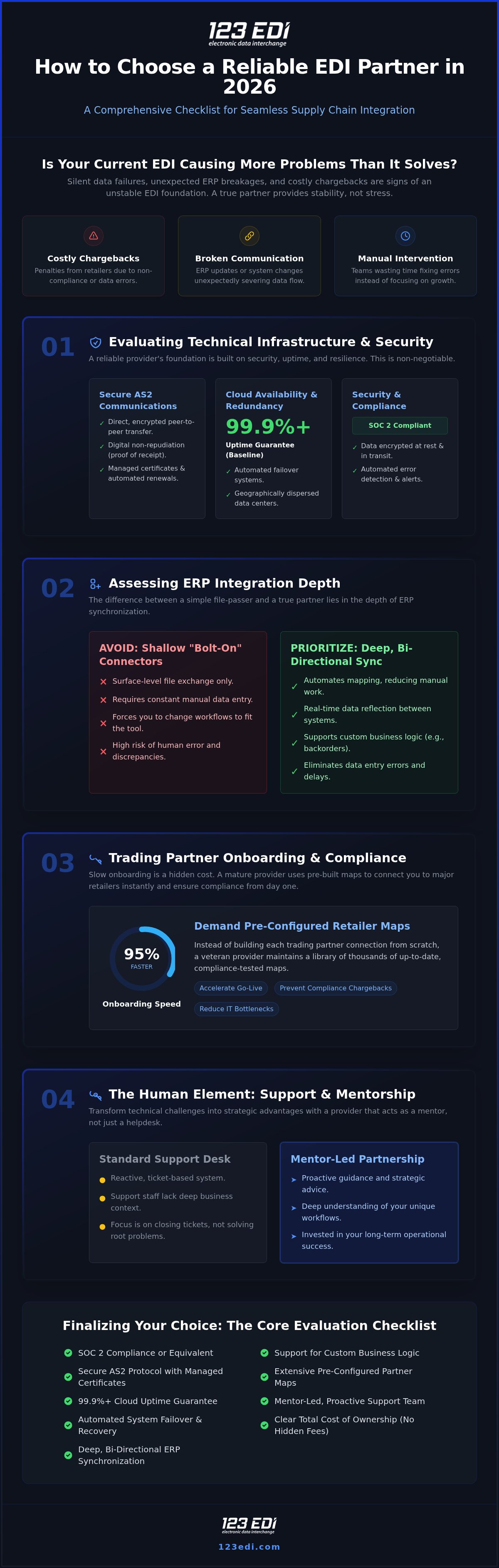
Checklist Item 4: The Human Element—Support and Mentorship
While technical infrastructure and ERP synchronization are vital, the human element is what truly defines a reliable EDI provider. In an era of increasing automation, having access to seasoned experts who understand your business goals is invaluable. Technology is the foundation, but people manage the complexities. You should look for a partner that adopts a mentor persona rather than a simple vendor relationship. This means they don’t just solve a ticket; they educate your team on best practices to prevent future errors. Dedicated account management is far superior to a generic ticketing system where your business is just another number in a queue.
Expertise isn’t just about code. It’s about clear communication. Evaluating whether a provider offers US-based support versus outsourced helpdesks is a critical step in your checklist. High-level technical support requires a deep understanding of domestic retail requirements and local business hours. When a shipment is stuck at a dock due to a data error, you need an immediate response from someone with the authority and knowledge to fix it. A reliable EDI provider invests in high-tier talent to ensure that your support experience is educational and efficient.
Beyond the Helpdesk: Strategic Partnership
A trusted partner acts as a stabilizing force when your business undergoes significant transitions. Whether you’re upgrading your ERP, moving warehouses, or entering a new international market, you need a consultant who can anticipate challenges before they arise. With a history dating back to 1994, a provider like 123 EDI brings over 30 years of institutional knowledge to every interaction. This depth of experience allows them to understand the subtle nuances of your specific industry, ensuring that your data management strategy evolves alongside your growth. If you’re looking for a partner that prioritizes this level of connection, explore our consultative approach to EDI.
Proactive Monitoring and Resolution
Real reliability is found in proactive resolution. Instead of waiting for you to report a failed transaction, your provider should alert you to issues before your trading partner even notices. Proactive system health checks and regular optimization reviews ensure your connections remain efficient. Human oversight remains the final line of defense against costly supply chain disruptions; it provides a layer of security that software alone cannot replicate. This hands-on approach minimizes the risk of retailer chargebacks and keeps your automated supply chain running smoothly.
- Dedicated Support: Verify if you will have a single point of contact who knows your system’s history.
- Education: Ask about training sessions for your staff to help them navigate the EDI portal effectively.
- Response Times: Confirm guaranteed response windows for critical system issues.
Finalizing Your Choice: The Reliable EDI Provider Selection Checklist
Selecting a reliable EDI provider is a strategic decision that shapes the future of your supply chain. Throughout this guide, we’ve explored the four core pillars of a successful partnership: technical infrastructure, deep ERP integration, compliance mastery, and human mentorship. When these elements align, your data interchange becomes a silent, stabilizing force that allows your team to focus on growth rather than troubleshooting. As you finalize your choice in 2026, it’s essential to look beyond the initial sales pitch and evaluate the total cost of ownership. This includes identifying potential hidden fees for mapping updates, transaction overages, or premium support tiers that can quickly inflate your budget.
Flexibility is another critical factor to consider. Your business needs will inevitably change, so your provider should offer contract terms that allow you to scale services as your transaction volume grows or as you add new ERP modules. A rigid partner can become a bottleneck during periods of rapid expansion. By using a proven framework, you can automate business transactions with EDI and ensure that your digital efficiency remains a competitive advantage. The goal is to find a partner that views your success as their own, offering the transparency and dedication required for a long-term collaborative engagement.
The Decision Matrix
Creating a matrix of “Must-Haves” versus “Nice-to-Haves” helps clarify your priorities. For most growing businesses, SOC 2 compliance and deep, bi-directional ERP synchronization are non-negotiable must-haves. Nice-to-haves might include specific localized reporting or advanced analytics dashboards. Before signing any agreement, conduct a thorough reference check with existing clients in your industry to verify the provider’s claims about support responsiveness. Watch out for red flags during the sales process, such as a lack of transparency regarding technical limitations or a refusal to discuss disaster recovery protocols in detail. A trustworthy consultant will be open about their capabilities and eager to assist with your due diligence.
Next Steps for Implementation
Once you’ve narrowed your list, request a proof-of-concept (POC) specifically for your ERP environment. Seeing how the connector handles your unique business logic provides the reassurance you need before a full-scale rollout. Preparing your internal team for a transition is equally important; ensure your IT and accounting departments understand the new workflow and the benefits of reduced manual entry. If you’re ready to move toward a more stable and automated future, consider contacting 123 EDI for a collaborative evaluation of your current data interchange needs. Our team is ready to act as the steady hand that guides your business through the complexities of modern EDI management.
- Cost Transparency: Request a full breakdown of all recurring and one-time fees.
- Reference Checks: Speak with at least two current clients with similar ERP setups.
- Scalability: Confirm the provider’s ability to support a 10x increase in volume.
Securing Your Supply Chain Future with a Strategic Partner
Building a resilient supply chain in 2026 requires more than just functional software; it demands a technical foundation built on secure AS2 communications and deep ERP synchronization. By prioritizing a reliable EDI provider that offers bi-directional data flow, you eliminate the friction of manual entry and the constant risk of retailer chargebacks. The most effective partnerships are those where technical precision is paired with the steady hand of a mentor who truly understands your specific industry nuances.
Since 1994, 123 EDI has acted as a stabilizing force for businesses managing complex data landscapes. Our specialized ERP-EDI integration support and secure cloud-based infrastructure provide the long-term stability your operations deserve to thrive. Don’t let technical debt or unresponsive support desks hinder your expansion. Partner with a reliable EDI provider that understands your ERP. Schedule a consultation with 123 EDI. We’re ready to help you transform your data exchange into a seamless, automated engine for success.
Frequently Asked Questions
What makes an EDI provider “reliable” in 2026?
Reliability in 2026 is defined by a combination of 99.9% uptime, technical precision in data mapping, and proactive human oversight. A truly reliable EDI provider ensures that your communication infrastructure is resilient against system failures and retailer requirement changes. It’s about more than just software; it’s about a partner who acts as a stabilizing force during business transitions and maintains secure, encrypted peer-to-peer connections through protocols like AS2.
How long does it typically take to switch to a new EDI provider?
The timeline to transition to a new provider varies based on the complexity of your ERP integration and the number of trading partners involved. Generally, a standard implementation can take anywhere from a few weeks to a couple of months. A seasoned partner with pre-configured retailer maps can often accelerate this process. Proper preparation, such as documenting your current business logic and mapping requirements, is essential to ensuring a smooth and efficient migration.
Can a reliable EDI provider help me avoid retailer chargebacks?
Yes, a reliable partner prevents costly chargebacks by using automated validation tools to catch errors before they’re transmitted to retailers. By maintaining updated libraries of mapping requirements for major trading partners like Walmart or Amazon, the provider ensures your documents always meet specific compliance standards. This proactive approach reduces the manual intervention that often leads to data entry mistakes, protecting your margins from the friction of non-compliance penalties.
Does a reliable provider need to support all ERP systems?
While no provider supports every niche platform, a reliable partner must demonstrate deep expertise in major systems like NetSuite, SAP Business One, and QuickBooks. The focus should be on the depth of the integration rather than the quantity of supported platforms. A deep, bi-directional sync is far more valuable than a surface-level “bolt-on” connector. You should verify that the provider understands the specific modules of your ERP, such as inventory and accounting.
What is the difference between an EDI software vendor and a managed service provider?
An EDI software vendor typically provides the tool and leaves the management of maps and partner communications to your internal team. In contrast, a managed service provider acts as a collaborative partner, handling the technical complexities, mapping updates, and trading partner onboarding on your behalf. This “mentor” approach allows your business to focus on growth while the provider ensures that your automated supply chain remains stable and compliant with evolving industry standards.
How do I evaluate the security of a cloud-based EDI portal?
Evaluating security starts with verifying SOC 2 compliance or equivalent certifications that ensure rigorous data protection standards. You should also look for support for secure AS2 communications, which provide encrypted peer-to-peer file transfers. Inquire about the provider’s redundancy protocols, such as geographically dispersed data centers and frequent data backups. A secure cloud-based EDI portal should offer 24/7 visibility into your transactions while maintaining failover systems to prevent any potential downtime.
Why is US-based support important for EDI reliability?
US-based support is critical because it ensures that your technical assistance aligns with domestic retail business hours and time zones. When a critical shipment is delayed due to a data error, you need immediate access to experts who have the authority and knowledge to resolve the issue quickly. Clear communication without language barriers or significant delays prevents small glitches from becoming major supply chain disruptions. This proximity fosters a stronger, more collaborative partnership with your reliable EDI provider.
What are the hidden costs often found with less reliable EDI providers?
Less reliable providers often hide costs in mapping updates, transaction overages, or premium support tiers that aren’t mentioned in the initial quote. You might face unexpected fees every time a retailer changes their compliance requirements or when you add a new trading partner. A transparent partner provides a clear breakdown of the total cost of ownership, ensuring that your budget remains predictable as your transaction volume and business needs scale over time.