

What if the very system meant to streamline your business is actually the source of your greatest operational friction? For many growing companies, manual data entry errors continue to trigger costly chargebacks, while the lack of internal expertise to manage complex AS2 protocols creates a persistent bottleneck. As we look toward the requirements of 2026, selecting the right edi software solutions is no longer just a technical checkbox; it’s a strategic necessity for maintaining healthy partner relationships and operational sanity.
It’s understandable to feel overwhelmed by the prospect of syncing your supply chain with a sophisticated ERP like NetSuite or SAP. You’ve likely realized that a simple “set it and forget it” approach rarely works in an environment defined by evolving compliance standards and strict retailer mandates. This comparative guide is designed to remove that stress by highlighting tools that prioritize automated business transactions and seamless data flow. We’ll explore the leading platforms of the year, providing you with a clear roadmap to achieve 100% compliance and turn your EDI from a technical burden into a reliable, steady engine for growth.
Key Takeaways
- Learn how to transition from cumbersome legacy systems to agile, cloud-native platforms that simplify your daily operations.
- Understand the critical differences between Direct EDI and VAN models to choose the most cost-effective path for your partner volume.
- Discover how modern edi software solutions provide real-time transaction visibility and automated error detection to eliminate costly retailer chargebacks.
- Identify the best integration approach for your specific ERP, ensuring a seamless data flow between your internal records and external partners.
- Gain insight into the collaborative mapping process that turns complex technical requirements into a steady, reliable business advantage.
Evaluating EDI Software Solutions for 2026 Business Demands
Modern business operations rely on the seamless movement of data, yet the gap between internal systems and external trading partners often remains a source of friction. At its heart, Electronic Data Interchange (EDI) acts as the digital language that allows disparate organizations to communicate without human intervention. By 2026, the demand for sophisticated edi software solutions has intensified, driven by retailers who now require near-instantaneous response times and perfect data accuracy. Moving away from legacy, on-premise systems is no longer a luxury; it’s a requirement for those who wish to avoid the heavy chargebacks associated with manual data entry errors and missed compliance windows.
The Core Components of a Modern EDI System
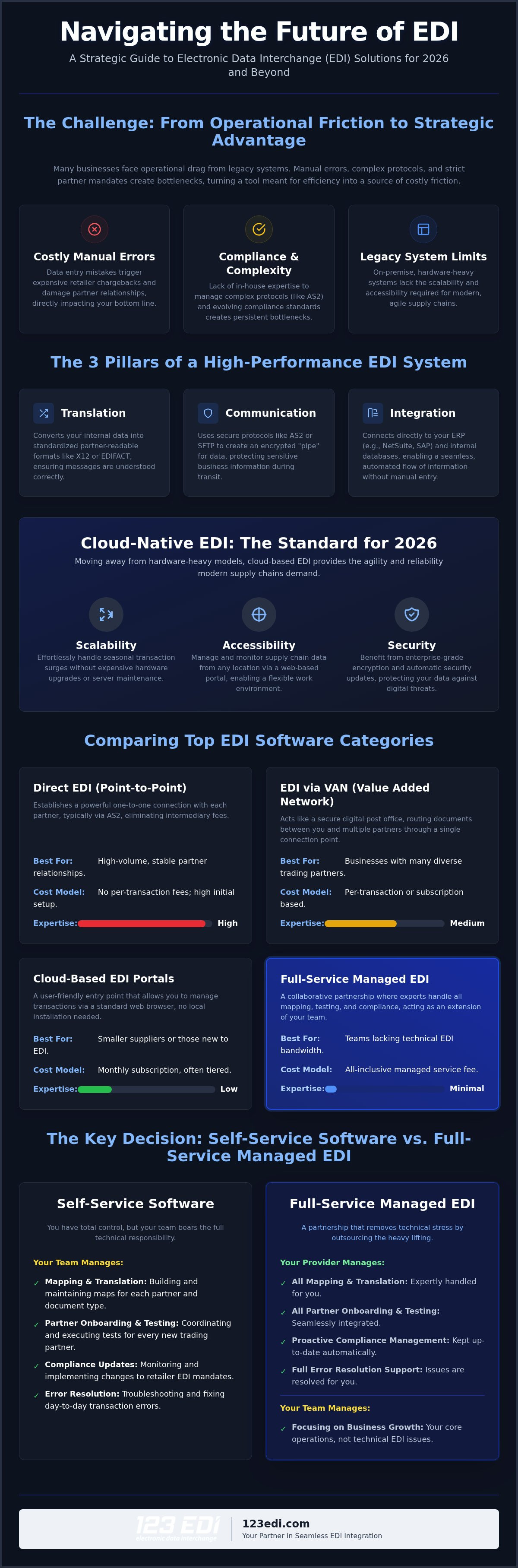
A robust EDI system is built on three foundational pillars that ensure your data remains secure and readable. Translation software serves as the first layer, taking your internal data and converting it into standardized formats such as X12 or EDIFACT. Without this step, your partners’ systems wouldn’t understand your purchase orders or invoices. Next, secure communication protocols like AS2 or SFTP provide the pipes through which this data travels, ensuring that sensitive business information is encrypted and protected from interception. Finally, the integration layer connects the software directly to your database, allowing for a fluid exchange of information that doesn’t require constant oversight.
Why Cloud-Based EDI is the Standard for 2026
The transition to cloud-native platforms has redefined how companies manage their supply chains. Unlike older hardware-heavy models, cloud-based EDI offers several distinct advantages that provide a steady hand in a complex environment:
- Scalability: You can handle seasonal surges in transaction volume without the need for expensive hardware upgrades or local server maintenance.
- Accessibility: By using a web-based EDI portal, your team can manage and monitor supply chain data from any location, providing the flexibility required in a modern work environment.
- Security: Cloud providers offer enterprise-grade encryption and automatic security updates, ensuring your system is always protected against the latest digital threats.
In 2026, the focus has shifted toward proactive management. High-quality edi software solutions don’t just move data; they provide the reliable oversight needed to navigate a complex technical landscape. This allows you to focus on growth rather than troubleshooting connectivity issues or worrying about whether an order was received correctly.
Comparing the Top Categories of EDI Software
Selecting the right architecture for your business requires a clear understanding of how different edi software solutions interact with your trading partners. While the modern relevance of EDI remains undisputed in supply chain management, the method of delivery can vary significantly based on your transaction volume and technical resources. Finding the right fit prevents operational bottlenecks and builds a foundation for long-term growth.
Direct EDI, often called Point-to-Point, is a powerful choice for high-volume, stable partner relationships. It establishes a one-to-one connection, usually via AS2 protocols, which eliminates per-transaction fees but requires significant internal expertise to maintain. On the other hand, EDI via a Value Added Network (VAN) serves as a traditional, reliable intermediary. It acts like a secure digital post office, handling the routing of documents between you and multiple partners through a single connection point.
For smaller suppliers or those just beginning their journey, cloud-based EDI portals offer a user-friendly entry point. These platforms allow you to manage transactions through a standard web browser, removing the need for complex local installations. If your team lacks the bandwidth to manage these technicalities, managed EDI services provide a collaborative path where experts handle the mapping, testing, and compliance on your behalf, acting as a steady extension of your own team.
Full-Service Managed EDI vs. Self-Service Software
Choosing between a managed service and self-service software often comes down to your internal technical bandwidth. Self-service tools give you total control but place the burden of mapping, translation, and partner testing squarely on your IT staff. A managed model functions more like a partnership; it removes the stress of intricate data management by outsourcing the technical heavy lifting to seasoned veterans. For many growing businesses, the cost of a managed subscription is easily offset by the reduction in manual errors and avoided chargebacks.
Hybrid EDI Models: The Best of Both Worlds
Some organizations find their ideal fit in a hybrid approach. This model combines the accessibility of a web-based portal with direct ERP synchronization, allowing for greater flexibility. It’s an excellent way to maintain visibility through centralized cloud dashboards while ensuring that data flows seamlessly into your accounting system. This setup allows you to add new trading partners quickly without reconfiguring your entire core architecture. If you’re looking for a steady hand to guide this transition, exploring tailored edi software solutions can help simplify the process.
Critical Features of a High-Performance EDI Integration Platform
To maintain a competitive edge in 2026, your business needs more than basic connectivity. High-performance edi software solutions distinguish themselves by providing deep, real-time visibility into every transaction. This means you can track a Purchase Order (850) from the moment it leaves the retailer and monitor the corresponding Invoice (810) as it processes. Such transparency allows you to identify delays before they impact your shipping schedule, providing a level of control that manual systems simply can’t match.
Reliability also stems from how your EDI communicates with your internal records. We’ve moved beyond the era of fragile flat-file transfers. Modern platforms prioritize seamless ERP connectivity through API or direct database integration. This ensures that data flows directly into systems like NetSuite or SAP without human intervention, which significantly reduces the risk of synchronization errors. When data moves directly between databases, it eliminates the “middleman” of manual file exports, keeping your inventory and financial records accurate in real time.
Security remains a cornerstone of these digital interactions. Utilizing advanced AS2 communication protocols ensures that your data interchange is direct and encrypted. This level of protection is essential for meeting the stringent security standards of major global trading partners. It provides the peace of mind that your sensitive business data is guarded by enterprise-grade encryption throughout its entire journey.
Automation and Workflow Orchestration
Automation is the engine that drives efficiency in the supply chain. By automating the Advance Ship Notice (856) workflow, you ensure that your partners receive critical shipping data the moment a truck leaves the dock. These systems can even trigger warehouse actions directly from incoming purchase orders, optimizing your entire fulfillment process. This level of orchestration shortens the “order-to-cash” cycle, allowing your business to realize revenue faster through perfectly synchronized data flow that doesn’t require constant manual oversight.
Compliance Management and Partner Mapping
Navigating the specific requirements of major retailers can be a daunting task for any team. Top-tier edi software solutions provide pre-configured maps for giants like Walmart, Amazon, and Target, which significantly accelerates the onboarding process. However, true flexibility lies in the ability to create custom maps for unique B2B partner requirements. As standards evolve, your platform should provide automatic updates to implementation guides, ensuring you remain in 100% compliance without needing to re-map every connection manually. This proactive approach turns compliance from a source of stress into a repeatable, reliable business process.
Aligning EDI Software with Your ERP Ecosystem
Your choice of EDI software is rarely a standalone decision; it’s fundamentally tied to the architecture of your existing ERP infrastructure. While many providers promise universal compatibility, the depth of synchronization determines whether your supply chain operates as a cohesive unit or a series of disconnected silos. Transitioning from simple “plug-and-play” connectors to tailored integrations ensures that data integrity is maintained as information moves between systems. For a deeper understanding of these technical requirements, you can explore our pillar on Mastering EDI Integration with ERP: The Comprehensive 2026 Guide.
Effective edi software solutions must adapt to the unique logic of your database rather than forcing you to change your internal processes. Whether you’re managing complex item fulfillment or high-volume retail orders, the synchronization process should feel like a natural extension of your daily workflow. High-performance systems prevent the data fragmentation that often occurs when manual interventions are required to fix mapping errors between the EDI translator and the ERP ledger.
NetSuite and SAP Business One Integration
For mid-market leaders, leveraging cloud-to-cloud connectivity for NetSuite EDI integration provides the scalability needed to handle rapid growth without increasing administrative overhead. This approach minimizes latency and ensures that inventory levels remain accurate across all channels in real time. Similarly, following established best practices for integrating EDI with SAP Business One allows for automated sync between warehouse actions and financial records. This level of oversight removes the stress of manual reconciliation, allowing your team to focus on strategic refinement rather than data entry.
QuickBooks Integration for Growing Businesses
Growing businesses often start by seeking ways to avoid manual data entry in QuickBooks through automated EDI workflows. As you scale from QuickBooks Online to more robust enterprise systems, maintaining your EDI history and partner compliance is vital for a smooth transition. Streamlining your accounts receivable with automated 810 invoice generation can significantly reduce the “order-to-cash” cycle, ensuring your cash flow remains steady as your partner network expands. To ensure your systems work in perfect harmony, consider partnering with an expert for specialized EDI integration with ERP systems tailored to your unique business demands.
Navigating the Selection Process with 123 EDI
Since our founding in 1994, we’ve guided businesses through every major shift in digital supply chain standards. Choosing among various edi software solutions isn’t just about comparing feature lists; it’s about finding a partner that understands the nuances of your specific workflow. At 123 EDI, our philosophy balances professional authority with service-oriented warmth. We don’t just provide a tool; we act as a stabilizing force that removes the stress of intricate data management. This approach ensures your team feels supported as they move from manual processes to a fully automated environment.
Working with an industry veteran provides the reassurance that your technical hurdles are being handled with precision and comprehensive oversight. We believe that technology should simplify your life, not complicate it. By positioning ourselves as a steady hand in a complex landscape, we help you transition from identifying a challenge to offering a path toward clarity and efficiency.
The 123 EDI Collaborative Support Model
During the critical mapping phase, our seasoned experts serve as mentors rather than detached technicians. We understand that every supply chain has its own rhythm, so we focus on customizing our cloud portals to match your unique operational requirements. This collaborative engagement allows us to simplify complex technical landscapes for you. By prioritizing human connection and mutual respect, we build a foundation of long-term trust that lasts far beyond the initial setup. Our support model is designed to be thorough and intentional, mirroring the stability of the services we provide.
Ready to Streamline Your B2B Transactions?
Moving from evaluation to a tailored implementation roadmap starts with a clear understanding of your current hurdles. We invite you to request a diagnostic review of your current EDI requirements to identify where automation can deliver the highest impact. Evaluating the potential ROI of integrated edi software solutions often reveals significant savings in reduced chargebacks and accelerated “order-to-cash” cycles. Whether you’re looking to enhance your AS2 communications or seek deep EDI integration with ERP systems, our team is ready to guide you. We value your understanding of the technical solution as much as the solution itself, ensuring you feel confident in your new digital infrastructure.
If you’re prepared to turn your digital transactions into a reliable business advantage, contact 123 EDI for a professional consultation. Our experts are dedicated to helping you achieve 100% compliance with a steady, reliable hand. We look forward to helping you navigate the complexities of 2026 with clarity and ease.
Future-Proofing Your Supply Chain with Confident EDI Integration
Modernizing your supply chain for 2026 requires more than a simple software update. It demands a strategic shift toward cloud-native agility and deep ERP synchronization. We’ve explored how the right edi software solutions act as a bridge between your internal records and global trading partners. This eliminates the manual errors that lead to costly chargebacks. By prioritizing real-time visibility and secure AS2 protocols, you transform your data management from a technical hurdle into a reliable engine for growth.
Selecting a partner with deep institutional knowledge ensures that your implementation is both smooth and sustainable. With over 30 years of EDI integration expertise, 123 EDI provides a specialized cloud-based portal designed for rapid deployment. We offer authoritative support for NetSuite, SAP, and QuickBooks to ensure your data flows without friction. We’re here to act as your steady hand, simplifying the technical landscape so you can focus on building stronger partner relationships.
Explore Professional EDI Software Solutions with 123 EDI to begin your transition toward a more automated, compliant future. Your path to seamless business transactions starts with a collaborative partnership built on trust and technical excellence.
Frequently Asked Questions
What are the main types of EDI software solutions available today?
The primary types of edi software solutions include Direct EDI, Value Added Networks (VANs), cloud-based portals, and fully managed services. Direct EDI establishes a point-to-point connection via AS2, while VANs act as a digital post office for multiple partners. Cloud portals offer a user-friendly, web-based entry point for suppliers. Managed services provide a collaborative partnership where technical experts handle the mapping and testing, allowing you to focus on your core business operations.
How much does EDI software typically cost to implement?
Implementation costs vary widely across the industry based on transaction volume and integration complexity. Industry data shows some entry-level web EDI plans starting around $50 per month, while enterprise-grade systems can reach $1,999 or more. It’s important to consider the total cost of ownership beyond the subscription fee. This includes potential costs for mapping updates, VAN fees, and compliance testing. Choosing a scalable cloud model often provides a more predictable cost structure.
Can I integrate EDI software with any ERP system?
Most modern EDI platforms are designed to integrate with major ERP systems like NetSuite, SAP Business One, and QuickBooks. The depth of this integration depends on whether you use a standard connector or a custom-built integration layer. Seamless data flow ensures that purchase orders and invoices synchronize directly with your internal records. This automation eliminates the need for manual data entry, which significantly reduces the risk of errors and costly retailer chargebacks.
What is the difference between an EDI portal and EDI software?
An EDI portal is a web-based interface where you manually enter and receive data through a browser. It’s an excellent, cost-effective solution for suppliers with lower transaction volumes. In contrast, EDI software usually refers to an integrated system that automates the exchange of data between your ERP and your trading partners. While portals are accessible and easy to deploy, integrated software solutions provide the high-level automation needed for high-volume, complex supply chains.
How long does it take to get EDI software up and running?
The time required for implementation ranges from a few days to several months. Some modern, AI-driven platforms claim to onboard partners in as little as 9 days, while traditional managed service setups typically take between 60 and 90 days. Factors such as the complexity of your ERP integration and the specific testing requirements of your trading partners will influence the final timeline. We prioritize a methodical approach to ensure your system is stable and compliant.
Do I need a dedicated IT team to manage EDI software?
You don’t necessarily need a dedicated internal IT team to manage your EDI operations. Many businesses choose managed services precisely because they outsource the technical heavy lifting to seasoned experts. This collaborative model provides you with a trusted consultant who handles AS2 protocols, mapping, and partner testing. It’s a practical way to maintain sophisticated edi software solutions without the overhead of hiring specialized staff to manage complex data transfers internally.
Is cloud-based EDI software secure enough for sensitive financial data?
Cloud-based EDI is built on enterprise-grade security protocols designed to protect sensitive financial data. These systems utilize secure communication methods like AS2 and SFTP, which include robust encryption and digital signatures. Automatic security updates ensure that your platform is always protected against the latest digital threats. By leveraging cloud infrastructure, you benefit from the same high-level security standards used by major global retailers, providing a steady and reliable environment for your transactions.
What happens if a retailer changes their EDI requirements?
When a retailer updates their implementation guides, your EDI maps must be adjusted to remain compliant. In a managed service model, these updates are typically handled by your provider, ensuring a seamless transition without disrupting your workflow. If you manage your system internally, your team must manually reconfigure the translation software to match the new standards. Staying proactive with these updates is essential for avoiding penalties and maintaining healthy relationships with your major trading partners.