

What if the complex web of retailer requirements wasn’t a barrier to your growth, but a bridge to a more streamlined operation? As you scale your business in 2026, the pressure to meet stringent technical standards often feels like a full-time job that pulls you away from your core mission. It’s understandable to feel overwhelmed by the constant threat of expensive chargebacks or the exhaustion that comes from manual data entry across multiple platforms. Utilizing a dedicated edi portal for suppliers provides the stabilizing force your operations need to move beyond these daily stresses and toward a more reliable future.
By choosing a path toward automated document exchange, you can secure quick compliance with your trading partners while gaining better visibility into every order status. This guide explores how a web-based EDI portal simplifies the technical landscape, allowing you to focus on building lasting, professional partnerships. We will walk through the essential strategies to accelerate your results and transform your data management into a competitive advantage, ensuring your business remains a preferred partner in an increasingly automated marketplace.
Key Takeaways
- Understand how a web-based interface serves as a secure translator, simplifying the complex technical landscape of global EDI standards.
- Discover how an edi portal for suppliers utilizes “PO Flip” mechanisms to transform purchase orders into invoices with a single click, removing the burden of manual data entry.
- Learn the strategic steps to achieve rapid compliance with major trading partners, effectively eliminating the risk of expensive retailer chargebacks.
- Gain insight into the structured onboarding journey, from analyzing specific partner requirements to establishing secure communication protocols like AS2.
- Explore the logical progression from a manual portal toward seamless ERP integration, providing the scalability needed for long-term business growth.
What is an EDI Portal for Suppliers?
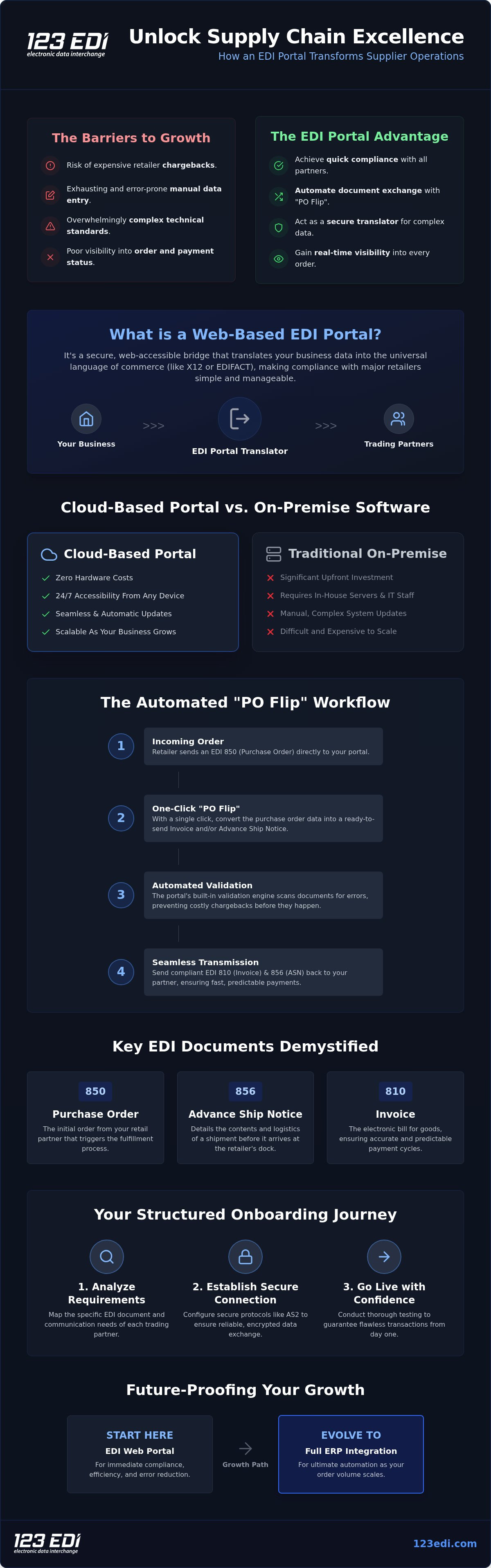
An edi portal for suppliers serves as a secure, web-accessible bridge between your business and your retail partners. Instead of requiring you to install complex, high-cost infrastructure, the portal provides a user-friendly interface that translates your business actions into technical formats like X12 or EDIFACT. Since its inception, Electronic Data Interchange (EDI) has evolved into the standard language of global commerce, and these portals make that language accessible to everyone. By centralizing your purchase orders, invoices, and shipping notices into one hub, you can manage multiple trading partners without the technical headaches of traditional data mapping.
The Role of Web-Based EDI in Modern Supply Chains
Major retailers now demand digital compliance as a non-negotiable requirement for doing business. In 2026, the speed of commerce doesn’t allow for the delays or errors inherent in paper-based systems or manual emails. Retailers require these digital standards to ensure their supply chains remain agile and responsive. Transitioning to a digital transaction hub moves your business into real-time operations, where order acknowledgments and shipping notices happen instantly.
This shift levels the playing field for small to mid-sized suppliers. You no longer need a massive IT department to work with the world’s largest retailers. A web-based portal handles the “heavy lifting” of data translation, allowing you to focus on product quality and fulfillment rather than technical file structures. It transforms a complex requirement into a manageable daily task, fostering a more collaborative relationship with your buyers.
Cloud-Based vs. On-Premise EDI Solutions
Choosing between cloud-based and on-premise solutions often comes down to how you want to allocate your resources. Traditional on-premise software requires significant upfront investment in hardware, servers, and specialized personnel to maintain the system. For many growing brands, this creates a barrier to entry that can stall growth. Modern cloud-based EDI solutions remove these obstacles by hosting the entire infrastructure in a secure, digital environment.
This approach offers several distinct advantages for the modern supplier:
- Zero Hardware Costs: You can access your portal from any device with an internet connection, eliminating the need for dedicated office servers.
- 24/7 Accessibility: Whether you are in the warehouse or working remotely, your data is always available when you need it.
- Seamless Updates: As retailers update their requirements or X12 standards change, the cloud provider manages those updates automatically.
By opting for a cloud-based edi portal for suppliers, you gain the stability of a professional enterprise system without the administrative burden. It’s a scalable path that supports your business as you add more trading partners and increase your order volume.
How an EDI Portal Streamlines Supplier Transactions
Using an edi portal for suppliers transforms the way you interact with incoming order data. One of the most impactful features is the “PO Flip” mechanism. This tool allows you to convert an incoming digital purchase order into an outgoing invoice or shipping notice with a single click. By reusing the data already provided by your retail partner, you eliminate the risk of typos or transposed numbers that often occur during manual entry. It’s a simple change that significantly reduces the administrative burden on your team.
Real-time notifications ensure you’re never left wondering if a new order has arrived. The portal alerts you immediately, allowing your fulfillment team to begin work without delay. Built-in validation engines act as a final safety net; they scan your documents for missing fields or formatting errors before you hit “send.” This proactive approach is essential for preventing the expensive retailer chargebacks that can erode your profit margins. Tracking the lifecycle of a document becomes effortless, as the portal provides a clear view from the moment a file is transmitted until the retailer sends back a functional acknowledgment.
Managing Key EDI Transactions: 850, 810, and 856
Automating the receipt of the 850 Purchase Order is the first step toward a faster fulfillment cycle. When the order data flows directly into your portal, your warehouse can pick and pack with higher precision. Generating the 810 Invoice accurately is equally vital; it ensures your payment cycles remain predictable and your cash flow stays healthy. While some providers focus only on billing, a comprehensive edi portal for suppliers prioritizes the 856 Advance Ship Notice (ASN). This document is critical for warehouse coordination, as it tells the retailer exactly what’s arriving and when, allowing them to prepare their receiving docks for your shipment.
The Benefits of a Unified Communication Hub
A centralized portal effectively eliminates the “phone tag” that often plagues supplier-retailer relationships. Instead of calling to confirm order statuses, both parties can view the same real-time data. This transparency builds trust and strengthens your standing as a reliable partner. Every transaction leaves a digital audit trail, providing a clear history of business communications that can be referenced if a dispute arises. Reducing manual data entry doesn’t just save time; it removes the root cause of most shipping delays. If you’re ready to move beyond manual entry, exploring a scalable EDI software solution can provide the clarity and stability your operations need.
Strategic Advantages: Why Suppliers Need a Dedicated Portal
Many growing businesses operate in a state of constant reaction, struggling to keep pace with the manual entry required by multiple retailer websites. This fragmented approach often leads to burnout and oversight. Adopting a dedicated edi portal for suppliers shifts your team from a reactive posture to a proactive strategy. By centralizing your operations, you gain immediate compliance with major trading partners like Walmart and Amazon. These retailers mandate digital standards to protect their own supply chain efficiency; meeting those standards quickly positions you as a professional, prepared partner ready for high-volume commerce.
The reduction in administrative overhead is often the first benefit your team will notice. When you eliminate the need to log into ten different retailer sites to check for orders, you free up your staff for higher-value tasks. Scalability becomes a natural byproduct of this efficiency. In a manual environment, doubling your order volume usually means doubling your headcount. With a portal, handling 100 orders is as manageable as handling ten, allowing your business to grow without a corresponding spike in labor costs. Improved data accuracy also leads to fewer disputes, which naturally raises your vendor scores and strengthens your standing in the eyes of retail buyers.
Avoiding Costly Retailer Chargebacks
Chargebacks are the hidden cost of manual supply chain management, representing the financial penalties retailers levy for data errors or shipping delays. An EDI portal acts as a stabilizing force by enforcing strict business rules before any document is sent. If a ship notice is missing a required field or is submitted past the retailer’s deadline, the system flags the issue immediately. This automated oversight reduces the late or inaccurate notices that typically trigger fines. By catching these discrepancies early, you protect your profit margins and ensure that your fulfillment process remains beyond reproach.
Strengthening Trading Partner Relationships
Reliability is the foundation of any long-term business partnership. When you utilize an edi portal for suppliers, you signal to large corporations that you possess the technical maturity to support their needs. Faster response times to sales forecasts and inventory inquiries allow retailers to keep their shelves stocked and their customers satisfied. Utilizing secure protocols like AS2 builds deep institutional trust, as it ensures that sensitive transaction data remains protected. This level of professional precision can help you transition from being just another vendor to becoming a “preferred partner,” opening doors to larger contracts and more significant shelf space.
The Path to EDI Compliance and Onboarding
The transition to a digital supply chain is a methodical journey that requires both technical precision and a steady hand. While the end goal is a streamlined edi portal for suppliers, the path to get there involves five distinct stages that ensure your data remains accurate and compliant. It begins with a partner requirement analysis to understand exactly what your retailer expects. From there, we move to connectivity setup, establishing secure links via AS2 or a Value Added Network (VAN). Document mapping follows, where your internal data is carefully translated into the retailer’s required format. Before any real business occurs, you’ll enter the testing and certification phase to validate transactions in a sandbox environment. Finally, the go-live stage marks your official entry into automated commerce, backed by ongoing support to handle any future updates.
As we move through 2026, the speed of these onboarding cycles has accelerated. While traditional setups once took seven to twelve weeks, modern platforms with pre-built connections can often reduce this timeline to just one or two weeks. This efficiency allows you to begin trading with new partners much faster, accelerating your time to market and providing a stabilizing force for your growing operations.
Understanding Your Retailer’s EDI Specifications
Every major retailer maintains a unique implementation guide. These documents serve as a blueprint for how they want to receive data, and they rarely look the same from one company to the next. For instance, the specific fields required for an 810 invoice at one big-box store might differ significantly from those at another. This is why working with an experienced EDI provider is so vital. They possess the institutional knowledge to navigate these specifications without the trial and error that stalls progress. Preparing your internal data for this digital transition is a collaborative effort, ensuring your product codes and descriptions are ready for the high-speed world of retail.
Testing for Success: The Certification Process
Testing is the most critical phase of the onboarding journey. It’s not enough to simply send a file; you must prove that your system can handle the nuances of real-world commerce. In a sandbox environment, we simulate various scenarios, such as partial shipments or backordered items, to ensure your communication remains error-free. We believe in a mentor-led approach to this process. Instead of leaving you to decipher complex mapping errors alone, a dedicated consultant walks you through the troubleshooting steps. This collaborative method removes the stress of technical validation and builds your confidence as a trading partner. If you’re ready to simplify your technical landscape, you can start your EDI onboarding journey today with a partner that values your success.
Future-Proofing with 123 EDI: Beyond the Portal
While a web-based edi portal for suppliers provides the immediate compliance necessary to begin trading with major retailers, your long-term success depends on your ability to scale without increasing manual effort. As your business matures in 2026, you may find that managing dozens of orders daily through a manual interface becomes a bottleneck. This is where the transition from a standalone portal to full ERP integration becomes a strategic necessity. By connecting your transaction data directly with systems like NetSuite, SAP Business One, or QuickBooks, you ensure that information flows seamlessly through your entire organization without the need for repetitive data entry.
We pride ourselves on being more than just a software provider; we are a dedicated partner in your digital transformation. Our deep institutional knowledge allows us to guide you through the complexities of Mastering EDI Integration with ERP, ensuring that your technical infrastructure supports your growth rather than hindering it. Choosing a partner that provides both the cloud-based software and the professional integration services offers a level of comprehensive oversight that standalone tools simply cannot match.
Scaling Your Business with Automated Workflows
The shift from “reading and typing” to “automated data sync” represents a significant milestone for any supplier. When your edi portal for suppliers is fully integrated with your back-office system, the need to log into a separate platform to manage orders effectively disappears. Purchase orders flow directly into your sales order module, and shipping notices are generated automatically from your warehouse activities. This level of automation provides a high long-term ROI by creating a fully integrated B2B ecosystem. It eliminates the human errors that lead to fulfillment delays, allowing your team to focus on expanding your product lines and pursuing new trading partners.
Why Choose 123 EDI as Your Strategic Partner?
As an industry veteran founded circa 1994, we possess the seasoned reliability you need to navigate a complex technical landscape. We position ourselves as a wise mentor and a steady hand, offering a stabilizing force for your data management needs. Our approach is rooted in mutual respect and a deep investment in your success. We don’t just deliver a technical solution; we provide a clear roadmap for every interaction. This welcoming, service-oriented style ensures that you feel supported at every stage, from your first web-based transaction to your most complex ERP integration. We believe in building foundations of long-term trust through transparency, competence, and a dedication to making your business a preferred partner in the global supply chain.
Building a Foundation for Automated Success
Transitioning to an automated environment doesn’t have to be a technical burden. By implementing a dedicated edi portal for suppliers, you’ve seen how easy it is to eliminate manual data entry and secure your standing with major retailers. This shift provides the visibility and precision required to avoid costly chargebacks while fostering long-term trust with your trading partners. Whether you’re just starting your digital journey or looking to refine your existing workflows, the right tools transform compliance from a hurdle into a strategic advantage.
Looking toward the future, the move toward full ERP integration with systems like NetSuite or SAP ensures your business remains agile as you scale nationally. With over 30 years of EDI expertise, we provide the seasoned reliability and cloud-based solutions needed to navigate this landscape with confidence. Our team is ready to serve as your stabilizing force, offering seamless transitions and professional oversight at every step. Simplify your supplier compliance today with 123 EDI and take the first step toward a more efficient, stress-free future.
Frequently Asked Questions
What is the difference between a web EDI portal and full EDI integration?
A web-based interface requires your team to manually enter or “flip” data within a browser. Full EDI integration connects your transaction data directly to your ERP system, such as NetSuite or SAP. While an edi portal for suppliers is perfect for those starting out, integration removes manual steps entirely. We often help businesses transition from the manual portal to a fully automated workflow as their order volume grows nationally.
How long does it take for a supplier to become EDI compliant?
Compliance timelines depend heavily on the technical requirements of your trading partner. While traditional onboarding often took seven to twelve weeks, modern platforms with pre-built connections can reduce this to just one or two weeks. This accelerated pace allows you to begin trading and generating revenue much sooner. Our team acts as a stabilizing force throughout this process, providing the mentorship needed to navigate testing and certification phases quickly.
Do I need special hardware to use an EDI portal?
You don’t need any specialized hardware or on-premise servers to use a cloud-based portal. Because the infrastructure is hosted in a secure digital environment, you only need a standard computer with a reliable internet connection and a modern web browser. This accessibility allows your team to manage purchase orders and invoices from any location, providing the flexibility required for modern supply chain management without the burden of maintaining physical IT equipment.
Can I use one EDI portal for multiple different retailers?
Yes, a primary advantage of a centralized edi portal for suppliers is the ability to manage all your trading partners in one location. Instead of logging into separate sites for Walmart, Amazon, and Target, you can view every purchase order and shipping notice through a single dashboard. This unified approach provides better visibility into your overall order status and significantly reduces the administrative time spent jumping between different retailer platforms.
What happens if I send an incorrect EDI document through the portal?
If an error bypasses the built-in validation engine and is sent to the retailer, they will typically return a functional acknowledgment (997) indicating a rejection. At this point, you must correct the data and resend the document to avoid potential chargebacks. Our portal is designed to catch most formatting errors before transmission, acting as a safety net that protects your profit margins and maintains your standing as a reliable, high-performing vendor.
Is an EDI portal secure enough for sensitive financial data?
Cloud-based portals utilize enterprise-level security protocols, including AS2 and advanced encryption, to protect your sensitive business information. These standards are specifically designed to meet the rigorous security demands of large corporations and financial institutions. By centralizing your data in a secure environment, you reduce the risks associated with unencrypted emails or paper documents. We ensure your business communications remain private and compliant with the latest industry security standards.
What are the typical costs associated with an EDI portal for suppliers?
Costs for an EDI solution generally consist of an initial setup fee and an ongoing monthly subscription. These fees cover the maintenance of your trading partner connections, technical support, and the secure hosting of your data. While we don’t quote specific dollar amounts because every supplier’s needs are unique, we focus on providing a scalable model. This ensures that your technical infrastructure remains cost-effective as you grow from a handful of orders to thousands.
How does an EDI portal help with Advance Ship Notices (ASN)?
The portal simplifies the creation of the 856 Advance Ship Notice (ASN) by pulling data directly from the original purchase order. This “PO Flip” ensures that the item descriptions, quantities, and store locations are perfectly accurate. By automating this critical step, you ensure your retailer’s warehouse is prepared to receive your shipment. This precision eliminates the shipping delays and fines that often occur when ASN data is entered manually or submitted late.