

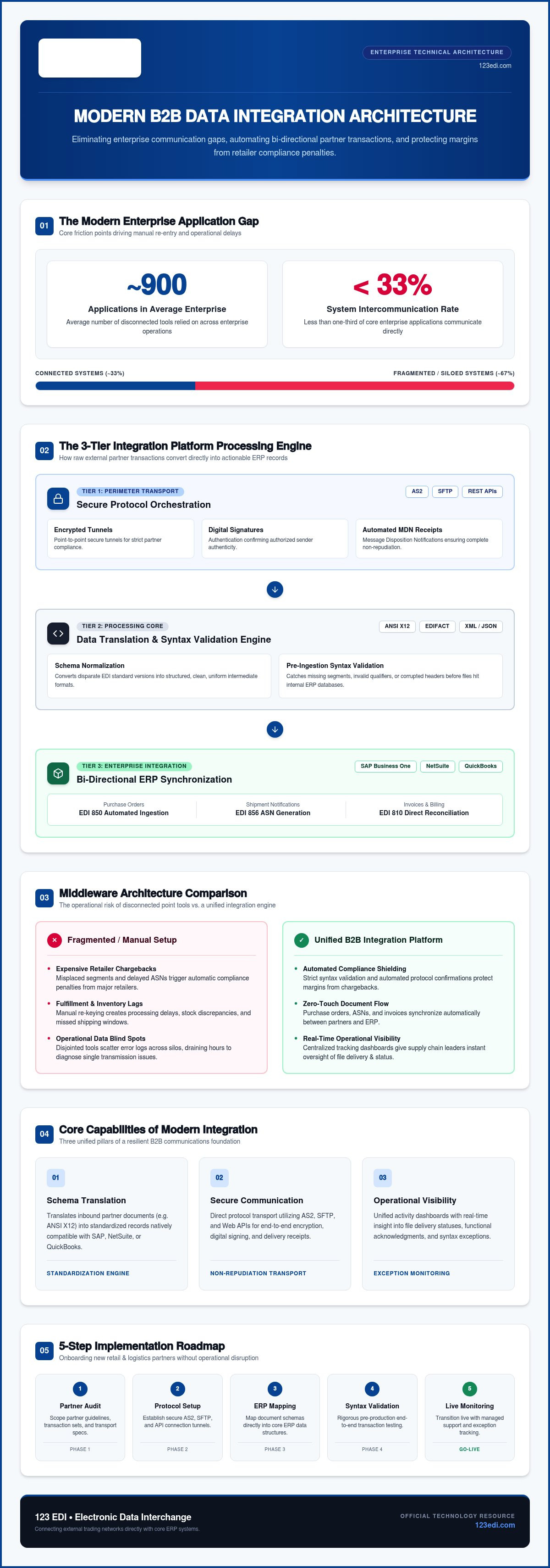
The average enterprise relies on nearly 900 applications, yet less than a third of them actually communicate with one another. When external trading partners demand flawless document transmission, that gap quickly translates into expensive retailer chargebacks, missed shipping windows, and strained teams. Establishing a resilient B2B data integration platform isn’t just a technical upgrade; it’s the operational foundation for protecting your margins and building lasting commercial relationships.
You already know the exhausting friction of reconciling unique ERP configurations with rigid customer formats. Manually re-keying purchase orders, advance shipping notices, and invoices drains internal resources and invites avoidable errors that slow fulfillment. In this guide, you’ll discover how modern B2B data integration platforms automate partner communication, connect core ERP systems, and eliminate supply chain friction. We’ll explore the essential architecture you need in 2026, proven strategies for automated bi-directional data flow, and practical steps to onboard new retail and logistics partners with confidence.
Key Takeaways
- Discover how a modern B2B data integration platform bridges external trading networks directly with core ERP systems to eliminate costly manual re-entry.
- Learn how secure communication protocols like AS2 and automated syntax validation shield your business from expensive retailer compliance chargebacks.
- Evaluate the essential criteria for selecting an integration model that balances managed technical expertise with intuitive cloud portal access.
- Follow a proven five-step implementation roadmap designed to onboard new retail and logistics partners rapidly without interrupting live operations.
- Understand why long-term supply chain resilience relies on collaborative integration specialists rather than standalone, unassisted software tools.
What Is a B2B Data Integration Platform?
At its core, a B2B data integration platform serves as a secure, centralized digital bridge connecting an enterprise to its suppliers, logistics providers, and retail customers. Instead of requiring operational teams to manually extract, reformat, and enter transactional files, the platform automates the direct exchange of structured business records. By understanding the core mechanics of data integration, growing organizations can connect external trading protocols directly with internal enterprise resource planning (ERP) systems, establishing frictionless, bi-directional data pipelines across commercial boundaries.
Rather than relying on disjointed point tools, a unified platform standardizes high-volume transactions into cohesive workflows. This architecture eliminates manual data entry bottlenecks, preserves data fidelity, and enforces compliance with strict trading guidelines across diverse distribution channels.
Core Capabilities of Modern Integration Architectures
A resilient integration architecture handles translation, transport, and monitoring in a unified system. Essential capabilities include:
- Schema Translation: Inbound partner documents (such as ANSI X12 EDI formats) automatically translate into standardized records compatible with core systems like NetSuite, SAP Business One, or QuickBooks.
- Secure Communication: Transport protocols like AS2, SFTP, and specialized web APIs deliver end-to-end data encryption and reliable delivery receipts.
- Operational Visibility: Detailed activity dashboards give supply chain leaders real-time oversight into file statuses, acknowledgment confirmations, and syntax exceptions.
The Operational Cost of Fragmented Middleware Systems
Relying on patchwork middleware or unassisted manual entry introduces compounding operational risks. When systems fail to communicate automatically, small syntax errors can spiral into systemic supply chain failures:
- Costly Retailer Chargebacks: Major enterprise retailers enforce unforgiving compliance criteria. A misplaced segment or an unfulfilled advance shipping notice (ASN) window triggers automated penalties that erode gross margins.
- Inventory and Fulfillment Delays: Manual order processing creates lag times between order receipt and warehouse fulfillment, generating stock discrepancies and frustrated customers.
- Data Blind Spots: Disparate translation tools scatter tracking logs across isolated silos. Without unified oversight, support teams waste valuable hours diagnosing simple transmission errors.
Consolidating these vital touchpoints into a unified B2B data integration platform protects your revenue, maintains strong customer relationships, and frees internal teams to focus on strategic growth.
How B2B Integration Platforms Work: Protocols, Translation, and ERP Sync
A high-performing B2B data integration platform operates as an automated processing engine that coordinates three distinct phases: transport orchestration, data transformation, and enterprise system synchronization. Rather than treating file ingestion and ERP ingestion as detached processes, the platform aligns these layers so raw transactions convert directly into actionable business records. For teams revisiting the underlying structural foundations, our detailed breakdown on what is edi explains how these standardized electronic documents revolutionized commercial relationships.
Secure Protocol Orchestration: AS2, SFTP, and APIs
Every inbound exchange begins at the communication perimeter. Modern architectures employ point-to-point protocols like AS2 (Applicability Statement 2) to establish encrypted tunnels, issue digital signatures, and return automated Message Disposition Notifications (MDNs) for non-repudiation. Deploying proven AS2 communication software guarantees strict compliance with major retailer security mandates. Secure FTP and modern REST APIs work in parallel, capturing proprietary file drops and cloud service streams without maintaining separate communications infrastructure.
Data Translation and Syntax Validation Engines
Once a file lands safely, the translation engine parses its raw structure against strict trading guidelines. This engine performs vital operational checks:
- Schema Normalization: Raw standards such as ANSI X12, EDIFACT, XML, and JSON are transformed into a clean, uniform intermediate data structure.
- Pre-Ingestion Validation: Field lengths, data types, and mandatory partner qualifiers are verified before the transaction ever reaches your accounting records.
- Automated Acknowledgments: The engine generates and transmits functional acknowledgments (such as an EDI 997) within seconds, confirming structural acceptance back to your trading partner.
Direct ERP Synchronization and Workflow Automation
The final phase delivers parsed transaction details directly into business databases without manual re-keying or intermittent CSV imports. Bi-directional database connectors populate purchase orders straight into platforms like NetSuite, SAP Business One, and QuickBooks. In reverse, outbound fulfillment data triggers automated advance shipping notices and electronic invoices. To see this bi-directional flow in practice, review our practical guide on EDI integration with ERP architectures.
When you align protocol governance with automated ERP mapping, your supply chain operates without friction. If your growing enterprise needs to modernize these complex transaction handoffs, collaborating with the seasoned integration specialists at 123 EDI ensures every trading partner channel remains reliable and fully compliant.
Evaluating B2B Data Integration Solutions: Key Comparison Criteria
Selecting the right B2B data integration platform requires looking past vendor checklists to evaluate how the system functions during daily operations. Your decision hinges on three core considerations: the underlying hosting architecture, the level of administrative maintenance your team can realistically absorb, and the breadth of the provider’s trading partner ecosystem. Balancing these factors protects operating margins and establishes long-term supply chain agility.
Cloud EDI Portals vs. On-Premise Software Installations
Legacy on-premise installations demand physical server maintenance, recurring software patches, and dedicated IT resources just to keep communications active. In contrast, modern cloud architectures eliminate costly hardware maintenance entirely. Secure, browser-based interfaces grant customer support, logistics, and finance teams instant operational visibility into transaction flows from any location. To evaluate how cloud models reduce administrative stress, review our comprehensive guide on cloud-based EDI solutions.
Managed Integration Services vs. Self-Service Tooling
While some vendors promote self-service tools, configuring them requires dedicated in-house mapping engineers. For many midmarket businesses, staffing full-time data specialists significantly inflates operational overhead. A managed integration model pairs your staff with experienced domain specialists who handle ongoing compliance changes, syntax updates, and partner exceptions. The most effective approach combines intuitive portal visibility with managed technical execution, giving internal staff complete operational clarity while specialists manage backend complexities.
Trading Partner Onboarding and Retailer Compliance Safeguards
A platform is only as valuable as the speed with which it connects you to new commercial channels. Pre-configured partner compliance kits allow you to onboard major retailers, third-party logistics providers (3PLs), and distributors within days instead of months. Built-in business rules catch invalid item identifiers, missing units of measure, or pricing mismatches before outbound transmission occurs. Exploring how automated validation rules automate business transactions EDI ensures your enterprise avoids margin-eroding chargebacks and maintains flawless partner scorecards.
5 Steps to Implement a B2B Integration Platform Without Disruption
Migrating to an advanced B2B data integration platform should never jeopardize live order flows or strain existing customer relationships. While software vendors often promise instant, friction-free cutovers, seasoned professionals recognize that seamless adoption requires methodical preparation. A disciplined rollout protects active commercial pipelines, giving your operations and IT teams the confidence that every inbound order and outbound invoice matches precise partner specifications from day one.
Phase 1: Transaction Audits and Partner Requirement Mapping
A successful transition starts with an unhurried, comprehensive assessment of your existing document landscape. Document every active transaction set, including purchase orders (EDI 850), advance shipping notices (EDI 856), and invoices (EDI 810). Collect the latest implementation guidelines directly from your major retail partners and 3PLs to identify undocumented business rules. Finally, audit your core ERP fields and database triggers so every custom segment has an explicit destination.
Phase 2: Configuration, Data Mapping, and Sandbox Testing
Armed with confirmed partner guidelines, integration engineers construct translation maps connecting partner schemas directly to your ERP fields. This stage involves concrete configuration steps:
- Credential Exchange: Configure communication endpoints, exchange public digital certificates, and register AS2 identifiers.
- Map Formulation: Align inbound line items, unit qualifiers, and tax segments with native ERP records.
- Historical File Replay: Ingest historical production records through an isolated sandbox environment to identify syntax mismatches before testing live channels.
Phase 3: Parallel Pilot Execution and Production Cutover
Never execute a hard cutover without validation. Run pilot transactions concurrently through your legacy workflows and your new cloud platform, verifying that data parsed into your accounting system matches past fulfillment records. Once your trading partners validate outbound test files across full order lifecycles, you can safely transition production communication endpoints.
Establish dedicated operational ownership across order fulfillment, logistics, and IT so syntax warnings receive immediate attention. If you are preparing to upgrade legacy infrastructure without risking partner delivery windows, schedule a consultation with the integration engineers at 123 EDI to execute a structured, risk-free deployment roadmap.
Choosing the Right Long-Term Integration Technology Partner
A modern B2B data integration platform is only as effective as the engineering and human expertise standing behind it. While software capability matrices look impressive during vendor demonstrations, changing trading partner rules inevitably generate unexpected mapping hurdles. Software alone won’t decipher an ambiguous retailer routing guide update or explain why an outbound shipment notice failed validation. True operational resilience comes from aligning with dedicated integration specialists who understand the mechanics of electronic supply chains and view your compliance as a shared mission.
Evaluating Technical Specialization Over Generic IT Providers
Generalist IT managed service providers often treat transaction workflows as simple background network traffic. However, handling EDI communications requires deep domain knowledge of transaction standards, carrier packaging structures, and stringent fulfillment timelines. When a transaction fails, a general IT helpdesk rarely possesses the specialized skill set to troubleshoot segment qualifiers or raw payload loops. Dedicated integration engineers resolve syntax anomalies immediately, preventing operational stalls. With decades of focused EDI engineering experience, seasoned specialists maintain stable ERP connectors for NetSuite, SAP Business One, and QuickBooks, insulating your business as trading requirements evolve.
The Value of Collaborative, Human-Led Integration Support
Relying exclusively on self-service forums or unassisted software tools introduces significant operational drag when trading partners update their technical specifications. When a mission-critical purchase order drops, your operations team can’t afford to wait in a multi-tiered ticketing queue. Effective technology partnerships deliver direct access to experienced integration architects who actively monitor communication channels and address transaction discrepancies before they incur penalties.
Selecting an integration partner is an investment in your company’s commercial reputation. When your B2B data integration platform is backed by dedicated professionals, you protect your margins and simplify external partner connectivity. Discover how collaborative expertise powers streamlined operations with 123 EDI, providing the reliable cloud portals, dedicated protocol management, and personal guidance needed to expand your partner network with complete confidence.
Modernize Your Trading Network for Long-Term Growth
Navigating evolving partner mandates doesn’t have to strain internal resources or expose your business to costly chargeback penalties. Deploying a modern B2B data integration platform transforms complex document exchanges into predictable, fully automated workflows. By uniting encrypted transport protocols, rigorous schema validation, and direct ERP synchronization, your operations team can eliminate manual re-entry and keep fulfillment moving without friction.
Achieving this level of operational stability requires more than standalone software; it requires a seasoned partner invested in your commercial success. Backed by over three decades of specialized EDI engineering and integration experience, 123 EDI delivers proven, direct connectors for leading ERP platforms including NetSuite, SAP Business One, and QuickBooks. Our dedicated technical specialists provide personalized, nationwide support, managing backend complexities so you can focus on building profitable commercial partnerships. Streamline your supply chain with proven B2B integration from 123 EDI and position your operations for scalable success.
Frequently Asked Questions
What is the difference between an EDI platform and a B2B data integration platform?
An EDI platform traditionally focuses on translating and transmitting standardized EDI documents, whereas a modern B2B data integration platform encompasses broader end-to-end connectivity. It unifies traditional EDI protocols with direct ERP database synchronization, API connections, and cloud portals. While an EDI tool handles specific syntax, a comprehensive integration platform automates the entire transaction lifecycle across all your enterprise applications.
Can a B2B integration platform connect directly to my existing ERP system?
Yes, modern platforms connect directly to core ERP systems like NetSuite, SAP Business One, and QuickBooks via bi-directional database connectors or dedicated APIs. This setup eliminates manual data exports and CSV imports. Inbound transactions parse straight into your accounting and warehouse records, while outgoing fulfillment data automatically triggers customer shipping notices and electronic invoices without human intervention.
How long does it take to onboard a new retail trading partner?
Onboarding timelines typically range from a few days to several weeks, depending on the retailer’s testing schedule and document complexity. Platforms equipped with pre-configured compliance kits significantly reduce this timeframe. Because standard mapping schemas and communication protocols are established in advance, your team spends less time configuring rules and more time validating transactions in partner sandbox environments.
Why do businesses use AS2 protocols for B2B data integration?
Businesses rely on AS2 because it provides point-to-point security, encrypted payloads, and legally verifiable proof of delivery over standard internet connections. Unlike regular email or basic file transfers, AS2 generates automated Message Disposition Notifications that confirm the recipient received and decrypted the exact file. Major retail chains often mandate AS2 to protect transaction integrity and prevent costly transmission disputes.
What happens when an EDI transaction fails or contains incorrect data?
When an inbound or outbound transaction violates syntax or validation rules, the integration system generates an automated error alert and stops bad data from reaching your ERP. In many cases, the platform transmits an EDI 997 Functional Acknowledgment indicating rejection. Operational teams can then inspect the specific error segment via a cloud portal or have dedicated integration specialists resolve the issue immediately.
Is a cloud-based B2B integration platform secure enough for financial and order data?
Yes, enterprise cloud platforms implement robust safeguards specifically designed for sensitive corporate data. They utilize TLS and AS2 transport-level encryption, multi-factor user authentication, and isolated database architectures. Operating within a dedicated cloud environment ensures that purchase orders, remittance records, and banking files move between trading networks under strict compliance protocols without exposing internal systems to external vulnerabilities.
Can modern B2B integration platforms handle non-EDI formats like XML and JSON?
Yes, a versatile B2B data integration platform translates a broad spectrum of data structures alongside traditional ANSI X12 files. It normalizes modern web formats such as JSON, XML, and delimited flat files into compatible ERP schemas. This flexibility enables businesses to connect e-commerce storefronts, 3PL platforms, and proprietary partner applications through a unified integration hub without maintaining separate translation tools.