

How many hours does your team spend manually re-entering data from retail portals into your back-office systems, only to find a typo caused a costly shipping delay? For many growing businesses, the “swivel-chair” approach to data entry isn’t just a nuisance; it’s a significant risk to your reputation with major partners. Implementing a robust EDI integration with ERP is no longer a luxury but a necessity to eliminate the high error rates and slow order-to-cash cycles that hinder your growth.
We understand the frustration of constant manual friction and the looming threat of retailer chargebacks that keep your operations team on edge. This guide will show you how to bridge the gap between your external partners and internal workflows to reach a state of true operational automation. We’ll walk you through the essential components of a modern setup, from secure AS2 communications to the utility of a cloud-based EDI portal. By the end of this article, you’ll have a clear roadmap to reduce overhead and build a scalable foundation that supports your long-term success.
Key Takeaways
- By establishing a digital bridge, you can move beyond manual data uploads and connect external partner data directly to your internal business logic.
- To improve data movement efficiency, it’s essential to understand the architectural shift from legacy file transfers to modern, real-time API connections.
- Through a seamless EDI integration with ERP, your organization can accelerate business results and gain the visibility needed to prevent inventory stockouts.
- Before beginning your automation journey, utilize a comprehensive readiness framework to ensure every technical requirement is met and your team is prepared.
- By partnering with a seasoned industry veteran, you can simplify your technical landscape and build a foundation of long-term operational trust.
What is EDI Integration with ERP and Why Does It Matter?
Establishing a digital bridge between your internal business logic and your external partners is the core of modern supply chain management. In the past, many organizations relied on siloed EDI, where teams manually uploaded files or re-keyed data from web portals into their systems. Today, a true EDI integration with ERP replaces those disjointed steps with automated synchronization, ensuring that data flows exactly where it needs to go without human intervention. This connection acts as a stabilizing force for your operations, providing the consistency required to manage complex trade relationships with confidence.
By automating these touchpoints, your business can achieve a significant acceleration in the Order-to-Cash (O2C) cycle, moving from purchase order to payment with unprecedented speed. This efficiency isn’t just about moving faster; it’s about creating a reliable foundation where your data is always accurate and up to date.
The Synergy Between EDI and ERP Systems
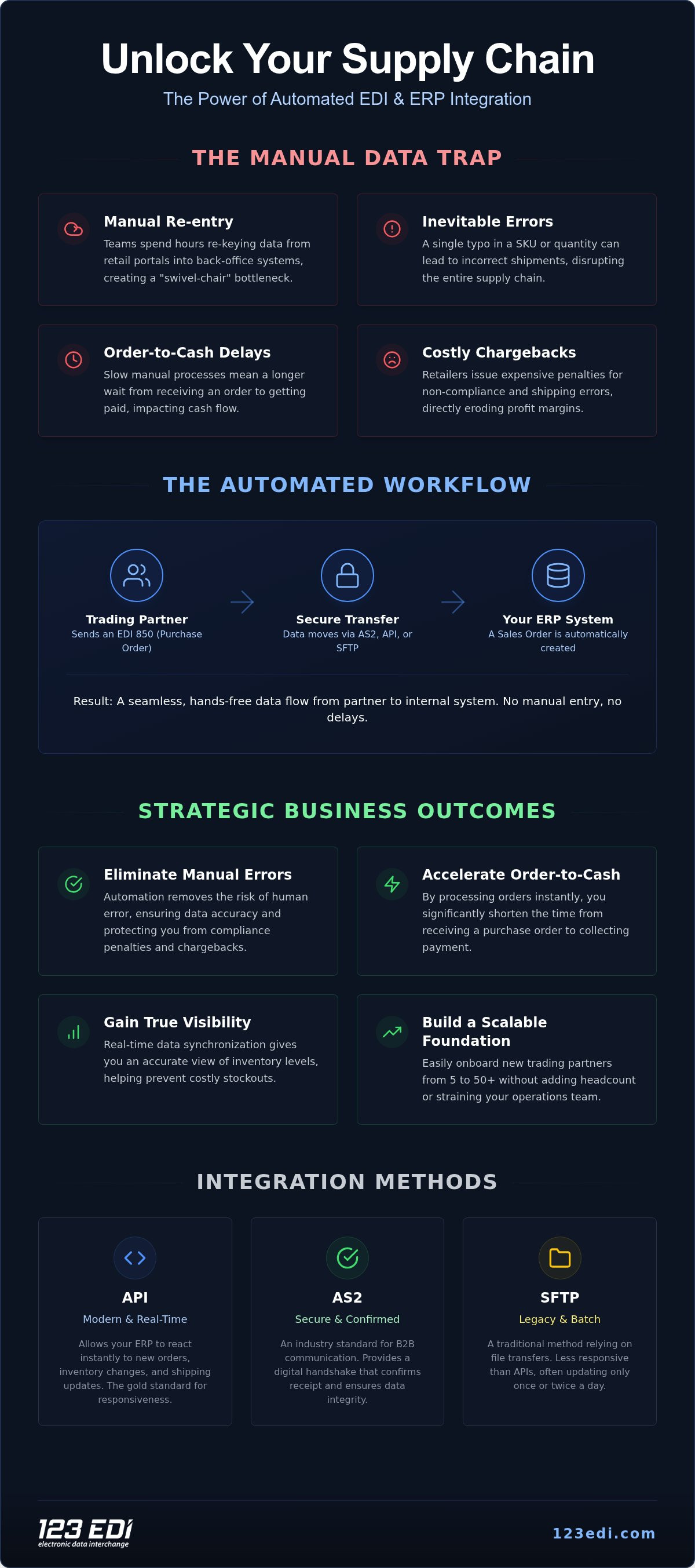
Trading partners often communicate using specific standards known as Electronic Data Interchange (EDI), which serves as the universal language for B2B transactions. If you’re new to the concept and want a thorough grounding before diving into integration specifics, our guide on what is EDI and how it works in modern supply chains provides the foundational context you need. While EDI handles the external conversation, your ERP system acts as the internal brain, managing your inventory levels, financial records, and logistics schedules. The magic moment occurs when these two systems begin to speak the same language. For instance, when an EDI 850 (Purchase Order) arrives from a retailer, an integrated system automatically populates a Sales Order within your ERP. There’s no manual entry, no delay, and no chance for a team member to mistype a SKU number or quantity.
The Cost of Staying Manual in 2026
Operating without a unified system in 2026 creates a hidden tax on every transaction you process. Manual data entry isn’t just slow; it’s expensive because of the labor hours consumed and the inevitable errors that lead to shipping mistakes. These errors often trigger retailer chargebacks, which are costly penalties for non-compliance that can quickly erode your profit margins. Beyond the immediate costs, manual processes hit a hard ceiling when you attempt to scale. While a small team might manage five trading partners through manual uploads, those same processes will inevitably fail when you grow to 50 partners. A robust EDI integration with ERP acts as a compliance shield, protecting your business from penalties while providing the infrastructure needed to support rapid growth without adding headcount.
The Technical Landscape: How Integration Actually Works
Understanding the architecture of an EDI integration with ERP doesn’t have to be overwhelming. Think of it as a sophisticated translation and transportation service that ensures two distinct systems can share vital information without friction. While legacy setups often relied on batch file transfers that only updated once or twice a day, modern environments prioritize the strategic benefits of a unified data ecosystem. This shift toward real-time responsiveness ensures your inventory levels and order statuses are always accurate, reflecting the true state of your business at any given moment.
At the heart of this process is data mapping. This is where we translate the complex, rigid requirements of your trading partners into formats your internal systems can digest. To move this data safely across the internet, we rely on secure protocols like AS2. AS2 provides a digital handshake that confirms receipt and ensures the data hasn’t been tampered with during transit, acting as a stabilizing force for your business communications.
Direct Integration vs. Managed Cloud Portals
Choosing the right path for your technical infrastructure depends largely on your internal resources and long-term goals. Direct integration offers high levels of control but places a heavy burden on your IT staff to maintain custom code and server uptime. Conversely, cloud-based EDI portals offer a collaborative approach that offloads technical complexity to a specialized partner. For many mid-market companies, a hybrid model provides refined results. It combines the deep system access of direct links with the user-friendly oversight of a managed portal. If you’re looking for a steady hand to guide this transition, exploring professional EDI integration with ERP systems can simplify your roadmap.
Common Integration Methods: API, SFTP, and AS2
The movement of data occurs through several primary channels, each with its own strengths. Application Programming Interfaces (APIs) are the modern standard for real-time responsiveness, allowing your ERP to react instantly to new orders or shipping updates. However, AS2 remains the gold standard for secure B2B file transfer due to its robust encryption and non-repudiation features. If you’re evaluating your communication options, understanding the key differences in AS2 vs FTP for EDI can help you select the protocol that best aligns with your trading partner requirements and security standards. At 123 EDI, we utilize these protocols to create a seamless flow of information that reduces technical stress. By combining the speed of APIs with the seasoned reliability of AS2, we ensure your data management remains both agile and secure as you scale your operations.
The Strategic Benefits of a Unified Data Ecosystem
Moving beyond the technical mechanics of data transfer allows us to see the true strategic value of a unified system. An EDI integration with ERP isn’t simply a tool for moving files; it’s a catalyst for the acceleration of results across your entire organization. When your systems communicate without manual intervention, your team shifts from reactive troubleshooting to proactive management. This transition provides immense emotional relief, as the constant fire-drills caused by data discrepancies disappear. Knowing your inventory levels are synchronized in real time prevents stockouts and ensures you can meet customer demand with confidence. For those seeking a deeper look at the underlying infrastructure that supports these benefits, our Comprehensive Guide to Cloud-Based EDI Solutions in 2026 offers extensive context.
Operational Efficiency and Error Reduction
One of the most immediate impacts of a successful EDI integration with ERP is the elimination of the “double-entry” trap. When your staff must manually re-key information from one system to another, typos and omissions are inevitable. These small errors often snowball into significant shipping mistakes and financial discrepancies. By automating documents like the Advance Ship Notice (ASN 856), your warehouse receiving accuracy improves dramatically. This precision has a positive ripple effect, leading to more reliable financial reporting and accounting. Current research on AI-enhanced EDI suggests that these automated workflows will become even more sophisticated, further refining the accuracy of high-volume transactions.
Strengthening Trading Partner Relationships
In the competitive world of retail and distribution, your reputation is built on reliability. By establishing a seamless data flow, you position your business as a “preferred supplier” in the eyes of major trading partners. Being 100% compliant and highly responsive builds a foundation of mutual respect that manual processes simply cannot match. Fast and accurate data interchange signals to retailers that your operations are professional and prepared for scale. This reliability serves as a powerful competitive edge when you bid for new contracts. Retailers are far more likely to award business to a partner who can guarantee a stabilizing force in their supply chain through automated, error-free communication.
A Readiness Framework: Preparing for ERP Integration
Before you write a single line of code or install a new connector, you must establish comprehensive oversight of your current environment. Think of this phase as the architectural blueprint for your digital future. An EDI integration with ERP is most successful when you approach it with the patience of a seasoned veteran. It’s not just about the technical link; it’s about ensuring your internal data is clean and your team understands the “why” behind every automated step. Choosing a partner that values your understanding as much as the solution itself will build a foundation of trust that lasts for years.
Auditing Your Current ERP Workflows
Mapping the path of a document is your first priority. Start by identifying which documents cause the most friction today. Usually, this includes the Purchase Order (850), Invoice (810), and the Advance Ship Notice (856). By following an order from the moment it arrives to the moment it’s archived, you’ll find the manual bottlenecks that slow your growth. You should also verify that your specific ERP version and database are ready for external connectivity. Older systems may require additional middleware to communicate effectively with modern cloud standards. Ensuring your internal data is accurate before the integration begins is the best way to prevent “garbage in, garbage out” scenarios.
Setting Realistic Goals and Timelines
We often advise our partners to avoid the “big bang” approach to implementation. Setting realistic goals for your EDI integration with ERP prevents the failures often seen in rushed projects. Instead, a phased rollout—onboarding one trading partner at a time—allows you to refine your workflows without overwhelming your staff. This methodical pace ensures stability and gives you the chance to address any unexpected business logic gaps. To measure your success, define clear KPIs such as reduced order lead times, lower manual error rates, or specific labor savings in your accounting department. A standard ERP EDI connector implementation typically takes between 6 to 12 weeks, depending on the complexity of your custom business rules and the number of unique partner maps required.
If you’re ready to start this journey with a trusted advisor who understands the nuances of supply chain automation, our team can help you build a custom EDI integration strategy that fits your unique business needs.
Future-Proofing with 123 EDI: Your Integration Partner
With over 30 years of experience since our founding in 1994, 123 EDI serves as a stabilizing force in the often turbulent world of supply chain technology. We’ve seen the industry transition from simple file exchanges to the complex, real-time demands of 2026. This deep institutional knowledge allows us to provide a level of seasoned reliability that ensures your operations remain steady as you scale. Whether you’re currently utilizing QuickBooks and planning a move to NetSuite, or you’re already operating on a robust SAP Business One platform, our cloud-based EDI solutions are designed to grow alongside your business. For distributors and manufacturers looking to integrate EDI with SAP Business One, our strategic guide provides a detailed roadmap for building a real-time, automated nervous system that scales with confidence. For mid-market companies on NetSuite specifically, our NetSuite EDI integration scalability guide for 2026 provides a detailed roadmap for automating your transaction flows and eliminating data entry errors. We prioritize human connection and mutual respect, ensuring that you never feel like just another ticket in a detached technical queue.
Achieving a successful EDI integration with ERP requires more than just a software connection; it requires a partner who understands your specific business logic. Our team brings a welcoming, service-oriented warmth to every interaction, aiming to simplify your technical landscape rather than complicate it. We’re here to build a foundation of long-term trust by delivering precise, high-performance results that remove the stress of intricate data management.
The 123 EDI Collaborative Approach
Our team functions as a patient educator, guiding your staff through the intricacies of your EDI integration with ERP. We don’t just hand over a tool and walk away. Instead, we offer a fully managed service that handles the heavy lifting of mapping, testing, and partner onboarding. This collaborative engagement ensures your team actually understands how the system supports their daily tasks, reducing the fear of the unknown. Even after the initial go-live, we remain by your side as a steady hand. Ongoing support is vital because trading partner requirements frequently shift, and having an expert available to manage those changes prevents operational downtime.
Seamless Connectivity Across the US
Building a responsive supply chain means having the ability to connect with any major US retailer or 3PL provider at a moment’s notice. Our infrastructure is built on secure EDI communications, utilizing robust AS2 protocols and a highly reliable cloud environment to keep your data moving safely. We take pride in our ability to facilitate these connections with precision, ensuring you remain 100% compliant with even the strictest retailer mandates. If you’re ready to move away from manual friction and toward true operational automation, we invite you to start a dialogue with us. Together, we can map out a custom integration roadmap that addresses your specific challenges and sets the stage for your future growth.
Building a Scalable Foundation for Your Supply Chain
Achieving a seamless data flow between your trading partners and internal systems is the most effective way to eliminate manual friction and protect your business from non-compliance penalties. By implementing a robust EDI integration with ERP, you move beyond reactive troubleshooting and establish a proactive environment where inventory and orders are always synchronized. This digital transformation provides the stability needed to grow your partner network without increasing operational overhead or risking costly data entry errors.
With over 30 years of institutional knowledge, our team at 123 EDI is here to serve as your steady hand throughout this transition. We’re proud to provide specialized AS2 secure data transfer and a comprehensive cloud-based EDI portal that simplifies even the most complex technical landscapes. Whether you’re refining current workflows or preparing for a major system migration, we’re dedicated to your success and understanding. Schedule a consultation with our integration experts to simplify your data landscape and take the first step toward a more automated, efficient future. Your path to operational clarity starts with a single collaborative dialogue.
Frequently Asked Questions
What is the difference between EDI and ERP?
ERP systems manage your internal business functions like inventory, finance, and logistics, while EDI is the standardized communication method used to exchange documents with external trading partners. Without an EDI integration with ERP, your team must manually bridge these two worlds, which often leads to data friction. Integration allows these systems to act as a single, unified ecosystem where external orders automatically become internal sales orders, saving time and improving data precision.
Can I integrate EDI with QuickBooks or is it only for large ERPs?
You can absolutely integrate EDI with QuickBooks. While many people associate these technologies with large enterprise systems like SAP or NetSuite, 123 EDI specializes in bringing automation to growing businesses using QuickBooks Desktop and Online. This allows smaller organizations to compete with larger rivals by meeting the same strict compliance standards and achieving a high level of operational efficiency through a refined, cloud-based approach.
How long does a typical EDI integration with ERP take to implement?
A standard implementation typically takes between 6 to 12 weeks to complete. This timeline depends on the number of trading partners you need to onboard and the complexity of your specific business rules. We recommend a phased approach, starting with your highest-volume partners first. This methodical pace ensures a stabilizing force for your operations and allows your team to adjust to the new automated workflows without feeling overwhelmed.
What are the most common challenges during an ERP EDI integration?
The most frequent hurdles include poor internal data cleanliness and the complexity of mapping unique partner requirements to your internal database. If your ERP contains duplicate SKUs or outdated pricing, these issues will surface during the testing phase. Working with a seasoned mentor helps you identify these friction points early. We guide you through the auditing process to ensure your data is ready for seamless movement before the first transaction occurs.
Do I need an internal IT team to manage an integrated EDI system?
You don’t need a dedicated internal IT team if you choose a managed service provider. 123 EDI acts as your external technical department, handling the complex tasks of document mapping, partner testing, and secure communication maintenance. Our cloud-based EDI portal provides a user-friendly interface that your operations or accounting staff can manage easily. This collaborative approach allows you to focus on your core business while we handle the technical intricacies.
Is EDI integration secure enough for sensitive financial data?
Yes, it’s highly secure when you utilize industry-standard protocols like AS2. AS2 provides robust encryption and digital signatures, ensuring that sensitive financial data remains protected during transit. Our infrastructure is built to maintain the highest levels of data integrity, providing you with a compliance shield against unauthorized access. This secure foundation is a critical component of a reliable EDI integration with ERP, giving you and your partners peace of mind. To better understand how AS2 compares to other transfer methods, our guide on AS2 vs FTP for EDI breaks down the security and compliance differences in plain language.
What happens if my ERP system undergoes an upgrade or migration?
When you upgrade or migrate your ERP, your integration partner should manage the transition to ensure continuity. 123 EDI has over 30 years of experience helping businesses move from entry-level software to advanced enterprise platforms like NetSuite EDI integration or SAP. We update the mapping and connectivity logic to match your new system’s requirements. This steady hand ensures that your trading partner relationships remain uninterrupted even as your internal technology landscape evolves and matures.
How does EDI integration help with retailer compliance and chargebacks?
Automation acts as a compliance shield by ensuring that every document meets the exact specifications of your trading partners. Most chargebacks result from manual entry errors, late notifications, or incorrect labeling. An integrated system sends Advance Ship Notices and invoices automatically, significantly reducing the risk of penalties. This precision helps you maintain a “preferred supplier” status and builds a foundation of long-term trust with major retailers across the country.