

What if the biggest obstacle to your next production milestone isn’t your shop floor capacity, but the rigid legacy software sitting in your back office? For many growing firms, the shift to cloud EDI for manufacturers represents the difference between struggling with manual data entry and running a truly synchronized operation. You’ve likely felt the sting of costly chargebacks from big-box retailers or watched your team lose hours re-keying purchase orders into your ERP. It’s frustrating to know your production is ready to scale while your administrative processes remain stuck in the past.
We understand that these technical bottlenecks create real stress for your leadership team. In this guide, you’ll discover how a modern cloud-based approach simplifies complex data landscapes and creates a seamless bridge to your ERP system. We’ll explore how automating your purchase-to-pay and order-to-cash workflows ensures 100% compliance with retail partners while significantly reducing overhead. By moving away from fragile on-premise setups, you can finally transform your EDI from a source of errors into a reliable engine for growth.
Key Takeaways
- Learn why modernizing with cloud EDI for manufacturers is the key to replacing rigid legacy systems and meeting the high-speed demands of modern production.
- Discover how to turn your ERP into an automated supply chain engine by moving beyond simple file exchanges to deep, real-time data synchronization.
- Gain insights into achieving 100% compliance with major retailers, effectively protecting your margins from expensive chargebacks and manual entry errors.
- Understand the phased roadmap for a seamless transition to a cloud-based portal, ensuring your operations remain stable during the integration process.
- See how specialized integration support can help you manage complex data mapping requirements for even the most intricate internal ERP environments.
Why Manufacturers are Migrating to Cloud-Based EDI Systems
To stay competitive in an era of rapid supply chain shifts, many leaders are rethinking their approach to data exchange. Cloud EDI for manufacturers acts as a hosted integration layer, managing critical B2B communications without the need for expensive or cumbersome on-site hardware. While the foundations of Electronic Data Interchange (EDI) have existed for decades, the transition to the cloud represents a significant leap forward in how production facilities handle high-volume transactions. We’ve seen that the most successful manufacturers view their technology not as a static tool, but as a dynamic partner in their growth. This shift toward cloud-hosted layers allows your team to focus on production excellence rather than server maintenance.
The Limitations of Legacy EDI in Modern Production
Traditional on-premise setups often struggle to keep pace with the precision required in modern manufacturing. When your team relies on manual file transfers or aging internal servers, the risk of inventory inaccuracies and production delays increases exponentially. Older systems often feel like a “black box” where data goes in and results come out, but nobody is quite sure how it works. This lack of transparency leads to bottlenecks when a trading partner changes their requirements. Instead of a quick update, you’re faced with a complex re-coding project that halts progress. Maintaining these proprietary systems isn’t just a technical challenge; it’s a drain on your IT budget that diverts resources away from innovation. Legacy debt in manufacturing EDI is the cumulative burden of maintaining outdated hardware and custom-coded scripts that restrict a company’s ability to adopt modern, agile supply chain practices.
Cloud-Based Flexibility for Scaling Manufacturers
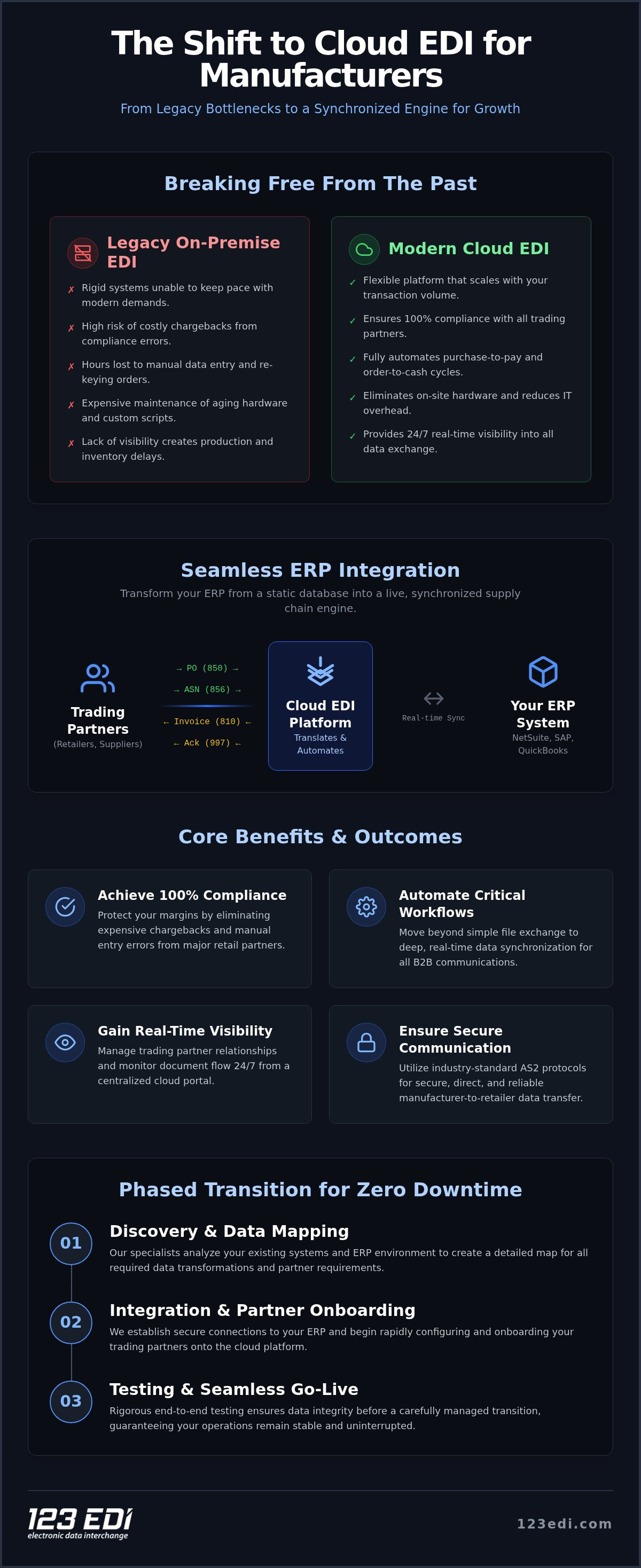
Scaling your operations shouldn’t be hindered by the speed of your IT department. Cloud-based solutions allow for the rapid onboarding of new suppliers and retail partners, turning what used to be weeks of configuration into a streamlined process. Through a centralized cloud portal, manufacturing leaders gain real-time visibility into the entire order-to-cash cycle. This accessibility is vital. It provides the reassurance that your data is moving securely via AS2 protocols, protected by the same level of oversight as your physical assets. Whether your staff is on the factory floor or working remotely, they can manage trading partner relationships from any location. This oversight ensures that whether you’re processing ten orders or ten thousand, your document flow remains stable. It’s about having a solution that grows alongside your transaction volume, providing 24/7 monitoring to catch errors before they impact your shipping schedule.
Bridging the Gap: Seamless EDI Integration with ERP Platforms
Moving beyond simple file exchange is where the real value of cloud EDI for manufacturers begins. It’s not just about sending a document; it’s about automated data synchronization that eliminates the friction between your trading partners and your internal database. By creating a direct pipeline, you ensure that order information flows into your system without human intervention. This shift significantly improves order accuracy and shortens lead times by removing the wait time inherent in manual processes. Industry experts agree that modernizing these connections is imperative for manufacturing growth and resilience.
Connecting NetSuite, SAP, and QuickBooks EDI
Integrating with platforms like NetSuite, SAP Business One, or QuickBooks allows for a sophisticated handshake between systems. The ERP connector acts as a specialized translator. It takes incoming X12 or EDIFACT standards and maps them directly into your internal formats. For example, when a retailer sends an automated purchase order (850), it doesn’t sit in an inbox waiting for a clerk to find it. It flows directly into your sales order module. Once the shipment is processed, the corresponding invoice (810) moves back out through the same channel. This circular automation maintains the integrity of your accounting and inventory records at every step, ensuring your static database becomes a live operational engine.
The Technical Backbone: AS2 and Secure Communications
Security is a primary concern when sharing proprietary designs or sensitive pricing data. AS2 protocols provide a secure, direct path for manufacturer-to-retailer data transfer, ensuring that your business intelligence remains confidential. These protocols use digital certificates and encryption to verify that the sender and receiver are exactly who they claim to be. AS2 is the gold standard for retail compliance. By utilizing cloud EDI for manufacturers, you gain a secure B2B file transfer environment that protects your most valuable assets while satisfying the strict communication requirements of your largest customers.
Navigating these complex ERP mappings requires more than just software. It demands a collaborative partnership with an expert who understands your specific operational nuances. We believe in providing a stabilizing force that removes the stress of intricate data management. If you’re looking for a steady hand to guide your transition, we invite you to learn more about our EDI integration with ERP systems and how it can support your long-term success.
Overcoming Compliance Hurdles and Chargeback Risks
While seamless ERP integration creates internal efficiency, its external value lies in protecting your bottom line from retail penalties. For many production leaders, the arrival of a “chargeback” notification from Walmart, Amazon, or Target is a source of significant stress. These financial penalties for non-compliance can quickly erode thin margins. By adopting cloud EDI for manufacturers, you gain a proactive defense against human error. This system is designed to enforce 100% compliance with strict retail document standards, ensuring that every transaction meets the exact specifications of your trading partners.
Current EDI market trends show that the move toward cloud-hosted validation is accelerating because it allows for pre-transmission checks. An EDI portal acts as a necessary safety net. It validates your data against the specific rules of your partner before that information ever leaves your digital front door. This level of oversight provides the steady confidence that your operations are fully aligned with industry expectations, removing the anxiety of potential “gotcha” moments in your supply chain. When evaluating your options, consulting a comprehensive modern EDI platform buyer’s guide can help you identify the essential criteria for selecting a solution that eliminates manual entry and integrates flawlessly with your existing systems.
Navigating Retailer-Specific Requirements
Every big-box retailer operates with its own unique set of digital rules. While one might demand specific pallet labeling, another might require unique data fields in an invoice that aren’t standard for other customers. We act as a mentor to help you navigate this compliance maze, ensuring you understand the logic behind every requirement. A critical component of this process is the 997 functional acknowledgment. This transaction serves as a digital receipt. It confirms that your partner successfully received and accepted your document, which removes the guesswork from your daily communications and ensures you stay in good standing with your buyers.
Automating the Advance Ship Notice (ASN)
Among all standard documents, the 856 Advance Ship Notice (ASN) is often the most complex yet vital for manufacturers. It requires a detailed, hierarchical breakdown of exactly what is inside every carton on every pallet. When you integrate your Warehouse Management System (WMS) with your cloud EDI for manufacturers software, you automate this generation process. This integration ensures the physical shipment matches the digital record exactly, which is essential for modern manufacturing logistics. Accurate shipping data has a direct impact on warehouse receiving efficiency. When your ASN is perfect, your products move through the retailer’s dock faster, building long-term trust and positioning your company as a reliable, professional partner.
Implementation Roadmap: Transitioning to Cloud EDI Without Downtime
Transitioning to cloud EDI for manufacturers often brings a sense of unease regarding potential production halts. We believe that a successful migration isn’t just about the software; it’s about a disciplined methodology that protects your daily operations. A clear roadmap provides the stability your team needs to move forward with confidence. By following a structured five-phase approach, we ensure your transition is smooth and your data remains secure.
- Phase 1: Workflow Audit. We conduct a comprehensive audit of your current ERP workflows and trading partner requirements to identify exactly how data should move through your facility.
- Phase 2: Data Mapping. Our team handles the translation setup to ensure your internal ERP logic is perfectly compatible with external EDI standards.
- Phase 3: Secure Testing. We perform rigorous testing of your connections using secure AS2 or VAN protocols to verify every digital handshake.
- Phase 4: Parallel Run. We initiate a parallel run where the cloud EDI for manufacturers platform operates alongside your legacy system to confirm accuracy before the final cutover.
- Phase 5: Continuous Optimization. Once live, we provide ongoing monitoring and collaborative support to refine your processes and handle new partner onboarding.
Testing and Validation Protocols
Before any system goes live, manufacturers must test every transaction set, including purchase orders (850), invoices (810), and the advance ship notice (856). We take the lead in managing the technical onboarding of your partner community, acting as the primary point of contact for their IT teams. This allows you to focus on manufacturing while we identify and resolve data discrepancies during the testing phase. It’s a collaborative effort that ensures every digital handshake is firm and accurate. We don’t just connect systems; we validate that the data moving between them is 100% reliable.
Ensuring Business Continuity During Migration
Maintaining production momentum is non-negotiable. Migrating legacy data without disrupting current lines requires a steady hand and decades of institutional knowledge. We prioritize a “no-surprises” approach, using a clear roadmap to prevent information overload for your staff. By treating the transition as a partnership rather than a mere installation, we ensure your history is preserved and your future is secure. If you’re ready to modernize your infrastructure with a reliable partner, explore our cloud-based EDI solutions designed for the manufacturing sector.
Driving Manufacturing Efficiency with 123 EDI Solutions
By centralizing your B2B communications, 123 EDI’s cloud portals provide a unified operational cockpit for manufacturing leaders. This visibility allows you to monitor the health of your supply chain in real-time, moving away from the fragmented data silos that often plague growing firms. We specialize in providing direct integration support for complex or custom ERP environments, ensuring that your specific business logic is preserved while your transactions are automated. Our role is to act as the stabilized force in your back office, removing the technical stress of data management so you can focus on production excellence. This transition from manual entry to a collaborative, automated future is the foundation of modern manufacturing agility.
Through the 123 EDI portal, you can track the status of every purchase order and invoice without digging through emails or calling your partners. This clarity reduces the cognitive load on your staff, allowing them to focus on higher-value tasks like production planning and quality control. We understand that every manufacturer has a unique way of managing their internal data, which is why we don’t offer one-size-fits-all solutions. Instead, we lean into our institutional knowledge to build a bridge between your legacy processes and the modern cloud. Using cloud EDI for manufacturers ensures that your technology remains an asset rather than a liability as your partner list grows.
A Collaborative Approach to EDI Managed Services
We believe that technology works best when it’s backed by human expertise. Our collaborative approach to managed services ensures you have a dedicated expert who understands your unique operational flow. Unlike cold, detached technology providers, we maintain a service-oriented warmth that prioritizes your understanding of the solution. This mentor-led strategy provides a significant long-term ROI by reducing the need for internal EDI specialists and ensuring your system evolves alongside your retail partnerships. It’s about building a foundation of trust that lasts for decades.
Our team, drawing on extensive experience as a stabilizing industry force since 1994, works as an extension of your own department to manage daily infrastructure and partner onboarding. We take the time to act as patient educators, valuing your team’s understanding of the technical solution as much as the solution itself. This partnership ensures that when challenges arise, you have a reliable, steady hand ready to assist. By outsourcing the complexities of EDI communications and mapping, you gain the freedom to scale your production without the fear of technical bottlenecks.
Ready to Automate Your Manufacturing Supply Chain?
The competitive advantage of integrated cloud EDI for manufacturers lies in its ability to transform a necessary compliance task into a strategic asset. By automating the data flow between your trading partners and your internal systems, you eliminate the friction that causes delays and errors. Scalable growth is built on a foundation of reliable data interchange, and we are here to provide the steady hand you need to reach your next milestone. Your journey toward a fully synchronized supply chain begins with a clear roadmap and a partner invested in your success.
We invite you to discuss your specific ERP integration needs with our team and discover how a collaborative partnership can secure your future. Whether you are currently struggling with manual entry or looking to migrate from a rigid legacy system, we offer the expertise to lead you toward a more efficient operation. Let’s work together to create a seamless, automated workflow that supports your long-term manufacturing goals.
Synchronizing Your Supply Chain for Sustainable Growth
Embracing a modern approach to data exchange is about more than just meeting retailer requirements. It’s about building a resilient foundation that allows your production to scale without the weight of manual errors. By implementing cloud EDI for manufacturers, you transform your ERP from a static database into a proactive operational engine. This automation ensures 100% compliance with partners while freeing your team to focus on innovation and quality on the shop floor.
Since 1994, we’ve served as a stabilizing force for firms navigating complex digital landscapes. We provide specialized support for NetSuite, SAP, and other major platforms, ensuring your integration is both secure and efficient. Our collaborative partnership approach means we don’t just provide software; we act as a mentor to guide you through every technical hurdle with seasoned reliability. We value your understanding of the process as much as the solution itself.
Streamline your manufacturing supply chain with 123 EDI today and discover the clarity that comes with professional data management. Your path to an automated, error-free future is closer than you think, and we’re ready to help you take that next step with confidence.
Frequently Asked Questions
What is cloud EDI specifically for manufacturers?
Cloud EDI is a hosted service that manages the exchange of business documents like purchase orders and shipping notices without requiring on-site hardware. It acts as a specialized communication layer between your production facility and your trading partners. This infrastructure handles the translation of complex data formats, allowing your team to focus on manufacturing excellence while the cloud ensures your digital transactions are compliant and secure.
How does cloud EDI integrate with my existing ERP system?
Integration happens through specialized connectors that map incoming data directly into your internal ERP fields. Whether you use NetSuite, SAP, or Microsoft Dynamics, the cloud platform translates X12 or EDIFACT files into a format your database understands. This creates a seamless flow for sales orders and invoices. It replaces manual entry with automated synchronization, ensuring your ERP remains a live, accurate reflection of your supply chain activity.
Will transitioning to cloud EDI disrupt my manufacturing production?
No, a structured migration plan ensures that your production lines continue to run without any interruption. By using a parallel run phase, you can verify that the new system is working perfectly before you disconnect your legacy setup. This methodical approach provides the stability needed to modernize your infrastructure. Our team acts as a steady hand, managing the technical transition so your warehouse and shop floor staff don’t experience downtime.
How does cloud EDI help prevent retailer chargebacks?
The system uses built-in validation rules to check every document against specific retailer standards before it’s sent. If an Advance Ship Notice (856) or invoice (810) contains errors, the system alerts you immediately. This proactive oversight ensures that your outgoing data meets the strict requirements of partners like Walmart or Amazon. By catching discrepancies early, cloud EDI for manufacturers protects your margins from costly and avoidable non-compliance penalties.
What is the difference between AS2 and a Web EDI portal?
AS2 is a secure communication protocol used for direct, automated machine-to-machine data transfer. A Web EDI portal is a browser-based interface where users can manually view, enter, or manage documents. While large manufacturers often prefer the automation of AS2 for high-volume partners, the portal provides a unified cockpit for visibility and manual adjustments. Many firms use a hybrid approach to maintain both security and operational flexibility across their entire partner network.
Can cloud EDI handle high volumes of transaction data for large manufacturers?
Yes, cloud-based infrastructure is designed to scale effortlessly as your transaction volume grows. Unlike on-premise servers that have fixed capacity, the cloud adjusts to handle seasonal spikes or rapid business expansion. This scalability is a core benefit of cloud EDI for manufacturers, as it ensures that thousands of documents can be processed simultaneously without slowing down your internal systems. It provides the reliable backbone needed for large-scale global operations.
What technical support is available during the EDI implementation process?
You receive dedicated integration support from industry veterans who manage the technical onboarding of your trading partners. This includes data mapping, protocol setup, and rigorous testing of every transaction set. We act as a mentor throughout the journey, providing clear guidance and transparent communication. This collaborative partnership ensures that your team understands the new system while we handle the heavy lifting of complex ERP configurations and partner compliance checks.
Is my manufacturing data secure in a cloud-based EDI environment?
Security is maintained through advanced encryption and digital certificates that protect your proprietary designs and pricing data. Using protocols like AS2 ensures that files are transferred directly between authorized parties without exposure. Cloud environments also benefit from 24/7 monitoring and redundant backups that are often more robust than internal IT setups. This creates a secure, reliable ecosystem that safeguards your business intelligence while maintaining the flow of critical supply chain information.