

Imagine it’s 2026, and you’re refreshing a partner portal for the third time this hour, hoping a critical Advance Shipping Notice actually reached your retailer. Every minute of silence increases the risk of a costly chargeback, yet the data remains trapped in a digital black box. This lack of transparency is why modern logistics leaders rely on real-time EDI tracking to regain control. This uncertainty isn’t just a minor inconvenience. It’s a structural flaw that threatens your bottom line and strains your most valuable business relationships.
You’ve likely felt the frustration of manual status checks and the persistent anxiety of missed transmissions. It’s exhausting to manage complex logistics when you’re effectively flying blind. We’re here to show you how real-time visibility transforms this chaotic process into a streamlined, transparent operation. You’ll discover how to eliminate blind spots and integrate these insights directly into your ERP for total transaction visibility. We’ll explore the shift from reactive manual checks to proactive automated alerts, ensuring your order-to-cash cycle remains uninterrupted and your partnerships stay strong.
Key Takeaways
- Gain clarity on how real-time EDI tracking provides live visibility into your document status, helping you avoid costly retailer chargebacks and delivery delays.
- Explore the mechanics of secure AS2 protocols and cloud-based portals that ensure your transaction data moves safely and instantaneously across your partner network.
- Learn why integrating EDI with your ERP system is vital for maintaining a single source of truth and streamlining your internal business processes.
- Identify the specific dashboard features and advanced filtering tools that allow your team to manage high volumes of data with effortless precision.
- Understand the value of partnering with an industry veteran to navigate complex technical landscapes and secure the long-term success of your supply chain.
What is Real-Time EDI Tracking and Why Does It Matter?
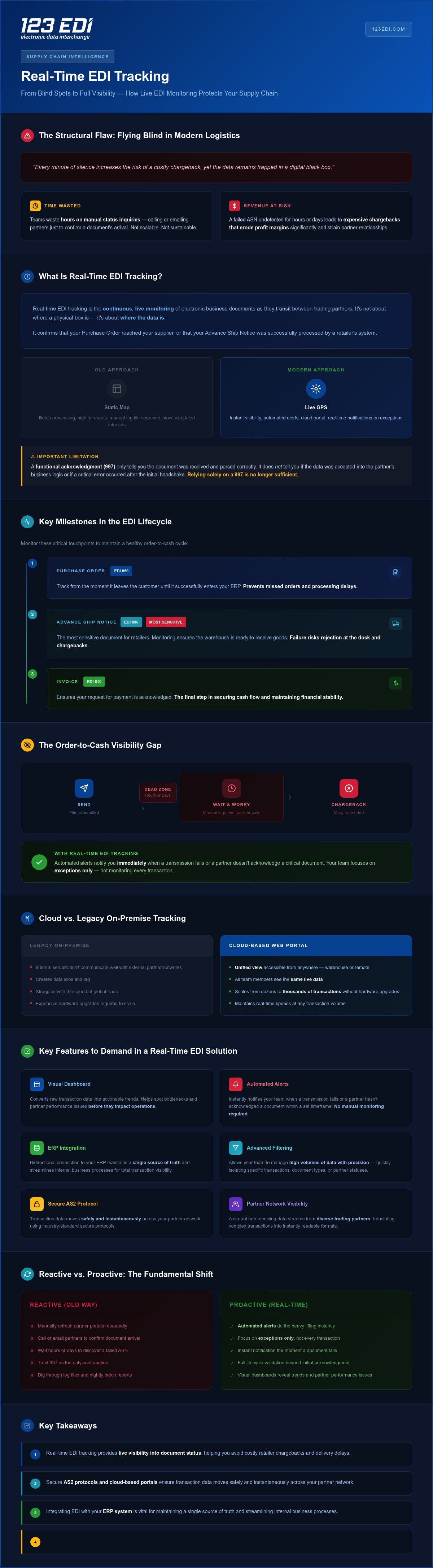
At its core, real-time EDI tracking is the continuous, live monitoring of electronic business documents as they transit between trading partners. While many people associate the term “tracking” with a UPS or FedEx parcel number, Electronic Data Interchange (EDI) tracking operates on a much deeper level. It isn’t about where a physical box is; it’s about where the data is. It confirms that your Purchase Order reached your supplier or that your Advance Ship Notice (ASN) was successfully processed by a retailer’s system.
By 2026, the old method of batch processing, where data moved in slow, scheduled intervals, has become a liability. Modern supply chains demand instant visibility. Relying solely on a functional acknowledgment (997) is no longer sufficient. A 997 only tells you the document was received and parsed correctly. It doesn’t tell you if the data was actually accepted into the partner’s business logic or if a critical error occurred after the initial handshake. True tracking provides the reassurance that the entire transaction cycle is proceeding as planned.
The Order-to-Cash Visibility Gap
In high-volume trading environments, documents often fall into dead zones. These are the silent intervals between sending a file and receiving a response. Without real-time EDI tracking, you might wait hours or days to realize an ASN failed to reach a retailer. This delay often results in expensive chargebacks, which can erode profit margins significantly. Beyond the financial cost, these blind spots create friction. Your team ends up wasting hours on manual status inquiries, calling or emailing partners just to confirm a document’s arrival. This manual approach is neither scalable nor sustainable for growing businesses.
Key Milestones in the EDI Lifecycle
To maintain a healthy supply chain, you must monitor several critical touchpoints that define the order-to-cash cycle. Having visibility into these milestones allows you to address issues before they escalate:
- Purchase Order (850): Tracking this from the moment it leaves the customer until it successfully enters your ERP prevents missed orders and processing delays.
- Advance Ship Notice (856): This is often the most sensitive document for retailers. Monitoring its status ensures the warehouse is ready to receive the goods, avoiding rejection at the dock.
- Invoice (810): Real-time visibility here ensures your request for payment is acknowledged, which is the final step in securing your cash flow and maintaining financial stability.
The Mechanics of Live Data: How Modern EDI Tracking Portals Work
Understanding the technical infrastructure behind real-time EDI tracking helps demystify how complex transactions become manageable. A modern system acts as a central hub, receiving data streams from diverse trading partners and translating them into a readable format instantly. Instead of digging through log files or waiting for nightly batch reports, supply chain managers use cloud-based EDI portals to see exactly where a document sits at any given moment. It’s the difference between looking at a static map and using a live GPS.
The transition from “searching for data” to “receiving notifications” represents a fundamental shift in logistics management. Automated alerts now do the heavy lifting. If a transmission fails or a partner doesn’t acknowledge a critical document within a set timeframe, the system notifies you immediately. This allows your team to focus on exceptions rather than monitoring every successful transaction. Visual dashboards then take this raw data and turn it into actionable trends, helping you spot bottlenecks or partner performance issues before they impact your operations.
Cloud vs. Legacy On-Premise Tracking
Legacy on-premise systems often struggle with the speed of 2026 global trade. These older setups frequently rely on internal servers that don’t communicate well with external partner networks, leading to data silos and lag. In contrast, a web-based EDI portal provides a unified view accessible from anywhere. Whether your team is in the warehouse or working remotely, they see the same live data. This scalability is essential. As your business grows from handling dozens to thousands of transactions, a cloud infrastructure maintains real-time EDI tracking speeds without requiring expensive hardware upgrades.
The Importance of AS2 in Real-Time Communication
Secure communication protocols are the backbone of this speed. AS2 provides immediate Message Disposition Notifications (MDNs), which act as digital receipts. These receipts confirm that the data arrived intact and was decrypted successfully. By centralizing these communications within a managed hub, you ensure that every transaction is logged and tracked the second it happens. This level of precision is why many leaders choose to implement EDI communications through a specialized provider to maintain high-speed data integrity and total oversight.
By utilizing these modern mechanics, you move away from the stress of the unknown. You gain a steady, reliable hand over your data flow, ensuring that your supply chain remains agile and your partners remain satisfied. It’s about building a foundation of trust through technical excellence and transparent communication.
Bridging the Gap: The Power of EDI Integration with ERP
While a standalone portal offers a valuable window into your data, real-time EDI tracking only reaches its full potential when it’s woven into your Enterprise Resource Planning (ERP) system. Without this connection, your team is forced to swivel chair between screens, manually verifying that the data in the portal matches the records in your internal software. Integration creates a “Single Source of Truth,” where the status of an EDI 856 or 810 is visible directly within your primary business interface. This eliminates the uncertainty that often occurs when data lives in isolated silos.
The true power of this synergy lies in the automated “write-back” capability. When a document is tracked and confirmed as received by a partner, the system automatically updates the order status in the ERP. This automation triggers essential downstream workflows, such as inventory adjustments or shipping schedules, without a single keystroke from your staff. It removes the silent drain of manual data entry. By automating these flows, you ensure that your internal teams always work with the most current information, allowing them to focus on high-value tasks rather than administrative upkeep.
NetSuite and SAP: Enterprise-Level Tracking
For larger organizations, Mastering EDI Integration with ERP is essential for maintaining global oversight. NetSuite users benefit from seeing real-time order statuses that reflect the exact moment a retailer acknowledges a shipment. Similarly, SAP Business One users utilize EDI connectors to ensure that high-volume transactions don’t lead to data bottlenecks. This enterprise-level visibility allows decision-makers to act on live data, refining logistics strategies in 2026’s fast-paced market with steady confidence.
Tracking for Small Business: QuickBooks Integration
Small businesses often feel they don’t have the IT resources for sophisticated tracking, but cloud-based solutions have changed that. Bringing enterprise-grade visibility to QuickBooks users allows smaller operations to simplify compliance for retail suppliers. You don’t need a massive internal team to manage these complex connections. By leveraging a managed cloud EDI service, growing businesses can level the playing field, ensuring they meet strict retailer requirements while keeping their internal operations lean. This accessibility ensures that transparency isn’t just for the giants of the industry, but for every partner in the chain.
Key Features to Demand in a Real-Time EDI Tracking Solution
Selecting the right platform requires looking beyond basic connectivity. To achieve true real-time EDI tracking, your solution must offer a user-centric interface that simplifies complex data streams. High-performance dashboards are essential, providing customizable “at-a-glance” views that highlight your most urgent tasks. Instead of scrolling through endless logs, your team should be able to use advanced filtering to locate specific transactions by PO number, date, or trading partner within seconds. This level of precision ensures that no document is ever truly lost.
Effective oversight also demands multi-user access with role-based permissions. Your logistics team needs different data than your finance department. By tailoring the view to the user’s specific responsibilities, you prevent information overload while maintaining high security standards. Comprehensive audit trails and historical data storage further support this structure, providing a reliable record for long-term analysis and compliance reporting. These features turn a simple tracking tool into a robust management system.
Proactive Alerting Systems
A reactive approach is no longer sustainable in 2026’s high-velocity trading environments. Proactive alerting systems shift the burden of monitoring from your staff to the software. You can configure alerts for missing documents, such as when a Purchase Order is received but no corresponding Advance Ship Notice (ASN) is sent within the required window. This instant error detection significantly reduces your Mean Time to Repair (MTTR) for failed transactions. By catching these gaps early, you protect your reputation with retailers and avoid the penalties associated with missed delivery windows.
Compliance and Audit Readiness
Retailers like Walmart maintain strict communication standards, and real-time tracking serves as your primary defense during disputes. If a retailer claims a document was never received, your tracking data provides the timestamped proof needed to resolve the issue quickly. For those still learning the foundational requirements of these standards, our guide on What is EDI? offers deeper context on how these protocols function. Having a steady hand over your compliance data ensures you can navigate audits with total confidence. To see how these features can stabilize your operations, explore our EDI software options today.
Optimizing Your Supply Chain with 123 EDI Tracking Solutions
Drawing on over three decades of institutional knowledge, 123 EDI blends the reliability of an industry veteran with the speed of 2026 cloud technology. Since our founding circa 1994, we’ve seen the industry evolve from basic data exchange to the sophisticated, live ecosystems we manage today. The 123 EDI Portal serves as a user-centric window into your entire supply chain, providing the clarity you need to make informed decisions. It’s about more than just data; it’s about providing a stabilizing force that removes the stress of intricate data management.
Achieving effective real-time EDI tracking requires more than just a software license. It demands a partner who understands the nuances of your specific ERP environment and your unique business goals. Our team doesn’t just hand you a tool and leave you to figure it out. We manage the entire integration process for you, ensuring that your transition to live tracking is smooth, logical, and thoroughly supported. This comprehensive oversight allows you to focus on growth while we handle the technical complexities of your partner communications.
A Collaborative Approach to Data Management
By positioning ourselves as a trusted consultant, we move beyond the cold feel of typical software providers to build a foundation of long-term trust. We believe that human connection is vital in a technical landscape. This is why we provide US-based expert support to assist with critical tracking issues and partner requirements. Our specialists act as patient educators, valuing your team’s understanding of the system as much as the technical solution itself. This collaborative spirit ensures that you always have a steady hand to rely on when challenges arise.
Next Steps: Achieving Total Visibility
To begin refining your operations, our team will work with you to evaluate your current tracking gaps and identify opportunities for automation. As you add new trading partners, our scalable cloud infrastructure grows with you, maintaining consistent performance regardless of transaction volume. We invite you to experience how a dedicated partner can transform your logistics through precision and transparency. Contact 123 EDI to see our real-time tracking portal in action and discover the path toward total transaction visibility.
Securing Your Supply Chain Future with Total Visibility
The transition toward absolute transparency isn’t just a technical upgrade; it’s a strategic move to protect your business relationships and your bottom line. By implementing real-time EDI tracking, you replace the anxiety of the unknown with the steady confidence of live data. We’ve seen how bridging the gap between your partner communications and your ERP system, whether you use NetSuite, SAP, or QuickBooks, creates a seamless flow of information that prevents costly errors before they occur.
With over 30 years of expertise and a commitment to secure AS2 communication protocols, 123 EDI stands as a reliable partner in your growth. We’re here to help you simplify complex technical landscapes and build a foundation of long-term trust through precision and human-centric support. It’s time to move beyond manual checks and embrace an automated, visible order-to-cash cycle that scales with your ambitions. Streamline your supply chain with 123 EDI’s real-time tracking solutions. We look forward to helping you achieve total transaction clarity.
Frequently Asked Questions
What is the difference between functional acknowledgments and real-time tracking?
Functional acknowledgments, like the 997, only confirm that a document was received and parsed by the partner’s system. They don’t indicate if the data was actually accepted into their business logic. Real-time EDI tracking goes further by providing live visibility into the entire transaction lifecycle. This ensures you know exactly when a document is processed, helping you spot delays that a simple acknowledgment might miss. It provides a deeper level of operational certainty.
Can I track EDI documents directly within my ERP system?
You can track your transactions directly within your ERP when you use a specialized integration. By connecting your EDI software with platforms like NetSuite, SAP, or QuickBooks, status updates flow automatically into your internal interface. This creates a single source of truth, allowing your team to monitor document delivery without leaving the software they use every day. It eliminates the need to jump between different portals just to verify your order statuses.
How does real-time EDI tracking help prevent retailer chargebacks?
It prevents chargebacks by providing immediate alerts for missing or failed transmissions. For example, it flags an Advance Ship Notice that didn’t reach the retailer. Since retailers often impose strict delivery windows, knowing about a failure early allows you to resend data before penalties are triggered. Real-time EDI tracking ensures you meet compliance requirements consistently, protecting your profit margins from avoidable fines and maintaining healthy partner relationships.
Do I need special software to access an EDI tracking portal?
You don’t need to install complex local hardware to access these insights. Modern solutions are cloud-based, meaning you can log into a secure EDI portal using any standard web browser. This accessibility is ideal for remote teams or warehouse staff who need to check document statuses on the go. The portal acts as a centralized hub, aggregating data from all your trading partners into one user-friendly dashboard without requiring intensive internal IT maintenance.
How quickly are EDI status updates reflected in a cloud portal?
Updates are reflected almost instantaneously as documents move through the secure communication network. Unlike legacy batch processing that might only update once a day, cloud portals utilize live data streams to provide current information. When a partner receives a file or sends an acknowledgment, the change appears in your tracking view within seconds. This speed is critical for managing fast-moving supply chains where every minute counts toward meeting your shipping deadlines.
Is real-time EDI tracking secure for sensitive business data?
Security is a top priority, and it’s essential that modern tracking utilizes encrypted protocols like AS2 to protect your sensitive information. These protocols ensure that data remains confidential and unaltered during transit between you and your trading partners. By using secure digital certificates, this live visibility provides a safe environment for exchanging purchase orders and invoices. This level of protection helps you maintain compliance with strict industry data security standards.
Can real-time tracking handle high volumes of transactions during peak seasons?
Cloud-based tracking is designed to scale effortlessly, making it highly effective during peak seasons when transaction volumes spike. The infrastructure can process thousands of documents simultaneously without any degradation in tracking speed or accuracy. This scalability ensures that your visibility remains constant even during your busiest months. You can rely on the system to provide steady, reliable oversight of your data flow, regardless of how many partners you’re communicating with at once.
What happens if an EDI transaction fails to reach its destination?
If a transaction fails, the tracking system triggers an automated alert to notify your team immediately. Instead of waiting for a retailer to complain about a missing document, you’re informed of the error the second it occurs. This proactive detection allows you to investigate the cause, whether it’s a connection issue or a data error, and resend the file quickly. It reduces the time spent on troubleshooting and keeps your logistics operations moving forward.