

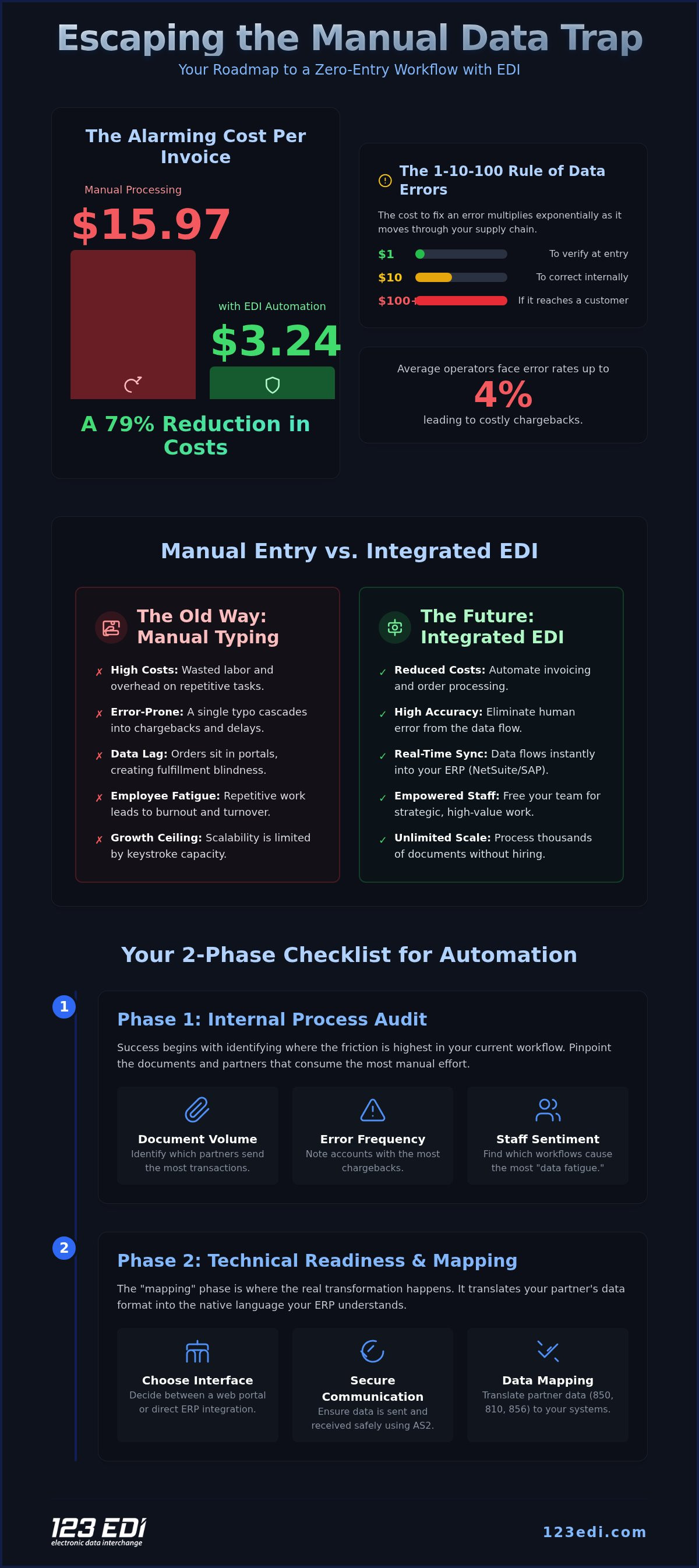
Did you know that manually processing a single invoice can cost your business nearly $16 in labor and overhead? When you consider that average operators face error rates up to 4%, it’s clear that the traditional way of handling paperwork is a silent drain on your resources. You’ve likely felt the frustration of a misplaced digit leading to a costly retailer chargeback or a shipment that sits idle while your team corrects data mismatches. To effectively reduce manual data entry EDI integration serves as the primary cure for these operational bottlenecks and helps protect your bottom line.
We understand that transitioning to a new system can feel complex, but the path to efficiency is shorter than it seems. This guide will show you how to eliminate those expensive typing errors and accelerate your entire supply chain through automated integration. You’ll discover a clear, actionable roadmap for 2026 that prioritizes seamless connection with your existing NetSuite or SAP systems. By the end of this checklist, you’ll have the tools to achieve up to a 79% reduction in processing costs and build a foundation of steady, automated growth that finally moves at the speed of your ambition.
Key Takeaways
- Understand the hidden financial and cultural impact of data fatigue and how a single typo can cascade through a high-volume supply chain.
- Learn how to audit your current touchpoints and standardize internal formats to effectively reduce manual data entry EDI through strategic automation.
- Compare the dramatic speed and accuracy differences between manual purchase order entry and integrated electronic mapping.
- Follow a clear roadmap for implementing a zero-entry workflow, from selecting a pilot trading partner to configuring real-time ERP synchronization.
- Discover how leveraging decades of integration expertise and cloud-based portals can simplify your transition to a more reliable data landscape.
The Hidden Costs of Manual Data Entry in 2026
Many leaders view manual typing as a necessary cost of doing business, but in reality, it’s a structural bottleneck that quietly erodes your margins. When a team member spends hours transcribing purchase orders, they aren’t just performing a task; they’re creating a risk profile for your company. A single misplaced digit in a high-volume supply chain can trigger a cascade of errors, from incorrect inventory counts to shipping delays that frustrate your retail partners. This friction creates a growth ceiling where your ability to take on new business is limited by how many keystrokes your staff can manage in a day. To truly scale, you must find ways to reduce manual data entry EDI integration is the most reliable way to break through this plateau.
The Financial Impact of Data Inaccuracy
The industry often references the 1-10-100 rule, which suggests it costs $1 to verify data at the point of entry, $10 to correct it later, and $100 or more if an error reaches the customer. In 2026, the stakes are even higher. Research indicates that manual invoice processing costs an average of $15.97 per document, while automated systems bring that down to just $3.24. If your business processes 1,000 invoices a month, you’re looking at a potential yearly loss of over $150,000 just in administrative overhead. These figures don’t even account for retailer chargebacks, which are direct financial penalties for data mismatches. Using Electronic Data Interchange (EDI) serves as your first line of defense against these avoidable losses.
Why “Double Entry” is a Structural Risk
Many organizations fall into the trap of double entry, where data exists in two separate truths: the EDI portal and the ERP system. This creates a dangerous lag time. An order might sit in a portal for hours before a human operator notices it and manually types it into NetSuite or SAP. During that window, your fulfillment team is blind to the demand. We’ve seen that this repetitive work leads to data fatigue, which is a primary driver of employee turnover. Your team’s value lies in their ability to analyze trends and build relationships, not in their speed at a keyboard. Transitioning to a zero-entry workflow ensures that your data remains synchronized in real-time, allowing your staff to focus on high-impact strategy rather than clerical recovery.
Your Checklist for Reducing Manual Data Entry with EDI
Transitioning from a manual environment to an automated one is a journey of refinement. It’s not just about installing software; it’s about aligning your internal logic with your partners’ requirements. To effectively reduce manual data entry EDI strategies must be implemented with a methodical checklist that addresses both process and technology. This structured approach ensures that your transition is stable and your long-term results are predictable.
Phase 1: Internal Process Audit
Success begins with identifying exactly where the friction is highest. Documents such as 850 Purchase Orders often consume the most labor hours because they contain the most variable data. We recommend tracking how much time your team spends on pure entry versus exception handling. An academic case study from the University of Twente confirms that replacing paper-based systems with EDI creates significantly faster and more cost-effective communication. When building your priority list, consider these factors:
- Document Volume: Identify which trading partners send the highest number of monthly transactions.
- Error Frequency: Note which accounts suffer from the most frequent retailer chargebacks due to mismatched data.
- Staff Sentiment: Listen to your team to find which workflows are causing the most significant “data fatigue.”
Phase 2: Technical Readiness and Mapping
Once you’ve audited your processes, you’ll need to decide on the right interface for your operations. You might choose a web-based EDI portal for lower volumes or a direct ERP integration for full automation. You’ll also need secure AS2 communication software to ensure data reaches its destination safely. The “mapping” phase is where the real transformation happens. Mapping essentially translates your partner’s specific data format into the native “language” your ERP understands. This ensures that an 850 (Purchase Order), 810 (Invoice), or 856 (Advance Ship Notice) flows into your system without a human ever touching a key. If you’re looking for a partner with decades of experience in these complex translations, you can explore our integration services to see how we simplify the data landscape.
Manual Typing vs. Integrated EDI: A Comparison
When we examine the operational mechanics of a modern warehouse, the difference between manual typing and automation becomes a matter of long-term survival. Relying on staff to transcribe an 850 Purchase Order from an email or fax creates a lag that ripples through your entire fulfillment cycle. In contrast, businesses that prioritize EDI integration with ERP systems find that data moves at the speed of light, effectively removing the human bottleneck. To truly reduce manual data entry EDI must be viewed as a stabilizing force that ensures your data keeps pace with your ambition.
Speed and Throughput Metrics
Manual data entry is inherently limited by the clock and human capacity. A skilled operator might take several minutes to process a complex order, and that productivity is tethered to standard business hours. Integrated EDI operates 24/7, receiving and translating documents the moment they are sent by your partner. This “hands-off” workflow allows for real-time inventory updates, ensuring that your stock levels are always accurate across all channels. When an order arrives, it flows directly into your ERP and triggers warehouse picking instructions without a single keystroke. This level of throughput is especially critical during peak seasonal demand, where the ability to scale doesn’t require hiring temporary staff, but simply letting your systems do what they were designed to do. If you want to go deeper on this topic, our step-by-step guide on how to automate purchase order workflow with EDI in 2026 walks through the full process from procurement to fulfillment.
Data Integrity and Security
Security is often an overlooked casualty of manual processes. Sending sensitive business documents via email or fax leaves your data vulnerable to interception and human error. Transitioning to secure AS2 data transfer protocols provides a much higher level of protection through digital signatures and heavy encryption. This ensures that only the intended recipient can access your information. Beyond security, automation acts as a gatekeeper for data quality. Automated validation rules can be configured to catch “bad data,” such as incorrect part numbers or invalid quantities, before they ever enter your ERP. This creates a single source of truth that you can rely on for reporting and forecasting. By removing the risk of “typo-driven” errors, you protect your professional reputation and build deeper trust with your trading partners. When evaluating your options, reviewing a comprehensive guide to B2B data interchange software can help you identify the right platform to support these security and accuracy requirements.
Implementing a Zero-Entry Workflow Roadmap
Implementing a zero-entry workflow isn’t just about a technical “flip of the switch.” It’s a methodical progression that transforms how your business interacts with its partners. By following a structured roadmap, you can finally reduce manual data entry EDI workflows that previously relied on human keystrokes. This journey begins with a pilot phase. We suggest selecting a single, high-volume partner to validate your new automated logic before rolling it out to your entire network. This controlled environment allows you to isolate variables and ensure your system handles the partner’s specific requirements perfectly.
The Role of the ERP Connector
A specialized ERP connector acts as the essential bridge between rigid EDI standards and the flexible logic of your internal system. Without this bridge, you’re left with the “double entry” risks we’ve previously discussed. Modern cloud-based connectors offer national scalability, allowing you to add new trading partners without straining your local IT resources or hardware. Real-time synchronization refers to the immediate, bi-directional flow of data where an order received in the morning is visible in your fulfillment queue seconds later. This ensures that your inventory levels and shipping statuses are always current, providing a reliable foundation for your team’s decision-making.
Testing and Partner Onboarding
Before going live, you must conduct thorough end-to-end testing, often called User Acceptance Testing (UAT). This phase is where you simulate complex business scenarios to ensure your data mapping is flawless. We recommend testing for specific outliers like partial shipments, backorders, and item substitutions. Maintaining retailer compliance is paramount during this transition; even a small mapping error can lead to those costly chargebacks we’ve already identified.
Taking a mentor-led approach to automate business transactions EDI ensures that your team feels supported as they move away from manual habits. Once you go live, your primary metric for success is the “exception rate.” This is the percentage of orders that still require human intervention. By monitoring this rate, you can fine-tune your automation rules to handle more edge cases over time. This continuous refinement eventually leads to a truly zero-entry workflow that scales with your company. If you’re ready to begin your own implementation journey, contact our expert team today to discuss your specific ERP requirements.
Why 123 EDI is Your Partner in Data Automation
Since our founding in 1994, we’ve dedicated ourselves to refining the way businesses exchange critical information. With over 30 years of institutional knowledge, we’ve seen every major shift in the industry, from the rise of specialized ERPs to the expansion of cloud-based EDI. We don’t just provide software; we provide a path to clarity. When you partner with us, our specialized integrations help you reduce manual data entry EDI workflows effectively. Our expertise in secure AS2 communications and direct ERP integration ensures that your data moves with precision and speed, regardless of your company’s size.
Our accessibility is a point of pride for our team. We offer a range of solutions, from intuitive web-based portals for lower volumes to complex, fully integrated systems for high-volume retailers. By focusing on specialized ERP integration services for platforms like NetSuite, SAP, and QuickBooks, we eliminate the need for custom development on your end. This collaborative approach means we work alongside your team to bridge the gap between your internal processes and your partners’ technical requirements, ensuring a smooth transition to automation. For businesses still evaluating their technology stack, our 2026 buyer’s evaluation guide for B2B data interchange software provides a seasoned framework for making the right platform decision.
A Stabilizing Force for Your Supply Chain
Intricate data management can feel overwhelming, but it doesn’t have to be a source of constant friction. We position ourselves as a stabilizing force, removing the stress of complex mapping and partner compliance. Our national US-based support team is composed of seasoned veterans who value human connection as much as technical accuracy. We aren’t a detached vendor; we’re a collaborative partner invested in your long-term stability. This relationship-first mindset ensures that as your business grows, your data infrastructure remains a reliable asset rather than a liability.
Getting Started with Automation
Moving toward a zero-entry workflow is a transformative step that requires a patient educator. Our consulting team acts as a wise mentor, guiding you through the nuances of how to reduce manual data entry EDI effectively. To begin, we’ll help you audit your current touchpoints and identify the most impactful areas for immediate improvement. If you’re ready to remove the manual bottlenecks that limit your operations, we invite you to reach out for a personalized consultation. Let’s work together to build a roadmap that accelerates your results and simplifies your daily operations.
Step Into a Zero-Entry Future
Transitioning from manual processes to an automated environment is more than a technical upgrade; it’s a strategic commitment to your company’s long-term stability. By following a structured checklist, you can move away from the high operational costs of “double entry” and the persistent risk of retailer chargebacks that stall your progress. We’ve explored how specialized ERP connectors for platforms like NetSuite, SAP, and QuickBooks serve as the vital bridge to a more efficient, scalable supply chain.
To effectively reduce manual data entry EDI solutions must be supported by secure cloud-based infrastructure and reliable AS2 protocols that protect your professional reputation. With over 30 years of integration expertise, we’re here to serve as your steady hand and patient mentor through every step of this transformation. You don’t have to navigate these complex technical landscapes alone. Ready to eliminate manual errors? Contact 123 EDI for a collaborative automation consultation. We look forward to helping you turn your data into a powerful asset for growth and seeing your team focus on the high-impact work they truly enjoy.
Frequently Asked Questions
How much time can EDI actually save my data entry team?
Transitioning to automation can virtually eliminate the time spent on repetitive transcription tasks. While manual entry for a single complex order might take several minutes, an integrated system processes that same data in seconds. This allows your team to shift their focus from clerical input to exception handling and strategic analysis. By removing the human bottleneck, you can scale your operations and handle peak seasonal surges without adding administrative headcount.
Can EDI integrate with my existing ERP system like NetSuite or SAP?
Yes, we provide specialized ERP integration services specifically designed for platforms like NetSuite, SAP, and QuickBooks. Our cloud-based infrastructure acts as a bridge between your internal system and your trading partners’ requirements. This seamless connection ensures that purchase orders flow directly into your fulfillment queue and invoices are sent automatically upon shipping. This bi-directional synchronization removes the need for “double entry” and ensures your inventory levels remain accurate in real-time.
Is EDI automation secure for sensitive financial data?
Automation is significantly more secure than traditional methods like email or fax. We utilize secure AS2 protocols and heavy encryption to ensure that your sensitive financial data is only accessible to the intended recipient. Digital signatures provide an additional layer of verification, confirming the identity of the sender. These secure B2B file transfer standards protect your business from data interception and provide a reliable, audit-ready trail for all your commercial transactions.
What happens if there is an error in an automated EDI transmission?
If an error occurs, automated validation rules act as a gatekeeper to prevent “bad data” from entering your system. Instead of processing an incorrect order, the system flags the document for human review. This allows your team to correct specific issues, such as invalid part numbers or price mismatches, before they cause shipping delays. This proactive approach ensures that your data remains accurate and helps you maintain a high level of trust with your trading partners.
Do I need a large IT team to manage an EDI system?
You don’t need an extensive internal IT department to manage a modern system. Our cloud-based EDI solutions are designed to be managed by our expert team, allowing you to focus on your core business goals. We handle the complex technical landscapes, including mapping updates and secure communications, on your behalf. This managed approach provides you with the benefits of sophisticated automation without the overhead of maintaining specialized hardware or hiring dedicated EDI personnel.
What is the first step to moving away from manual data entry?
The first step to reduce manual data entry EDI workflows is to conduct a thorough audit of your current touchpoints. Identify which trading partners generate the highest volume of manual work and where errors occur most frequently. Once you understand these bottlenecks, we can help you select a pilot partner to test an automated workflow. This phased approach ensures a stable transition while providing immediate relief for your most labor-intensive administrative processes.
How does EDI help avoid retailer chargebacks?
Retailer chargebacks are often the result of data mismatches between what was ordered and what was shipped or invoiced. Automation eliminates these human-driven typos by ensuring that data remains consistent across every document in the cycle. When your 856 Advance Ship Notice perfectly matches the original 850 Purchase Order, you meet the strict compliance requirements of major retailers. This precision protects your profit margins and strengthens your professional reputation within the supply chain.
Can I use a web-based EDI portal if I don’t have an ERP?
Yes, a web-based EDI portal is an excellent solution for businesses that aren’t yet using a full ERP system. These portals allow you to receive, view, and respond to your partners’ documents through a secure browser interface. It’s a scalable starting point that still helps you reduce manual data entry EDI by providing a structured way to manage transactions. As your business grows, you can easily transition from a portal to a fully integrated ERP connection.