

Did you know that every manual invoice your team processes today could be draining up to $15 from your bottom line? For many growing companies, the hidden costs of manual data entry, retailer chargebacks, and slow order-to-cash cycles are more than just a nuisance; they’re a barrier to scaling. You likely feel the pressure to automate business transactions EDI to keep up with major retailers who demand perfect compliance. It’s frustrating when manual errors lead to expensive penalties, especially when you’re focused on building a stronger supply chain.
We understand that the technical landscape of 2026 feels complex, but it’s also full of opportunity for those who choose a steady, reliable path. This guide will show you how modern, cloud-based systems eliminate manual friction and transform your operations into an automated growth engine. You’ll learn how seamless ERP integration and 100% compliance ensure your business remains a preferred partner for major retailers. We’ll explore the latest industry standards and how a collaborative approach to technology can finally give you the scalable efficiency your company deserves.
Key Takeaways
- Recognize the specific manual friction points that drain your resources and learn how to replace them with streamlined digital workflows.
- Discover how to automate business transactions EDI to ensure 100% compliance with major retailers and eliminate the risk of costly chargebacks.
- Explore the 2026 shift toward hybrid API models and predictive analytics to transform your transaction data into a strategic forecasting tool.
- Follow a structured five-step roadmap to integrate your EDI system with your ERP, creating a scalable foundation for long-term growth.
- Understand the value of a collaborative partnership that simplifies complex data management through expert mentorship and reliable cloud infrastructure.
The Growing Cost of Manual Transaction Management in 2026
In the current fast-moving market, we often view technology as a tool, but it’s more accurate to describe Electronic Data Interchange (EDI) as a digital bridge. This bridge connects you directly to your trading partners, allowing data to flow without the friction of human intervention. When you decide to automate business transactions EDI, you’re building a foundation for growth that doesn’t rely on the physical speed of an office clerk. Without this automation, your business pays a “hidden tax” on every single document processed.
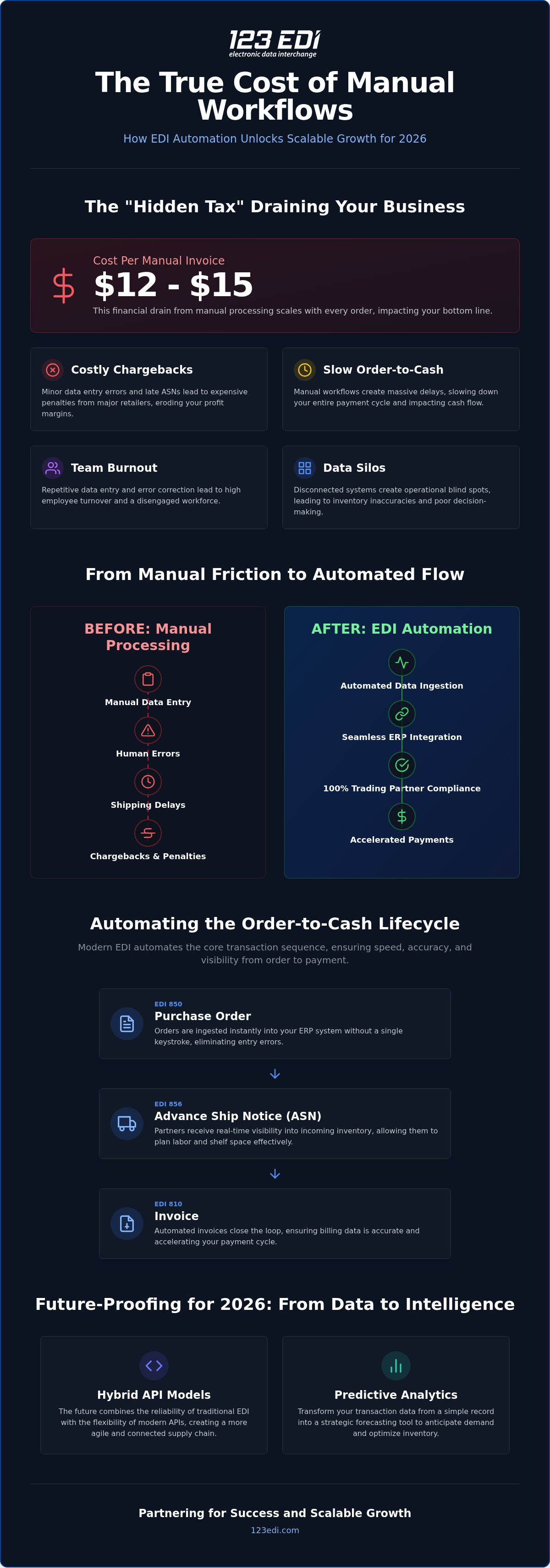
This tax manifests as high labor costs and frequent errors. Industry data suggests that processing a single invoice manually can cost between $12 and $15. When you multiply that by hundreds of orders, the financial drain becomes undeniable. Manual entry isn’t just slow; it’s prone to the small mistakes that cause massive delays in the order-to-cash cycle. By 2026, the complexity of global supply chains has reached a point where “email-and-spreadsheet” workflows simply cannot keep pace with the real-time demands of modern commerce. If your team is still relying on these outdated methods, our 2026 efficiency checklist for reducing manual data entry with EDI provides a clear, actionable starting point.
There’s also an emotional cost that many providers overlook. When your team spends their days correcting typos or hunting down missing purchase orders, they experience significant burnout. We’ve seen how this repetitive friction leads to high turnover and a lack of engagement. Empowering your staff with automated tools allows them to focus on high-value tasks, like relationship building and strategic planning, rather than drowning in data entry.
The Chargeback Trap: Why Compliance Matters
Major retailers now use strict EDI requirements as a way to enforce speed and accuracy across their entire supply chain. If an Advanced Shipping Notice (ASN) arrives five minutes late or contains a minor SKU error, the result is often a costly chargeback. These penalties are designed to protect the retailer’s efficiency, but they can devastate a supplier’s margins. Moving from a reactive stance to proactive compliance management means you’re no longer waiting for a penalty to fix a problem. Instead, you’re using automated validation to ensure every transaction is perfect before it ever leaves your system.
Modern Data Silos and Operational Blind Spots
Disconnected systems create a fog that makes it impossible to see the true state of your business. When your ERP doesn’t talk to your communication channels, inventory inaccuracies start to pile up. You might think you have stock available because a spreadsheet says so, only to find the physical shelf is empty. To bring clarity to your operations, it’s helpful to understand what is edi and how it acts as the central nervous system of modern business by synchronizing data across all your platforms. This synchronization eliminates blind spots, ensuring that your fulfillment team and your customers are always looking at the same set of facts.
How Modern EDI Systems Automate the Transaction Lifecycle
To truly automate business transactions EDI, your team should look beyond simple data transmission and focus on the entire lifecycle of a sale. Modern systems act as an “invisible hand,” validating incoming data against your specific business rules before it ever touches your internal records. This proactive layer ensures that if a partner sends an incorrect price or an invalid SKU, the system flags it immediately. By catching these discrepancies at the source, you prevent the downstream chaos that typically follows manual entry errors and ensures your ERP remains a clean source of truth.
We view this transaction sequence not just as a technical requirement, but as a roadmap for operational excellence. Understanding how these documents interact allows you to identify bottlenecks before they impact your customer relationships. A cloud-based EDI Portal centralizes these communications, giving you a single window into your global operations. Instead of managing dozens of individual connections, you can oversee your entire partner network from one secure hub, which is the transparency needed to scale with confidence.
The Core Transaction Sequence (850, 856, 810)
The core of this efficiency is the Order-to-Cash loop. It begins with the Purchase Order (850), which is ingested instantly into your sales system without a single keystroke. Once the warehouse prepares the shipment, an Advance Ship Notice (856) is generated to give your partners real-time visibility into their incoming inventory. This visibility is essential for retailers to plan their labor and shelf space. Finally, the Invoice (810) closes the loop, accelerating your payment cycle by ensuring the billing data matches the original order perfectly, reducing the time spent on reconciliation.
Secure Communication Protocols: AS2 and Beyond
Security in the modern supply chain is non-negotiable. Establishing a secure AS2 data transfer ensures that every document is encrypted and digitally signed, providing a clear audit trail. When comparing AS2 vs FTP for your infrastructure, it’s helpful to note that AS2 offers built-in receipt notifications. These receipts confirm your partner actually received the data, eliminating the “he-said, she-said” disputes that can delay shipments. According to Gartner on EDI trends, these secure, standardized protocols remain the backbone of resilient B2B integration, protecting your data integrity through every encrypted handshake.
2026 Trends: From Data Connectivity to Intelligent Automation
2026 marks a turning point where data connectivity matures into intelligent automation. We’ve seen the industry move past the simple exchange of files toward a more proactive, predictive model. This evolution is largely driven by the adoption of cloud-based EDI solutions, which remove the technical debt of legacy on-premise hardware. By offloading server maintenance to a trusted partner, you gain the freedom to manage your supply chain from anywhere. This shift toward “Managed EDI” reflects a broader desire for simplicity and reliability, allowing your team to focus on growth rather than troubleshooting infrastructure.
The Hybrid Future: API and EDI Working Together
While Electronic Data Interchange (EDI) has served as the reliable language of global commerce for decades, it’s now evolving. In 2026, it remains the backbone of high-volume trade because of its unparalleled standardization. However, modern businesses are now pairing it with APIs to achieve real-time agility. This hybrid approach allows you to automate business transactions EDI for large document batches while using APIs for instantaneous tasks like parcel tracking or credit checks. It’s about future-proofing your operations, ensuring you have the stability of traditional standards and the speed of modern web services. If you’re evaluating your technology stack, our B2B data interchange software buyer’s evaluation guide for 2026 offers a seasoned framework for selecting the right solution for your digital supply chain.
AI-Enhanced Transaction Monitoring
Intelligence in 2026 also means having a digital supervisor for every transaction. Modern systems now provide automated anomaly detection that acts as a safety net for your operations. If a partner accidentally sends an order for 10,000 units instead of 100, the system flags the discrepancy before it reaches your warehouse. This level of oversight protects your margins and prevents fulfillment disasters. Using transaction history also allows you to optimize inventory levels and simplify the onboarding process for new partners, turning your data into a strategic asset.
Beyond simple error catching, these intelligent systems use transaction history to forecast potential bottlenecks. By analyzing patterns, you can predict when a supplier might struggle with lead times or when warehouse picking needs to be adjusted for seasonal surges. AI also plays a vital role in simplifying partner onboarding. It automates the mapping of complex data requirements, which historically took weeks of manual labor. This acceleration means you can start trading with new retailers in days, not months, providing a competitive edge that legacy systems simply can’t match.
Building an Automation Roadmap: 5 Steps to ERP Integration
Moving from manual processes to a fully digital environment requires more than just software; it needs a clear, methodical plan. When you prepare to automate business transactions EDI, a structured roadmap prevents the common pitfalls of technical debt and partner friction. We’ve found that a phased approach allows your team to adjust to new workflows without disrupting daily operations. By following a proven sequence, you can transform a complex technical hurdle into a manageable business upgrade.
- Phase 1: Assessment. Begin by auditing your current data environment and documenting the specific requirements of your major trading partners.
- Phase 2: Partner Selection. Choose a scalable EDI integration with ERP partner that understands both your industry and your specific software stack.
- Phase 3: Data Mapping. Align your internal database fields with global EDI standards to ensure information translates perfectly between systems.
- Phase 4: Testing. Conduct rigorous end-to-end testing and obtain certification from your trading partners to verify data integrity.
- Phase 5: Go-Live. Transition to the live environment with continuous monitoring to optimize performance and catch any early discrepancies.
Choosing the Right Integration Partner
Experience is the most valuable asset during a digital transition. While “new-to-market” software may look sleek, it often lacks the institutional knowledge required to navigate the nuances of diverse retailer requirements. We believe that over 30 years of industry experience, such as the foundation built by 123 EDI since 1994, provides a level of seasoned reliability that newer platforms can’t match. Human support is also vital during the mapping and testing phases. Having a patient educator to guide your team ensures that the technical solution aligns with your actual business goals, providing a much higher long-term ROI than a “self-service” tool. To make a more informed decision during this phase, reviewing a comprehensive guide to evaluating B2B data interchange software can help you identify the criteria that matter most for your specific supply chain needs.
Bridging the ERP Gap
The true power of automation is realized when your communication systems and your ERP function as a single unit. Whether you’re using NetSuite, SAP, or QuickBooks, the goal is to create a seamless flow of information. By synchronizing fields like inventory levels, pricing, and shipping dates, you eliminate the need for any manual intervention. Automated workflows reduce manual data entry EDI errors by up to 99%. This level of precision doesn’t just save money; it builds trust with your partners. To see how a tailored roadmap can stabilize your data environment, you can explore our integration services and begin your transition today.
Partnering for Success: Scaling with 123 EDI
While the technical roadmap we’ve discussed provides the “how,” the ultimate success of your digital transition often depends on the quality of the partnership behind the technology. In an era where many large providers treat data management as a cold, impersonal transaction, we maintain a focus on human connection and mutual respect. When you choose to automate business transactions EDI with a dedicated team, you aren’t just purchasing a software license; you’re gaining a stabilizing force for your entire supply chain. Our philosophy centers on transparency and collaborative support, ensuring that the inherent complexity of modern data interchange never becomes an overwhelming burden for your internal staff.
Our cloud portals are specifically designed to simplify the intricate world of B2B data interchange. By centralizing your communications into a single, intuitive interface, we remove the technical barriers that often stall growth. This centralized oversight gives you the peace of mind that comes from knowing your data is secure, compliant, and moving at the speed your partners expect. Whether you’re managing a handful of national distributors or dozens of retail chains, our infrastructure provides the scalability required to grow without the need for constant technical intervention.
A Legacy of Trust Since 1994
Since our founding circa 1994, we’ve focused on building a foundation of trust through seasoned reliability and deep industry expertise. This legacy allows us to leverage decades of institutional knowledge to solve the specific challenges you face in 2026. We prefer a “Mentor” approach to integration, where we teach your team how to succeed with EDI rather than just handing over a finished product. This educational focus ensures that you aren’t just reacting to partner demands but are proactively managing your digital strategy. Our clients view us as a strategic partner because we’re deeply invested in their success, providing a steady hand to navigate the complexities of X12 standards and retailer-specific mandates.
Your Next Steps Toward Automation
Transitioning to an automated environment should be a smooth, logical progression rather than a source of technical anxiety. We’ve refined our consultation process to identify your specific pain points quickly, allowing us to offer a clear path toward clarity and efficiency. Our national scope ensures that we can support your business across the United States, helping you automate business transactions EDI for new trading partners in days rather than the months required by legacy systems. This rapid scalability transforms your supply chain into a true growth engine. To begin your journey toward a more resilient operation, Speak with a 123 EDI expert today to automate your business transactions.
Modernize Your Operations for the Next Decade of Trade
The transition from manual workflows to a fully integrated digital environment is no longer a luxury for growing businesses. By choosing to automate business transactions EDI, you eliminate the friction of data entry errors and ensure total compliance with your most important retail partners. We’ve explored how a structured integration roadmap and the adoption of hybrid cloud technologies can transform your supply chain into a resilient, high-performance growth engine.
With over 30 years of EDI expertise, we provide the steady hand and deep institutional knowledge needed to navigate this technical landscape. Our specialized support for seamless ERP integration ensures your systems communicate perfectly; meanwhile, our national scope allows us to serve partners across the United States. You don’t have to face these complexities alone. We’re here to act as your mentor and strategic consultant through every phase of your journey.
Automate your business transactions with a trusted EDI partner—Request a Consultation. Your path toward a more efficient, error-free future starts with a single, collaborative conversation.
Frequently Asked Questions
What does it mean to automate business transactions via EDI?
It means using Electronic Data Interchange to exchange documents like purchase orders and invoices directly between computer systems without manual entry. This process allows you to automate business transactions EDI by creating a digital bridge between your ERP and your partner’s systems. It doesn’t require paper or email attachments, ensuring that data flows instantly and accurately according to standardized formats that retailers across the country recognize.
Is EDI still relevant with the rise of APIs in 2026?
EDI’s the foundational standard for high-volume B2B transactions because of its unmatched reliability and global standardization. While APIs offer real-time agility for specific tasks like parcel tracking, EDI handles the heavy lifting of complex, multi-document trade cycles. Most modern enterprises use a hybrid approach where EDI provides the stable backbone for supply chain compliance while APIs manage instantaneous status updates for inventory or shipping levels.
How long does it typically take to integrate EDI with an ERP system?
The timeline for integration varies based on the complexity of your ERP and the number of trading partners, but it generally ranges from a few weeks to a few months. It’s a process that involves mapping data fields, configuring communication protocols like AS2, and conducting rigorous testing. Working with a seasoned partner who has decades of institutional knowledge can significantly accelerate this process by leveraging pre-existing maps for major retailers.
Can EDI automation help my business avoid retailer chargebacks?
Automation is the most effective way to eliminate the manual errors that trigger retailer chargebacks and late fees. By validating data against partner requirements before it’s sent, your system ensures that every Advanced Shipping Notice (ASN) and invoice is 100% compliant. This proactive approach doesn’t just save money; it moves your business to a steady state of operational excellence, protecting your profit margins from expensive non-compliance penalties.
What is the difference between a Cloud EDI portal and EDI software?
A Cloud EDI portal is a web-based interface that allows you to manage transactions through a browser without installing local hardware. In contrast, EDI software often refers to on-premise applications that reside on your own servers. Most businesses don’t want the hassle of local maintenance in 2026 and prefer cloud solutions because they offer better scalability, lower costs, and the ability to manage your supply chain remotely.
Do I need a dedicated IT team to manage an EDI system?
You don’t need an internal IT team if you’re partnered with a provider that offers cloud portals and integration support. We’re your external experts, handling the complex mapping and communication protocols on your behalf. This partnership-driven approach allows your team to focus on core business operations while we provide the mentor-like guidance and technical oversight required to keep your data flowing smoothly across your entire national network.
What are the most common EDI transactions I should automate first?
Most businesses begin by automating the primary documents in the order-to-cash cycle to see the fastest ROI. It’s the best way to start, focusing on:
- The 850 Purchase Order
- The 856 Advance Ship Notice (ASN)
- The 810 Invoice
Automating these helps you automate business transactions EDI where the volume of manual entry is highest, immediately reducing errors and accelerating your payment cycles.
How does EDI automation improve supply chain visibility?
Automation provides real-time data synchronization across your entire network, ensuring that your ERP reflects the exact status of every shipment and order. Instead of waiting for manual updates or checking multiple spreadsheets, you’ll gain a single source of truth for your inventory and fulfillment. This clarity allows you to identify potential bottlenecks early and provide your trading partners with the accurate information they need to maintain a resilient supply chain.